 blog
blog
10 Famous Aviation Artists to Follow in 2026
Table of Contents
- Why Aviation Art Captures the Imagination
- 10 Famous Aviation Artists to Follow
- Sam Lyons: Four Decades of Flight
- Alan Brain: Painting the Sensation of Flight
- Frank Wootton: Historical Realism in Aviation Art
- Michael Turner: Master of the Jet Age
- Keith Ferris: Technical Precision and Aviation Heritage
- Robert Taylor: Dogfight Scenes and Military Aviation
- William Phillips: Aviation Illustration and Commercial Aircraft
- Emerging Contemporary Aviation Artists to Watch
- Digital Tools in Modern Aviation Art
- Space Exploration Art: The New Frontier
- Vintage Aviation Wall Art for Home Office
- Collecting Aviation Art Prints
- How to Display Aviation Art
- Evaluating Quality in Aviation Art
- Frequently Asked Questions
Last Updated: October 1, 2026
Why Aviation Art Captures the Imagination
Aviation art is the practice of depicting aircraft, flight, and the people who fly, using painting, illustration, and printmaking to turn motion and machine into something you can hang on a wall. It works because it freezes a moment that normally lasts a second. Fifty young artists earned recognition in the 2026 International Aviation Art Contest, a sign that the subject still pulls new people in every year (North Carolina Department of Transportation aviation art contest results).
10 Famous Aviation Artists to Follow
Below are ten names worth your attention, grouped by the era they work in and the reason collectors follow them. Each entry notes the medium, the signature subject, and where to actually track new releases, because "following" an aviation artist means watching gallery drops, society exhibitions, and print releases, not just bookmarking a website.
Sam Lyons: Four Decades of Flight
Sam Lyons has painted aviation professionally for 40 years, a run that makes him one of the most enduring working artists in the field (The ART of FLYING! Legendary Aviation Artist Sam Lyons). His work leans warm and narrative, pilots, ground crews, and the quiet moments around aircraft rather than the aircraft alone. He works primarily in oil and gouache, and his print releases tend to center on general aviation and warbird subjects.
Alan Brain: Painting the Sensation of Flight
Alan Brain moved away from strict realism toward the emotions and physical sensations of flying (Alan Brain Art profile). The result reads less like a plane portrait and more like what it is to be inside one, loose brushwork, compressed horizons, and color used for feeling rather than livery accuracy. If you want aviation art that reads as mood rather than record, start here.
Frank Wootton: Historical Realism in Aviation Art
Frank Wootton helped define historical realism in the genre, and the Guild of Aviation Artists still treats his documentation of aviation history through fine art as foundational (The Guild of Aviation Artists). His aircraft profiles reward close looking: correct panel lines, period-correct markings, and skies built from observed weather rather than formula. Wootton's career spanned World War II through the jet age, which makes his catalog a visual timeline of the genre itself.
Michael Turner: Master of the Jet Age
Michael Turner is the jet age's defining painter. His skies, light, and aircraft livery capture the shift from propeller to turbine, the swept wings, the afterburner glow, the cold blue of high-altitude light. Turner's composition habit is to place the aircraft slightly off-center and let the sky do the emotional work. He is widely collected in the United Kingdom, and his limited editions are the entry point most new collectors use.
Keith Ferris: Technical Precision and Aviation Heritage
Keith Ferris pairs technical precision with aviation heritage. His work sits at the meeting point of illustration and history, and it holds up under a pilot's scrutiny, which is the real test in this genre. Ferris is known for large-scale murals and for research-driven accuracy in aircraft markings and formation geometry. If you care about whether the aircraft is drawn correctly, his catalog is the benchmark.
Robert Taylor: Dogfight Scenes and Military Aviation
Robert Taylor built a reputation on dogfight scenes and military aviation, the kind of dramatic aerial combat work that anchors many collections. His strength is narrative tension: the moment before the guns fire, the wingman breaking away, the smoke trail behind. Taylor's limited editions are among the most widely traded in the military aviation print market, which makes him a useful reference point when you are comparing edition sizes and secondary-market pricing.
William Phillips: Aviation Illustration and Commercial Aircraft
William Phillips works in aviation illustration with a focus on commercial aircraft, a quieter corner of the field that appeals to airline people. His compositions tend to treat airliners as design objects, clean profiles, accurate liveries, and airport environments rendered with the same care a military painter gives a dogfight. Following him means watching airline-commissioned work and aviation-enthusiast publications.
Emerging Contemporary Aviation Artists to Watch
This is the gap most lists skip. Established names dominate search results, but state contests and open exhibitions keep surfacing new talent. The 2026 FAI Young Artists Contest, run with the National Association of State Aviation Officials, named a first-place winner from Tennessee (NASAO and NAA announce U.S. winners). Texas selected three Category II winners the same year (Texas Department of Transportation aviation art contest winners).
Digital Tools in Modern Aviation Art
Digital painting has changed how artists work, not whether the result counts as fine art. Tablets and 3D references speed up composition and let artists test aerial perspective before committing to canvas. A common workflow is to block the aircraft in a 3D program, rotate it to the desired angle, then paint over the render for lighting and atmosphere. The finished piece still lives or dies on artistic composition, the software solves geometry, not drama.
Space Exploration Art: The New Frontier
Space exploration art extends the genre past the atmosphere. Rockets, orbit, and lunar surfaces now sit beside propeller-era and jet-age work in the same collections. It is the fastest-moving corner of aviation art, partly because the reference material keeps changing, new launch vehicles, new mission patches, new imagery from orbit. Artists working in this space often come from a science-fiction illustration background, which gives the work a different visual grammar than traditional aviation painting.
Vintage Aviation Wall Art for Home Office
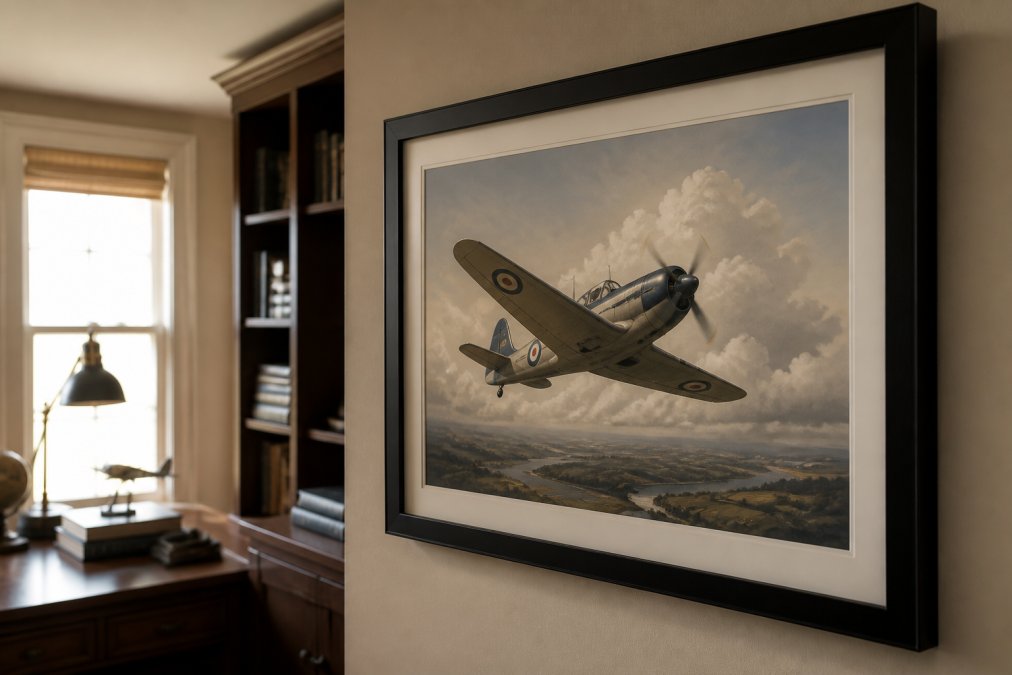
Vintage aviation wall art for home office spaces works best when the era matches the room. A propeller-era piece suits a wood-and-leather study. Jet-age work fits a cleaner, modern desk setup. Scale matters more than most people expect: a single large print reads stronger than four small ones. Warm lighting helps, and so does hanging at eye level from where you sit. Our Historic Aviation Prints collection covers both eras.
Collecting Aviation Art Prints
- Edition size sets the ceiling. A signed and numbered run of 500 from a well-known painter holds value better than an open edition of the same image, because scarcity is verifiable. Smaller runs, often 100 to 250 for higher-end releases, tend to hold up best.
- Signatures matter, and so does who signed. Many military aviation prints are co-signed by pilots or crew who flew the aircraft depicted. A print signed by a decorated veteran carries a premium over the same image signed by the artist alone. Verify the signature against the publisher's certificate of authenticity.
- Originals versus prints. An original oil or gouache is a one-of-one asset with no edition risk, but it also has no comparable sales to benchmark against, which makes pricing opaque. Prints are easier to value because identical copies trade publicly. If you want liquidity, prints. If you want a unique object, originals.
- Condition is everything on the secondary market. Foxing, fading, trim marks, and frame damage all cut value hard. Store prints flat, out of sunlight, in an acid-free sleeve, and keep the certificate of authenticity with the print.
- Subject drives demand more than artist fame. Certain aircraft and certain missions have dedicated collector bases. A technically excellent print of an obscure aircraft may sit unsold while a competent print of a famous one moves quickly.
Beyond valuation, the practical checklist is short. Check the paper weight, the ink type, and whether the seller ships flat or rolled, rolled prints can arrive with curl memory that never fully relaxes. Ask about archival inks, because fading is the main long-term risk. And buy the subject you actually love, not the one that looks like an investment. Passion holds value better than speculation, and it is the only reason to own a print you will look at every day.
How to Display Aviation Art
How to display aviation art comes down to three choices: frame, light, and placement. Use UV-filtering glass to slow fading. Keep prints off walls that get direct sun. Group by era rather than by color if you own several pieces. Museum-style matting gives smaller prints more presence. For a study or office, hang the main piece behind your chair so visitors see it as they walk in.
Evaluating Quality in Aviation Art
Quality in aviation art rests on accuracy, composition, and craft. Check the aircraft profile against reference photos. Look at how the artist handles aerial perspective, the way distant aircraft soften and cool in tone. Then check the print itself: sharp edges, no banding, even color across the sheet. A beautiful painting printed badly is still a bad print. This is where most online buyers get burned, and it is why paper and ink specs matter as much as the image.
Frequently Asked Questions
Who are some of the best aviation artists to follow today?
The best aviation artists to follow in 2026 include established figures like Sam Lyons, who has had a 40-year career, and Alan Brain, known for painting the emotions of flight. Historical masters such as Frank Wootton and Michael Turner remain influential. Emerging contemporary artists are also gaining recognition through events like the American Society of Aviation Artists' 38th Aerospace Art Forum. Following these artists offers a range of styles from technical precision to expressive interpretations of flight.
How do I start collecting aviation art prints?
Start by deciding on a theme, such as vintage aviation wall art for home office or military aviation. Look for limited edition prints from reputable artists or galleries, and consider the historical accuracy and print quality. Begin with one or two pieces that resonate with you, and build your collection over time. Online marketplaces and specialized galleries offer curated selections. Always verify the artist's background and the print's provenance to ensure authenticity.
What defines high-quality aviation art?
High-quality aviation art combines historical accuracy, technical precision, and artistic composition. Look for correct aircraft profiles, attention to detail in markings and livery, and a sense of aerial perspective. The medium also matters: original oil paintings and limited edition prints on archival paper or canvas tend to hold value. Artists like Keith Ferris are known for their meticulous research. Additionally, the emotional impact of the piece, whether it captures the thrill of flight or the nostalgia of aviation heritage, is a key indicator of quality.
How does aviation art complement home office decor?
Aviation art adds a sense of adventure and history to a home office. Vintage aviation wall art for home office can inspire creativity and reflect personal interests. When displaying aviation art, consider the scale of the room and the color palette. Grouping prints by era or theme, such as propeller era or jet age, creates a cohesive look. Proper framing with UV-protective glass preserves the artwork. For a sophisticated touch, mix different prints to build a gallery wall that tells a story.