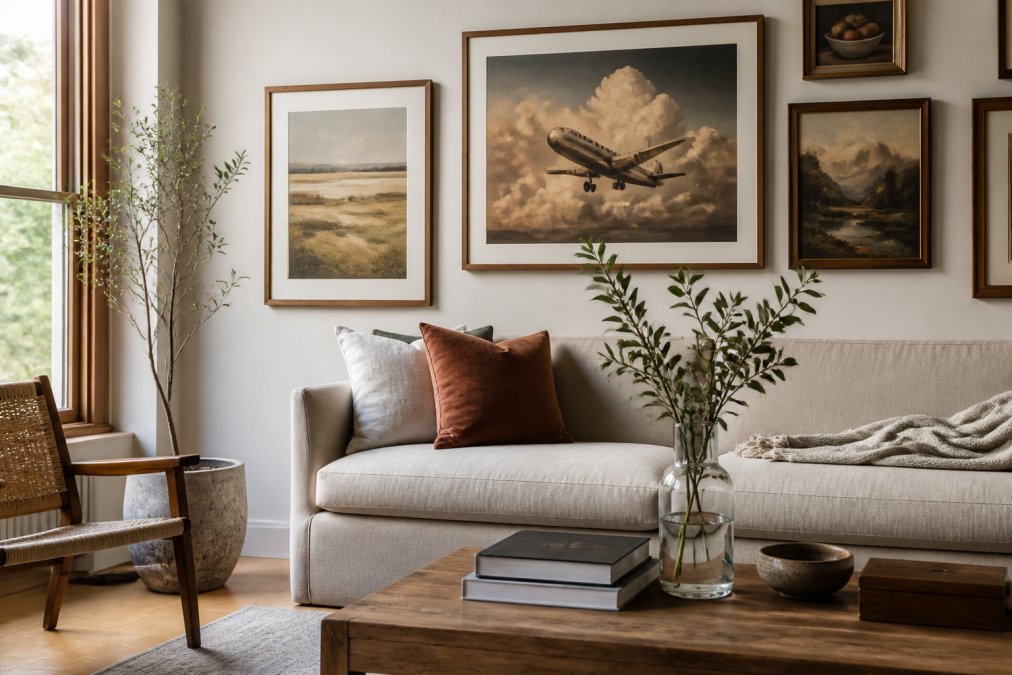
 listicle
Unique Art Prints for Living Room: 2026 Guide
Table of Contents
- How to Choose Unique Art Prints for Your Living Room
- Top Styles of Art Prints for Living Rooms in 2026
- Large Scale Wall Art for Living Room: Making a Statement
- How to Arrange Art Prints on a Wall: Art Placement Geometry
- Budget-Friendly DIY Framing for Fine Art Prints
- Sustainability and Printing Processes: What to Look For
- Best Online Shops for Independent Art: What Sets Them Apart
- Frequently Asked Questions
Last Updated: August 15, 2026
How to Choose Unique Art Prints for Your Living Room
Finding unique art prints for your living room is harder than it looks. Most people default to trending decor, end up with something that feels borrowed, and wonder why the room still doesn't feel right.
At Runway & Heirloom Art, we've learned that the difference between walls that feel alive and walls that feel merely decorated comes down to intention: choosing art that means something, rather than art that fills space.
This guide covers the full process, from understanding how art affects mood to placement geometry, budget framing, and finding independent artists worth supporting.
Art Psychology and Mood: What Your Walls Do to a Room
Art is not neutral. Research in environmental psychology shows that visual stimuli in domestic spaces affect stress levels, focus, and comfort. American Psychological Association overview of environmental psychology
Warm-toned abstract pieces create energy and sociability. Cool blues and greens lean toward calm. High-contrast black and white photography adds visual tension.
Decide how you want the room to feel before deciding what you want it to look like. A gallery wall of dramatic prints energizes a space; a single quiet landscape anchors it.
Matching Color Palette Without Matching Too Closely
A common mistake is treating art like a paint swatch, pulling a print that exactly matches the sofa or rug. The result feels coordinated but flat.
Find art that shares one or two colors with your existing palette while introducing at least one unexpected tone. If your living room runs neutral, a print with a single warm amber or terracotta does more visual work than an entire gallery wall of beige abstracts.
Pull color from the art, not the other way around. Hang the piece first, live with it for a week, then adjust cushions or throws to echo what's already there.
Top Styles of Art Prints for Living Rooms in 2026
The current moment in interior styling mixes maximalism and minimalism rather than choosing between them. The most compelling living rooms blend registers rather than commit to a single aesthetic.
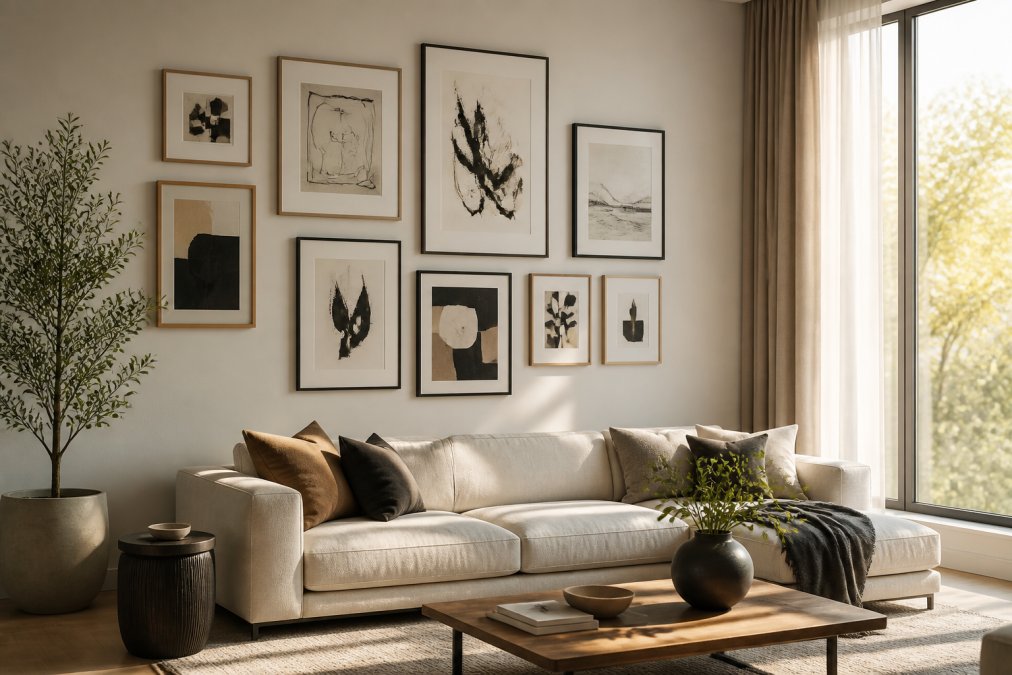
Abstract Art Prints and Abstract Expressionism
Abstract art prints remain the most versatile category for living rooms. They carry emotional weight without demanding narrative interpretation, working across many interior styles without becoming dated.
Abstract expressionism, with its gestural marks and layered color fields, brings textural interest even in reproduction. Look for prints with genuine compositional tension, not just color blocks, but work where something is actually happening visually. Giclee prints on archival paper or canvas wrap reproduce painted surfaces far better than standard digital prints.
Seek out independent artists whose work has a specific point of view rather than defaulting to safe, mass-produced options.
Minimalist Wall Decor and Scandi Style
Minimalist design and Scandi style continue to dominate living room searches. The best minimalist prints are more considered than they appear. A single line drawing or botanical study in a floating frame can anchor a wall without overwhelming it.
Good minimalist wall decor has compositional weight and earns its white space. Matte finish prints on thick stock suit this aesthetic better than glossy alternatives.
Landscape and Nature Photography Prints
Landscape and nature photography has moved beyond generic mountain imagery. The strongest work brings a specific point of view: unusual light, unexpected framing, or genuinely remote landscapes rather than stock images.
High-resolution photography printed at large scale functions as a window, visually expanding smaller living rooms. Archival quality matters more here than in other categories, photography that fades within years loses its entire impact.
Black and White Photography
Black and white photography is the most forgiving style to integrate into existing living rooms because it operates outside the color palette entirely. It creates interest through contrast, texture, and composition rather than hue.
A single oversized black and white photograph in a simple frame can serve as the focal point an entire room is built around.
Mid-Century Modern Prints
Mid-century modern prints have sustained momentum rather than brief trend cycles. The clean geometry, warm earth tones, and confident graphic sensibility translate naturally into contemporary spaces. Teak frames and warm wood tones pair naturally with this aesthetic.
Boho Style Wall Art
Boho style wall art works best as one element in a layered room rather than the entire concept. Woven wall hangings, botanical prints, and earthy abstract work contribute to a warm, textural aesthetic.
Avoid going too literal, a room full of macramé and desert landscapes reads as theme rather than home. Use one or two boho pieces to add warmth to a more edited space.
Large Scale Wall Art for Living Room: Making a Statement
Large scale wall art is one of the highest-impact changes you can make to a room, and one of the most commonly underdone. Most people buy art that's too small and hang it too high.
A statement piece functions as a focal point: the first thing the eye goes to when entering the room. The art should occupy roughly two-thirds of the wall width above a sofa or console, usually larger than instinct suggests.
Triptychs and Gallery Wall Sets
A triptych, three related panels displayed together, offers the visual impact of a large-scale piece with more compositional flexibility. Panels can be hung with consistent gaps (typically 2-3 inches) or spread across a wider wall.
Gallery wall sets are a curated collection of prints in complementary styles, sizes, and frames. The difference between a gallery wall that works and one that looks chaotic is planning. Lay the arrangement out on the floor before anything goes on the wall.
Canvas Wrap vs. Floating Frame vs. Matte Finish
| Format | Best For | Visual Effect | Framing Required |
|---|---|---|---|
| Canvas wrap | Large-scale statement pieces | Painterly, dimensional | No |
| Floating frame | Contemporary or mid-century prints | Clean, architectural | No (frame included) |
| Matte finish print | Minimalist, photography, fine art | Flat, refined | Yes |
| Giclee on archival paper | Fine art reproduction | Richest color depth | Yes |
Canvas wrap suits large abstract or photographic work. A floating frame, where the print sits slightly recessed, works well for contemporary art and adds gallery quality. Matte finish prints require separate framing but offer the most flexibility.
How to Arrange Art Prints on a Wall: Art Placement Geometry
How to arrange art prints on a wall has surprisingly concrete answers. Most interior designers follow geometric principles that eliminate guesswork and produce professionally done results.
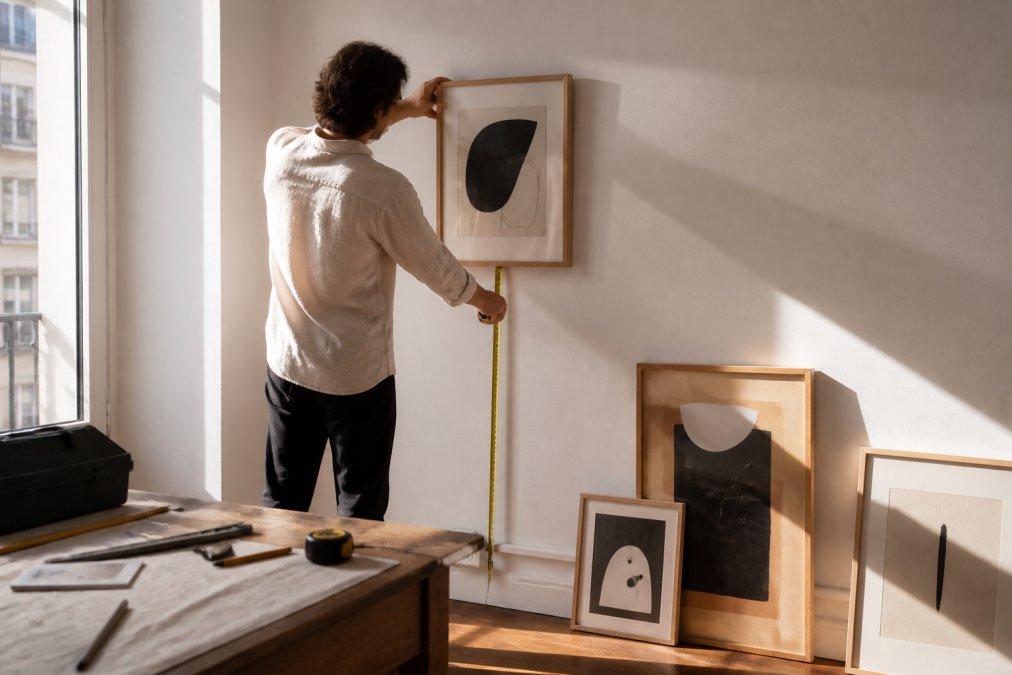
The 57-Inch Rule and Focal Point Placement
The 57-inch rule is the standard used by galleries and professional installers: hang art so the center sits at 57 inches from the floor, corresponding to average eye level when standing. This applies to individual pieces and to the visual center of a gallery wall.
The rule holds in most living rooms with standard ceiling heights. The most common mistake is hanging art too high, which disconnects it from furniture below and makes the room feel top-heavy.
Above a sofa, leave 6-8 inches of space between the top of the sofa and the bottom of the frame. This visually connects the art to the furniture and creates a cohesive vignette.
Building a Gallery Wall Without Guesswork
A gallery wall arrangement that works has underlying logic, even when it appears spontaneous.
- Start with the largest piece slightly left of center, at the 57-inch eye-level mark
- Build outward, balancing visual weight rather than counting pieces
- Maintain consistent gaps between frames (2-3 inches is standard)
- Mix frame finishes within a coherent family: black, natural wood, and brass work together
- Trace each frame on paper, cut out shapes, and tape to the wall before committing to nails
Budget-Friendly DIY Framing for Fine Art Prints
Fine art prints don't require expensive custom framing to look exceptional. The gap between a $300 custom frame and a well-chosen $40 option is smaller than the framing industry suggests.
Mat board quality is most important. A wide, acid-free mat in white or off-white elevates almost any print and creates breathing room that makes fine art read as intentional. Simple black, white, or natural wood frames suit a wider range of prints than elaborate molded options.
For large-scale pieces, consider poster frames with acrylic glazing rather than glass, they're lighter and easier to hang. For smaller prints, clip frames or frameless floating mounts work well with minimalist aesthetics.
According to the Fine Art Trade Guild's guidance on archival framing standards, UV-protective glazing is the single most impactful upgrade for preserving print quality over time.
Sustainability and Printing Processes: What to Look For
The environmental footprint of art printing varies considerably. Giclee printing uses archival inks on acid-free substrates and produces prints that last significantly longer than standard digital prints, reducing replacement frequency and overall waste.
For paper-based prints, FSC-certified stock (certified by the Forest Stewardship Council certification standards) indicates responsibly sourced materials. Some independent studios use water-based pigment inks rather than solvent-based alternatives, reducing volatile organic compound emissions.
Digital download formats, like those offered by Runway & Heirloom Art, eliminate shipping entirely. A digital file printed locally produces no transport emissions and allows you to choose your own archival materials.
Best Online Shops for Independent Art: What Sets Them Apart
The best online shops for independent art share qualities that separate them from mass-market alternatives: genuine curation, direct relationships with artists, and commitment to print quality beyond commodity production.
What to look for when evaluating any online art source:
- Archival materials: Does the shop specify paper weight, ink type, and longevity? Vague descriptions are a warning sign.
- Artist transparency: Can you find out who made the work and what their practice is?
- Bespoke sizing options: The ability to print at custom dimensions is significant, particularly for gallery walls.
- Limited edition availability: Limited edition prints hold value differently than open-edition reproductions.
Runway & Heirloom Art offers art with genuine narrative content drawn from art history, aviation, childhood, and nostalgia. These aren't generic prints produced to match a color palette, they're pieces with a point of view, available as digital downloads for immediate access and local printing.
According to Americans for the Arts annual survey on art participation and purchasing, buyers who purchase directly from independent artists report significantly higher long-term satisfaction than those who buy through mass-market channels. The difference comes down to meaning: knowing the story behind a piece changes how you experience it every day.
| What to Evaluate | Mass-Market Providers | Independent Art Studios |
|---|---|---|
| Print longevity | Standard inks, variable quality | Archival giclee, specified materials |
| Artist transparency | Rarely disclosed | Typically featured |
| Sizing flexibility | Fixed standard sizes | Often bespoke or custom |
| Narrative content | Generic themes | Subject-specific, curated |
| Edition control | Open edition, unlimited | Limited edition options available |
| Sustainability | Variable | Often FSC-certified, low-waste |
Choosing unique art prints for your living room is harder when shopping from thousands of identical options and easier when you know what you're looking for. The walls of a well-considered living room carry personality, history, and intention. Runway & Heirloom Art offers a curated collection of narrative-driven prints, available as instant digital downloads, spanning aviation, art history, childhood, and nostalgia. Browse the collection and find something that belongs in your story.
Frequently Asked Questions
Where can I get unique art prints for my living room?
Independent art studios and curated online shops are the best sources for truly unique art prints for a living room. Unlike mass-market retailers, these sellers offer limited edition and bespoke sizing options, archival quality giclee prints, and artwork with a distinct point of view. Look for shops that describe their printing process, use acid-free materials, and offer digital downloads so you can print locally at the size that fits your wall.
What kind of art looks good in a living room?
Art that creates a clear focal point tends to work best. Abstract art prints, large-scale landscape photography, and minimalist wall decor all perform well in living rooms because they hold visual interest without competing with furniture. The style matters less than scale and color palette, a piece that echoes one or two tones already in the room will feel intentional rather than accidental. A statement piece above the sofa or fireplace anchors the whole space.
How do I choose the right size art print for my living room wall?
Measure the wall space first. For a sofa wall, the art or gallery arrangement should span roughly two-thirds of the sofa's width. A single statement piece works best between 24 x 36 inches and 40 x 60 inches for most standard living rooms. Hang the center of the piece at eye level, approximately 57 inches from the floor. If the wall feels bare after one piece, a triptych or gallery wall set fills the space without overwhelming it.
Should living room art match the furniture?
Art does not need to match furniture exactly, it needs to complement the room's color palette and mood. Pulling one accent color from an abstract print into a throw pillow or rug creates cohesion without making the space feel too coordinated. Mid-century modern prints pair naturally with warm wood tones; minimalist or scandi-style wall art suits cooler, neutral palettes. The goal is visual harmony, not a matching set.
What are the current trends in living room art for 2026?
Oversized single-canvas statement pieces and curated gallery walls remain dominant. Watercolor abstracts, art-history-inspired prints, and nature photography with a contemporary aesthetic are all trending. There is also growing interest in art with personal meaning, aviation prints, nostalgic illustrations, and limited edition fine art prints that reflect the homeowner's identity rather than generic decor. Sustainability is also influencing purchasing, with buyers favoring archival giclee prints and responsibly sourced materials.
This article was written using GrandRanker