 blog
blog
Curated Art Prints for Children's Rooms: 2026 Guide
Table of Contents
- Why Curated Art Prints Beat Themed Sets in 2026
- How to Choose Art for Nursery Spaces That Evolve
- Curated Art Prints by Room: Nursery, Playroom, and Beyond
- Gallery Wall Layout for Kids Room: Planning Before You Hammer
- Best Practices for Hanging Children's Art Safely
- Color Psychology and Sustainable Printing: What Competitors Skip
- Budget-Friendly DIY vs. Professional Prints
- Conclusion
- Frequently Asked Questions
Last Updated: September 23, 2026
Why Curated Art Prints Beat Themed Sets in 2026
A themed room set often looks dated within two years, while curated art prints for children rooms grow with the child. That single difference explains why parents are moving away from matching bedding-and-wall bundles toward individual pieces chosen one at a time.
How to Choose Art for Nursery Spaces That Evolve
Choosing art for a nursery works best when you pick pieces for the room's long life, not just the first eighteen months. Buy two or three anchors now and leave room to add.
Matching Art to Age and Developmental Stage
Infants respond to high contrast and simple shapes; toddlers gravitate toward recognizable animals, vehicles, and letters. Wallfully's 2026 guidance on children's [wall art(https://runwayheirloom.com/art/4554612112-english-cottage-nursery-wall-art.html) | wallfully.com] recommends selecting pieces that evolve with the child and reflect their specific age, interests, and personality. In practice, that means avoiding art tied to a phase your child will outgrow in a year.
Gender-Neutral and Modern Nursery Palettes
Gender-neutral does not mean beige. Warm boho, floral maximalism, and coastal palettes lead 2026 nursery design, according to Ana Brandt Photography's 2026 Nursery Trend Report, which also notes a move away from cool grays. Choose two or three colors from the room and repeat them across frames.
| Age Range | Best Subject Matter | Typical Print Size |
|---|---|---|
| 0-12 months | High-contrast shapes, animals | 8x10 to 11x14 in |
| 1-3 years | Vehicles, letters, nature | 11x14 to 16x20 in |
| 4-7 years | Hobbies, places, story scenes | 16x20 to 24x36 in |
| 8+ years | Personal interests, art history | 18x24 in and up |
Curated Art Prints by Room: Nursery, Playroom, and Beyond
Different rooms ask different things of the art on their walls. A nursery wants calm; a playroom can handle noise; a small bedroom needs pieces that do not crowd the space. Treat each room as its own brief, then let one or two colors or motifs carry across the whole home so the collection still reads as curated.
Nursery Wall Art Ideas for Calm and Sleep
Soft watercolor botanicals, muted landscapes, and single-subject animal studies keep a nursery quiet. Standard print sizes run from 5x7 inches to 39x59 inches, according to Desenio's 2026 sizing guide, so a small trio above a crib and one large piece above the dresser both work within the same collection.
- A trio above the crib. Three 8x10 or 11x14 inch prints in matching frames, spaced 2 to 3 inches apart, centered on the crib. Keeps the sightline low and calm.
- One large anchor over the dresser or glider. A 24x36 inch piece gives the room a focal point without a gallery wall's visual noise.
- A single-subject animal study. One animal, one background, no busy scene. Reads clearly from across the room and does not compete with the crib mobile or textiles.
- A muted landscape or abstract horizon. Works as a neutral backdrop that survives a palette change when the child moves to a toddler bed.
Playroom Decor Inspiration for Creative Spaces
Playrooms reward brighter color and busier compositions: alphabet charts, maps, trains, classic cars. Group them lower, around 40 to 48 inches from the floor, so children can actually see them. A playroom is also the right room to let the collection get loud, this is where saturated primaries, illustrated maps, and story-scene prints earn their place.
Ideas that work in a playroom:
- An alphabet or number chart as the anchor piece, with smaller prints flanking it.
- A world or neighborhood map at child height, so kids can point to places.
- A row of vehicles, animals, or dinosaurs in matching frames, repetition reads as intentional, not cluttered.
- A rotating "current obsession" spot. One frame you swap as interests shift, so the wall stays alive without a full redo.
Art for Small Bedrooms and Shared Rooms
Small rooms need fewer, larger pieces, not more small ones. A single 18x24 or 24x36 inch print over the bed does more than six 8x10s, and it leaves wall space for shelves and hooks. In a shared room, give each child one wall or one vertical column of frames so the art marks territory without a full-room theme.
Gallery Wall Layout for Kids Room: Planning Before You Hammer
A gallery wall layout for kids room succeeds or fails on paper, before a single nail goes in. Lay every frame on the floor first and photograph the arrangement.
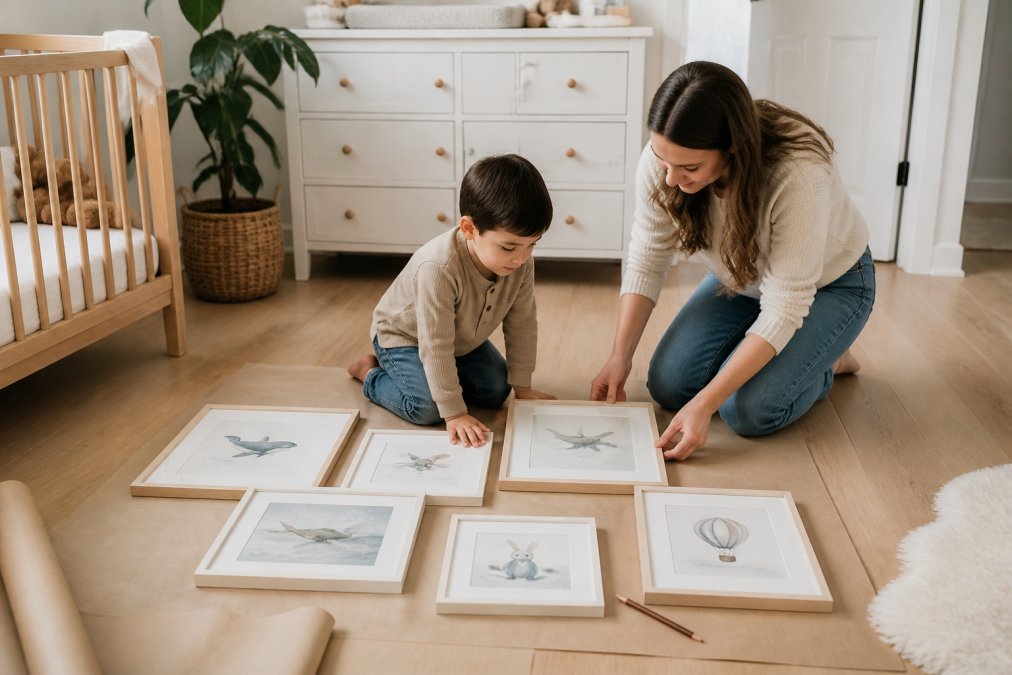
Three layouts cover most rooms:
- Grid: four to six same-size frames, even gaps. Best for a tight, modern look.
- Salon: mixed sizes around one large anchor piece. Best for a collection that will grow.
- Ledger: one long horizontal row at eye level. Best above a crib or low dresser.
Best Practices for Hanging Children's Art Safely
Safety comes down to three things: the hardware, the height, and what sits beneath. Follow these best practices for hanging children's art and the rest is styling.
- Use two hooks per frame for anything wider than 16 inches.
- Choose wall anchors rated for at least twice the weight of the framed piece.
- Keep heavy or glass-fronted frames out of reach of cribs and beds.
- Prefer acrylic glazing over glass in children's rooms.
- Check every frame monthly; children pull on things.
Color Psychology and Sustainable Printing: What Competitors Skip
Most buying guides stop at "pick colors you like." Two things they almost never cover, how color actually affects a child's mood and sleep, and what the print is made of, are the two that matter most for a room a child spends 10 to 12 hours a day in.
How Color Changes the Room's Job
Color is not decoration; it is a cue. The general pattern most designers and child-development practitioners describe:
- Cool blues and greens read as calming and are the safest default for a nursery or a child who struggles to wind down.
- Saturated yellows, oranges, and reds raise energy and alertness, better suited to a playroom or a homework corner than a sleep space.
- Warm neutrals, soft pinks, and muted earth tones are flexible and tend to age well as a child's taste shifts.
- High-contrast black-and-white supports visual development in the first months, then can be phased out as the room becomes a toddler's.
What "Sustainable" Actually Means on a Print
"Eco-friendly" is a marketing word until you check the specifics. For children's rooms, three things are worth asking about:
- Paper. Look for FSC-certified or recycled stock. FSC certification means the fiber comes from responsibly managed forests, which is the closest thing to a verifiable claim in this category.
- Inks. Water-based, pigment, or otherwise low-VOC inks matter more in a child's room than in an office, because the print sits at breathing height and near a bed. Ask whether the ink is archival and whether it is solvent-free.
- Finish and glazing. Acrylic glazing is lighter and safer than glass in a child's room, and it does not shatter if a frame comes down. If a print is framed, ask what the frame is finished with, low-VOC or water-based finishes are the better choice for a nursery.
Budget-Friendly DIY vs. Professional Prints
DIY is cheaper up front and usually costs more over time. Printing at home or at a copy shop is fine for a temporary poster, but standard inks fade, and paper yellows. Professional fine art prints cost more per piece and typically hold their color for decades.
Conclusion
The hard part of decorating a child's room is not finding art. It is finding art that still belongs there in five years, when the toddler becomes a reader with opinions about airplanes.
Frequently Asked Questions
What are some creative art ideas for a kids' room?
Curated art prints for children's rooms range from whimsical illustrations and animal themes to educational alphabet posters and abstract calm designs. Consider mixing a large focal print with smaller companion pieces, or pairing a personalized name print with nature-inspired art. The goal is a collection that feels intentional rather than themed, so pieces can stay as your child grows.
How do you choose art that grows with a child?
Skip rigid themes and choose pieces that reflect your child's personality rather than a single character or trend. Industry guidance from Wallfully in 2026 emphasizes selecting art that evolves with the child's age, interests, and developmental stage. A gallery wall layout for kids room can start with neutral, abstract, or nature prints, then add personalized or interest-specific pieces over time. This approach reduces the need to replace everything when tastes change.
How do you frame art prints for a child's room safely?
Use lightweight frames or canvas prints, and hang them well above reach, ideally with two anchors for stability. Best practices for hanging children's art include using wall anchors rated for the frame weight, avoiding glass in favor of acrylic or canvas for lower risk, and securing frames with museum putty or safety straps. Keep mounting hardware out of reach and check stability periodically, especially in play areas.
What is the best way to display curated art prints in a nursery?
Plan a gallery wall layout for kids room by measuring your wall and using paper templates before hanging. Mix one large statement piece with smaller accents. Hang art at eye level for an adult, roughly 57 to 60 inches from the floor, and leave 2 to 3 inches between frames.