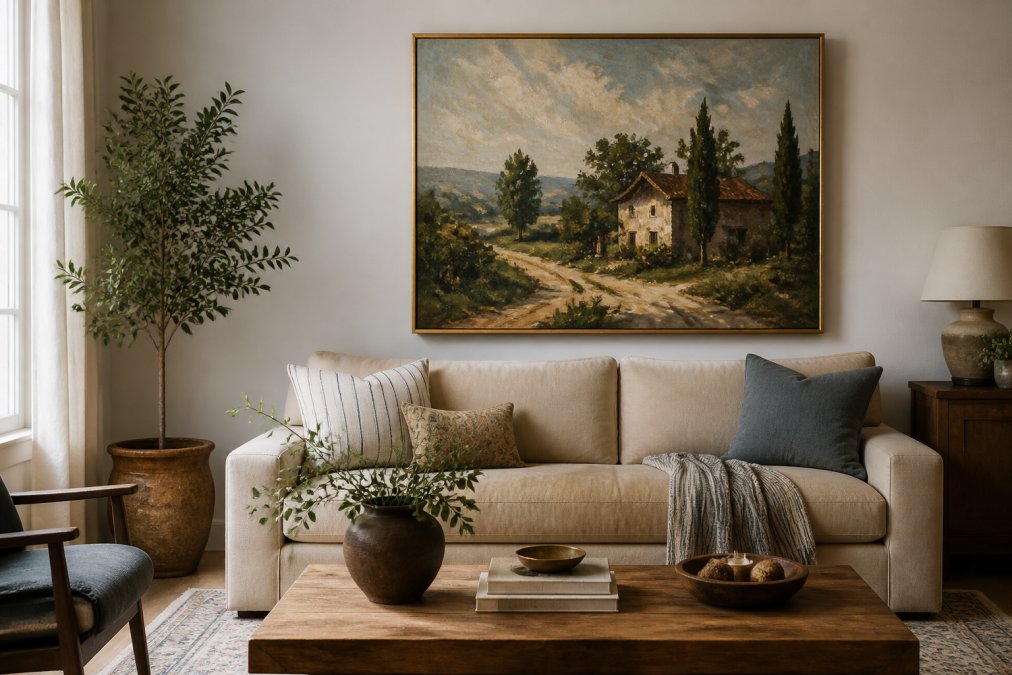
 listicle
Oil Painting Prints for Living Room: 2026 Style Guide
Table of Contents
- Why Oil Painting Prints Work in a Living Room
- Fine Art Canvas Reproductions vs. Original Oils
- Best Art Themes for Living Room Walls
- How to Hang Large Wall Art Without Regret
- Lighting, Care, and Keeping Prints Heirloom-Ready
- Framed vs. Unframed Oil Painting Prints
- Frequently Asked Questions
Last Updated: September 16, 2026
Why Oil Painting Prints Work in a Living Room
The global wall art market reached $61.01 billion in 2025 and is projected to hit $64.22 billion in 2026, according to Grand View Research's wall art market report. That growth reflects something designers have known for years: oil painting prints for living room walls deliver the visual weight of original fine art without the gallery price tag.
Oil painting prints are high-quality reproductions of original oil paintings, typically produced on canvas or archival paper using techniques that preserve brushstroke detail and color depth. Homeowners move toward them because they offer dimensional texture and composition that reads as intentional, not decorative filler.
The timing matters. The U.S. art market saw a 5.6% year-on-year decline in overall sales, yet specific segments grew 54.1%, contributing to a 23.1% rise in full-year totals compared to 2024 (U.S. Art Market Report). Buyers aren't abandoning art. They're redirecting spending toward accessible fine art canvas reproductions that feel curated rather than mass-produced.
Here's what most guides miss: oil painting prints aren't just cheaper alternatives. A large-scale reproduction anchors a room's color palette and gives the eye a focal point that flat digital prints cannot replicate.
Fine Art Canvas Reproductions vs. Original Oils
Fine art canvas reproductions are printed or hand-painted copies of original oil works, designed to capture the visual impact of the source painting at a fraction of the cost. Up to 85% of museum-quality hand-painted oil reproductions are available as alternatives to original works, according to OilPaintings.com market data.
The real difference comes down to three factors:
- Provenance: Originals carry documented history and authentication. Reproductions don't, and that's fine for most living rooms.
- Texture: Hand-painted reproductions using acrylic paints or oils replicate impasto brushstrokes. Printed reproductions vary widely in how they capture dimensional texture.
- Longevity: Both can last decades with proper care, but originals typically appreciate while reproductions hold decorative value.
Some art providers argue that "no printing" is involved in their process, emphasizing that 100% handmade oil and acrylic paintings offer a fundamentally different value proposition than mass-produced prints (Art by Maudsch on hand-painted vs. printed art). That distinction matters when you're choosing between a $40 poster and a $400 hand-painted canvas.
For living rooms, the practical question isn't "original or reproduction." It's "what level of authenticity does this space require?"
Best Art Themes for Living Room Walls
The best art themes for living room walls in 2026 lean toward neutral abstract canvas prints, botanical themes, earthy tones, and Mediterranean-inspired artwork, according to Buy Wall Art's 2026 style report. These styles work because they complement rather than compete with existing furniture and textiles.
But "best-selling" doesn't mean "best for your room." The deeper question is what each theme does to mood and perceived space.
| Theme | Mood It Creates | Perceived Effect | Best For | Color Palette |
|---|---|---|---|---|
| Impressionist landscapes | Calm, expansive, nostalgic | Opens small rooms via horizon lines and atmospheric depth | Traditional and transitional rooms | Soft greens, blues, warm golds |
| Modern portraiture | Intimate, conversational, slightly formal | Adds a human presence; anchors seating areas | Contemporary and minimalist interiors | Monochrome, bold accents |
| Abstract expressionism | Energetic or meditative, depending on palette | Fills large walls without competing with architecture | Open-plan living spaces | Neutral with one saturated hue |
| Botanical and still life | Grounded, warm, domestic | Softens hard architectural lines and sharp corners | Cozy, textured rooms | Earthy greens, terracotta |
| Coastal and marine | Airy, restful, vacation-like | Extends the room visually toward windows | Rooms with natural light | Blues, whites, sand tones |
| Moody tonalism | Quiet, sophisticated, contemplative | Compresses large walls into a single focal point | Rooms with low natural light | Deep grays, muted browns, dusk blues |
- If your living room already has strong patterns in rugs or upholstery, choose abstract art with restrained color. Two competing patterns fight; one pattern plus one quiet piece reads as intentional.
- If the room feels flat or boxy, a textured landscape with visible brushstrokes adds visual depth without requiring new furniture.
- If the room is small, a landscape with a clear horizon line placed on the longest wall can make the space feel wider than it is.
- If the room is large and open-plan, a single oversized abstract or a tonal piece prevents the "gallery of small things" look that makes big rooms feel cluttered.
- If the room gets little natural light, lean toward warm palettes (golds, terracotta, warm whites) rather than cool blues and grays, which can read as cold in dim conditions.
If unsure, order the theme you're drawn to in the smallest size offered, live with it for a week in the actual room, then commit to the large version. Most buyers regret scale, not style.
How to Hang Large Wall Art Without Regret
Hanging large wall art comes down to one rule: center the piece at eye level, typically 57 to 60 inches from the floor to the artwork's center. This gallery height works for most living room configurations.
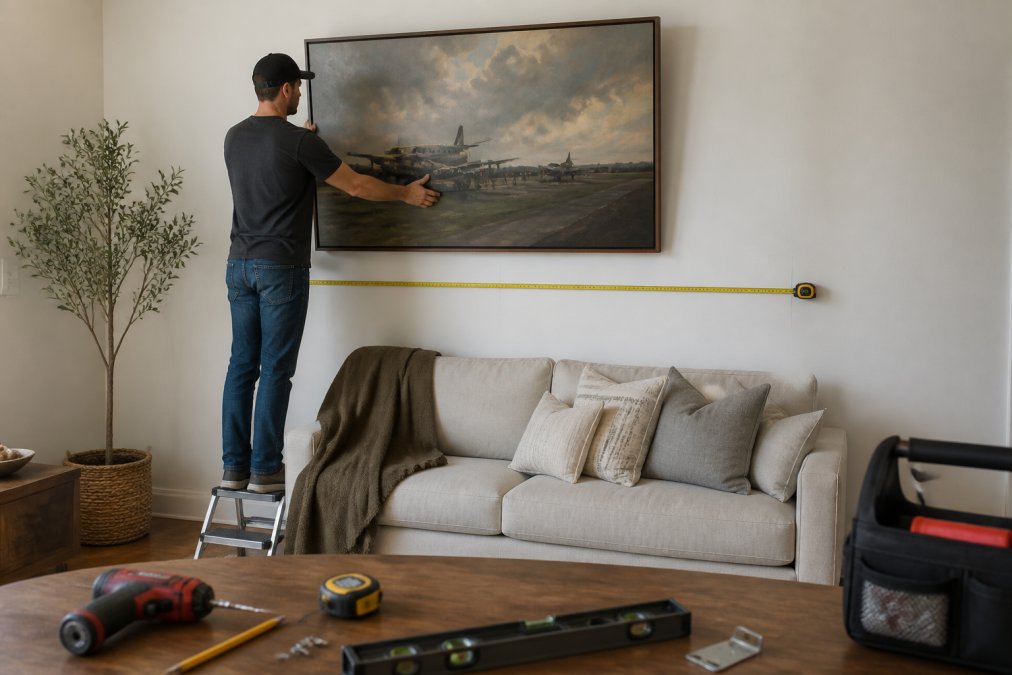
Before you drill, work through this sequence:
- Measure your wall. The art should occupy 60-75% of the width of the furniture below it. A sofa that's 84 inches wide needs art between 50 and 63 inches wide.
- Mark the center point. Use painter's tape to outline the frame's dimensions on the wall. Live with it for a day.
- Check lighting. Art placed opposite a window will catch glare. Art on a wall that receives direct afternoon sun will fade faster.
- Choose your hardware. A 30-pound canvas needs two hooks rated for 50 pounds each. French cleats work better for oversized pieces.
- Hang, then adjust. Step back at least 10 feet. If the art feels too high, it probably is.
Lighting, Care, and Keeping Prints Heirloom-Ready
Proper lighting and care determine whether your oil painting prints last five years or fifty. Three elements matter most: light exposure, humidity control, and dust management. Lighting does double duty, it determines whether texture and brushstrokes read as fine art or flatten into a poster.
A few specifics that matter in a living room:
- Color temperature: Warm-white bulbs (around 2700K-3000K) flatter oil palettes and warm tones. Cool-white or daylight bulbs (5000K+) can make warm paintings look yellow and cool paintings look clinical.
- Brightness: Aim for roughly 3-5 times the ambient light level in the room on the artwork's surface. Too dim and the piece disappears; too bright and it becomes a glare source.
- Placement: Art placed opposite a window will catch glare during the day. Art on a wall that receives direct afternoon sun will fade faster, even with UV glazing.
- Picture lights: For canvases over 30 inches wide, a single centered picture light often leaves the corners dark. Two smaller lights, or a linear LED bar sized to about two-thirds the canvas width, distribute light more evenly.
- Framed pieces under glass: Use anti-reflective glazing if the piece will be lit from the front. Standard glass turns a picture light into a mirror.
Framed vs. Unframed Oil Painting Prints
Framed oil painting prints suit formal living rooms and traditional compositions. Unframed gallery wrap canvases suit modern, minimalist, and transitional spaces where clean lines matter more than ornate detail.
The decision comes down to three questions:
- What's the room's style? Traditional and transitional rooms benefit from frames. Contemporary and Scandinavian-inspired spaces usually look better with gallery wrap.
- How large is the piece? Canvases over 40 inches wide often look better unframed because large frames become visually heavy.
- What's your budget? Custom framing can double the cost of a print. Gallery wrap eliminates that expense entirely.
Frequently Asked Questions
What kind of art looks good in a living room?
Neutral abstract canvas prints, botanical themes, and earthy tones are the best-selling wall art styles for 2026, according to Buy Wall Art. Impressionist landscapes and large textured canvas pieces also work well as a focal point. Match the color palette to your existing furniture and textiles rather than the other way around, and keep the subject matter broad enough that you will still like it in five years.
Are canvas prints a good alternative to original oil paintings?
Yes. Up to 85% of museum-quality hand-painted oil reproductions are available as alternatives to original works, according to OilPaintings.com (2026). Fine art canvas reproductions cost far less than originals while preserving brushwork and color depth. The trade-off is that they are not one-of-a-kind pieces, so resale value differs. For a living room where the goal is visual impact rather than investment, reproductions are a practical choice.
How do I choose the right size oil painting print for my wall?
Measure the wall space first, then aim for art that covers roughly 60 to 75 percent of the width of the furniture below it. A large textured canvas can anchor a living room. If you are unsure, order a paper template or tape the dimensions on the wall before buying.
How can I style vintage-inspired art in a contemporary living room?
Pair one vintage-inspired piece with modern furniture and a restrained color palette so the art reads as intentional rather than mismatched. Designers in 2026 recommend sets, such as four identical prints, to create a balanced, deliberate look, according to Living Spaces. Keep frames simple and let the artwork supply the texture. A single large piece usually works better than a scattered gallery wall in a modern room.