 listicle
Why Modern Nursery Art Trends for Boys Are Changing
Table of Contents
- Why Nursery Art Trends for Boys Are Moving Away From Blue Themes
- Gender-Neutral Nursery Art Ideas That Still Feel Personal
- How to Choose Art for a Nursery That Grows With Your Child
- The Psychology Behind Nursery Art and Early Visual Development
- Budget-Friendly DIY and Digital Art Options for Boys' Rooms
- Cultural Inclusivity and Storytelling in Modern Nursery Decor
- What These Shifts Mean for the Future of Boys' Nursery Design
- Frequently Asked Questions
Last Updated: October 3, 2026
Why Nursery Art Trends for Boys Are Moving Away From Blue Themes
The nursery design world is shifting, and the old rules are fading fast. According to The 2026 Nursery Trend Report, parents are actively moving away from cool grays and stark beige in favor of warmer, more personal spaces.
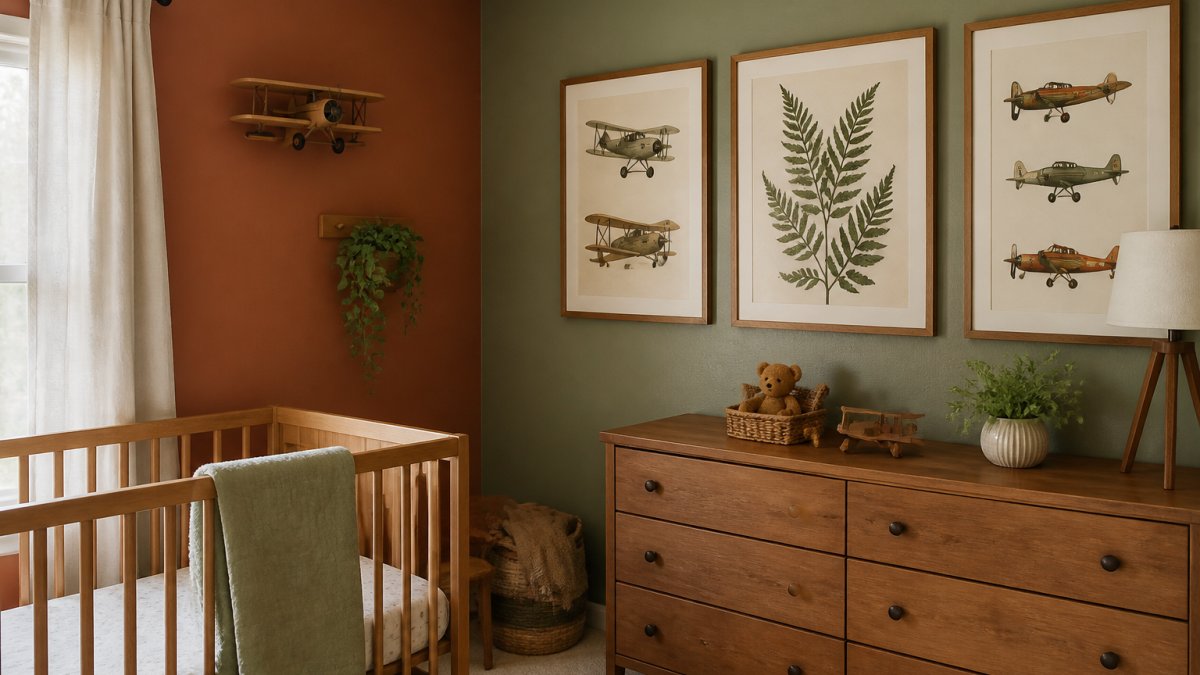
At RunwayandHeirloomArt, we watch these shifts closely because our prints live in exactly these rooms. The parents we hear from are not asking for another blue-and-white whale theme.
Why is this happening now? Three forces are converging: a rejection of mass-produced themes, a desire for spaces that feel lived-in rather than staged, and a growing understanding that the art on a nursery wall does more than decorate.
The End of Cool Grays and Stark Beige
Cool neutrals dominated nursery design for years, but that era is closing. The 2026 Nursery Trend Report notes that after years of cool grays and stark beige, parents are actively choosing warmer, more grounded color palettes.
For boys' nurseries specifically, this opens up a wider palette. Terracotta, ochre, sage, warm cream, and deep olive replace the predictable blue-and-gray formula. These tones work with wood furniture, natural textiles, and the kind of art that feels collected rather than purchased in a single aisle.
Heritage, Romance, and the Return to Meaningful Pieces
The most interesting shift is toward meaning. According to Pehr's 2026 nursery style report, parents are moving away from overly themed designs and embracing a "return to romance and heritage," favoring curated, meaningful art over mass-produced, predictable themes.
That word, heritage, matters. A framed vintage aviation print, a botanist's study of a native wildflower, or a classic storybook illustration carries weight that a cartoon character poster never will. These pieces feel chosen, not assembled. They give a boy's room a sense of history before he has any of his own.
Gender-Neutral Nursery Art Ideas That Still Feel Personal
Gender-neutral does not mean generic. The best gender-neutral nursery art ideas lean on subject matter and palette rather than a prescribed color for boys or girls. Babylist noted in early 2026 that parents are widely "ditching pink and blue" in favor of palettes that work for any child and any future sibling.
The trick is personalization. A neutral room still needs a point of view, and art is the fastest way to give it one. Here is how we think about it.
| Approach | Palette | Example Subjects | Why It Works |
|---|---|---|---|
| Earth tones | Terracotta, sage, ochre | Botanical studies, landscapes | Warm, grounded, ages well |
| Biophilic | Greens, browns, sky blue | Nature prints, animal studies | Calming, supports development |
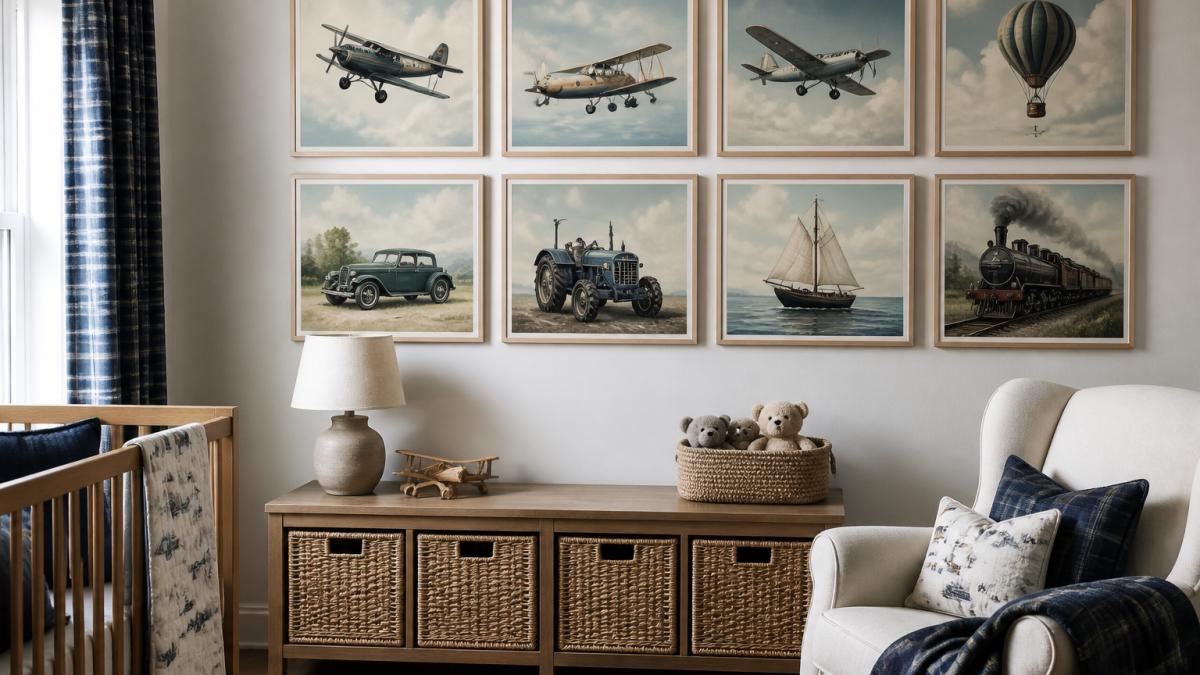
| Heritage | Deep navy, cream, gold | Aviation, classic cars, trains | Storytelling, timeless |
| Abstract | Monochromatic | Sculpted shapes, soft curves | Versatile, easy to restyle |
Earth Tones, Organic Textures, and Sculpted Shapes
Warm, grounded palettes pair naturally with organic textures: linen, wool, unfinished wood, and clay. Art that echoes those textures, watercolor washes, soft-edged botanical prints, and pieces with visible brushwork, sits comfortably in these rooms. Sculpted shapes in frames and furniture reinforce the effect.
Biophilic Design and Nature-Inspired Wall Art
Biophilic design is the practice of bringing natural elements indoors to support wellbeing and development. According to Americord's 2026 nursery trend report, modern nurseries are prioritizing biophilic elements to enhance neonatal development, moving away from traditional "boy" motifs toward earthy, nature-focused aesthetics.
For wall art, that means botanical prints, bird and animal studies, and landscape pieces in muted, natural tones. These subjects grow with a child far better than a themed character ever will.
How to Choose Art for a Nursery That Grows With Your Child
The answer to how to choose art for a nursery is simpler than most parents expect: buy for the room's future, not just its first year. LevBaby's 2026 design guide emphasizes "timeless décor" intended to evolve as the child grows, avoiding predictable palettes and specific themes that date quickly.
We recommend a three-part test before you buy any print:
- Timelessness: Would this still feel right in ten years, or is it tied to a trend that will fade?
- Versatility: Can it move to a hallway, study, or older child's room later?
- Story: Does it say something about your family, or is it just filling wall space?
Age-Appropriate Placement and Safety Standards
Placement matters as much as the art itself. Keep all framed pieces well out of reach of the crib and changing table, and secure every frame with a wall anchor or safety strap. For infants, high-contrast black-and-white images support early visual development; as a child grows, you can swap in more detailed, colorful pieces at eye level.
The Psychology Behind Nursery Art and Early Visual Development
Nursery art is not just decoration; it is part of a baby's first visual environment. Newborns respond most strongly to high-contrast images, then gradually to faces, patterns, and color as their sight develops. A wall of calm, well-chosen art gives a baby something meaningful to look at during the many quiet hours spent in the room.
This is the angle most trend pieces miss. The question is not only what looks good on Instagram, but what a child actually sees, day after day, in the space where they learn and rest.
Budget-Friendly DIY and Digital Art Options for Boys' Rooms
You do not need a gallery budget to give a boy's room meaningful art. In fact, the parents we hear from most often are not choosing between a $400 framed print and a $40 one, they are trying to build a wall that looks intentional on a realistic budget. That is a gap most trend pieces skip entirely, because high-end design photography does not show the $12 printable in a thrifted frame.
Here is what actually works, with real numbers.
Printable Downloads: The Cheapest Path to Real Art
A high-quality digital file from an independent artist typically runs $5-$25. Printing it at a local shop on archival matte paper costs roughly $3-$8 for an 8x10, $8-$15 for an 11x14, and $15-$30 for a 16x20, depending on paper weight and whether you choose giclée. That puts a finished, archival-quality 11x14 print in the $15-$40 range before framing, often less than a mass-market poster of the same size.
What to watch for:
- Resolution matters. A file needs to be at least 300 DPI at the size you plan to print. A 300 DPI 11x14 requires roughly 3300 x 4200 pixels. Files sold as "printable" usually specify this; if they do not, ask.
- Color profile matters. Ask the print shop to use a color-managed workflow. A file designed in sRGB printed on a shop calibrated for Adobe RGB will come out muddy.
- Paper matters more than the printer. Archival matte or cotton rag paper will outlast a standard glossy photo print by decades under normal indoor light.
DIY Framing: Where the Real Savings Live
Framing is the single biggest line item in most nursery art budgets. Custom framing for a 16x20 can easily run $150-$300. The DIY alternative:
- Thrift and secondhand frames. Goodwill, estate sales, and Facebook Marketplace regularly turn up solid wood frames for $3-$15. Look for frames with intact glass or acrylic and a backing board you can reuse.
- Repaint to match your palette. A $6 can of matte spray paint in sage, terracotta, or warm cream will unify mismatched frames into a coherent wall. This is the single highest-leverage DIY move in nursery design.
- Standard sizes only. Stick to 8x10, 11x14, and 16x20. Custom sizes force custom mats and custom glass, which erases the savings.
- Mats are optional and often unnecessary. A print with a generous white border can be framed without a mat, which saves $10-$25 per piece.
A realistic budget for a five-piece gallery wall: $40-$80 in printables, $25-$60 in thrifted frames, $10 in spray paint, and $15-$30 in printing. Total: roughly $90-$180 for a wall that reads as collected rather than assembled.
Digital Displays: The Emerging Option
A small digital frame or tablet mounted on the wall can rotate art as your child's interests change, which solves the "outgrown in two years" problem directly. Wi-Fi digital frames in the 10-inch range now start around $60-$120, and many accept uploads from a phone app.
Trade-offs to weigh:
- Cords are a safety issue. Any digital display in a nursery needs cord management that keeps the cable fully out of reach of a crib or playpen. The AAP's guidance on cords near sleep spaces applies here.
- Screens emit light. A glowing frame in a dark nursery can interfere with sleep cues. Choose a model with a scheduled off time, or place it on a wall the child does not face while falling asleep.
- It is not an heirloom. A digital file will not become the piece your child takes to their first apartment. A printed and framed piece will.
A Hybrid Approach Most Parents Land On
In practice, the strongest budget walls mix methods: one or two printed-and-framed pieces that carry the story, plus a rotating digital display for the pieces that change with age. That gives you the heirloom quality where it matters and the flexibility where it does not.
For parents who want the heirloom feel without the DIY work, our watercolor nursery art collection and historic aviation prints offer ready-to-frame pieces that carry the same storytelling quality.
Cultural Inclusivity and Storytelling in Modern Nursery Decor
The most personal nurseries tell a specific story, and that story is increasingly cultural. Parents are weaving in family heritage, ancestral landscapes, and traditions from their own backgrounds rather than defaulting to a single mainstream aesthetic.
This is where nursery art trends and personal meaning intersect most powerfully. The art becomes an heirloom in the making, something a child can grow up alongside and eventually keep.
What These Shifts Mean for the Future of Boys' Nursery Design
The direction is clear. Boys' nursery design is moving toward warmer palettes, meaningful subjects, and art that grows with the child rather than being outgrown in two years. The themed, mass-produced nursery is giving way to something more personal and more lasting.
That is exactly the kind of art we create at RunwayandHeirloomArt. Our collection spans Art Deco prints, historic aviation pieces, and watercolor nursery art, each chosen to tell a story rather than fill a wall.
Frequently Asked Questions
How has nursery art for boys evolved in recent years?
Nursery art for boys has moved away from predictable blue palettes and cartoon themes toward warmer, more personal design. Parents are choosing heritage-inspired pieces, earthy tones, and art that reflects family history or individual interests. According to the 2026 Nursery Trend Report, families are ditching cool grays and stark beige for grounded, inviting palettes. The result is a curated space that feels lived-in rather than themed.
Why are parents choosing gender-neutral nursery art ideas for boys' rooms?
Gender-neutral nursery art ideas offer versatility. Parents want pieces that can stay on the wall as a child grows, rather than being replaced when a theme feels outdated. Babylist reported in January 2026 that families are ditching pink and blue in favor of neutral palettes that allow art and decor to be repurposed over time. This approach also makes hand-me-downs and sibling room shares easier.
How do I choose art for a nursery that will last beyond the baby stage?
Look for timeless design elements: organic textures, muted color palettes, and subjects that appeal across ages. Avoid character-specific or trend-driven prints that date quickly. LevBaby's 2026 report recommends timeless decor that evolves with the child. Framed prints of aviation, nature, or abstract shapes can move to a big-kid room or hallway later.
Are traditional nursery themes for boys becoming outdated?
Traditional themes like cartoon animals and sports motifs are losing ground to more personal, design-forward approaches. USABabyPR noted in 2026 that highly colorful, theme-specific nurseries are increasingly viewed as outdated. Parents now favor curated spaces with art that tells a story, whether that's a vintage aviation print or a watercolor landscape. The shift reflects a broader preference for sustainable, future-ready decor over disposable trends.