 ultimate-guide
Printable Nursery Wall Art: 2026 Ideas & Printing Guide
Table of Contents
- Why Printable Nursery Wall Art Is the Smartest Decor Move in 2026
- Nursery Wall Art Ideas by Style
- File Formats and Resolution: What to Check Before You Download
- How to Print Digital Art at Home
- The Best Paper for Nursery Prints
- Sizing Guide and Gallery Wall Planning
- Budget-Friendly Framing and Sustainable Printing
- Conclusion
- Frequently Asked Questions
Last Updated: September 14, 2026
Why Printable Nursery Wall Art Is the Smartest Decor Move in 2026
Printable nursery wall art is a digital file you buy once, download instantly, and print at the size and on the paper you choose. It removes the two biggest nursery decorating headaches: waiting weeks for a shipped canvas and paying gallery prices for a single piece.
The numbers back it up. According to Shutterstock's 2026 nursery printable collection, more than 55,000 stock images now sit under the nursery printable category, and free collections like The Yellow Bird House's printable nursery art roundup bundle over 300 downloads in one place. Choice is not the problem anymore.
The problem is quality control: a file that looks crisp on your phone can print soft, washed out, or pixelated at 16x20. What follows is the practical side of nursery wall art, which styles are trending, what resolution you need, how to print at home, and how to hang a gallery wall that looks intentional.
Nursery Wall Art Ideas by Style
The strongest nursery wall art ideas start with a theme, not a color. Pick the motif first, then let the palette follow. A 2026 trend report from Ana Brandt Photography's nursery trend report notes a move away from cool grays and stark beige toward bolder signature pieces, while softer blush and peach accents keep the room calm. Industry roundups of the top nursery themes for 2026 consistently place woodland, safari, nautical, and wildflower motifs at the top, which tells you parents are buying timeless over trendy.
Animal-Themed Prints: Woodland, Safari, and Nautical
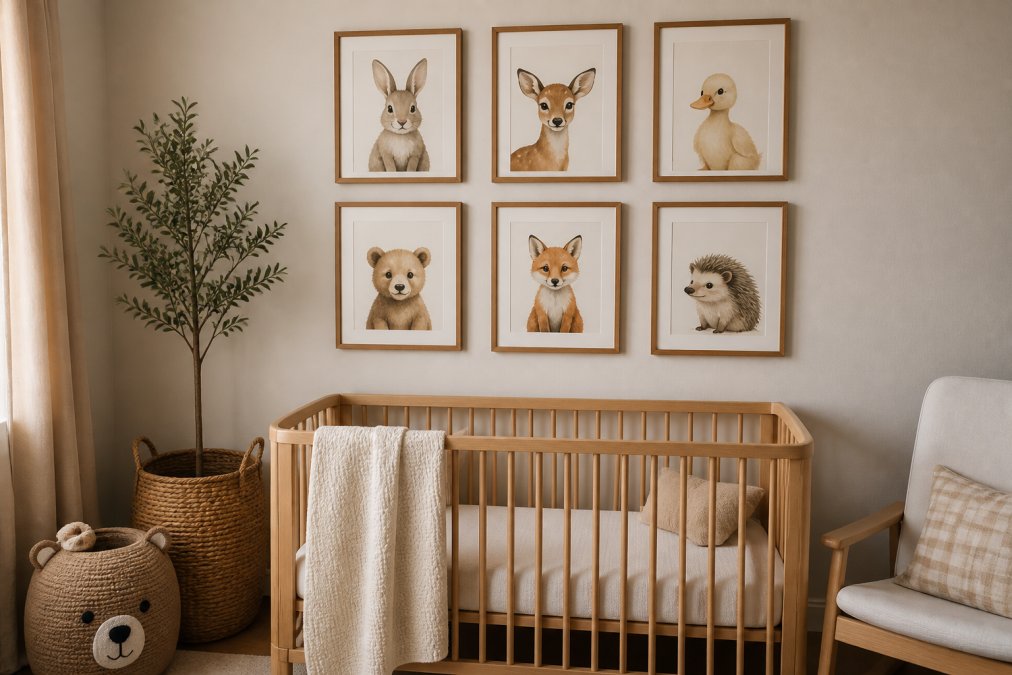
Animal prints carry a nursery better than almost any other category because they scale from newborn to toddler without feeling babyish. Woodland sets lean quiet and earthy, with foxes, bears, and deer in muted greens and browns. Safari brings warmer energy through lions, elephants, and giraffes. Nautical leans graphic, using whales, sailboats, and anchors in navy and white.
A common mistake is mixing three animal styles in one room. Pick one habitat and stay inside it.
Modern, Minimalist, and Black-and-White Designs
Minimalist nursery wall art works on restraint: a single line-drawn animal, a simple arch, or typography with the baby's name in a clean serif. Black-and-white nursery decor is the most practical choice for a gender-neutral room, and high-contrast images are easier for newborn eyes to focus on.
For rooms with a specific palette, a minimalist set in two or three colors will match almost any bedding you already own.
Botanical, Boho, and Whimsical Options
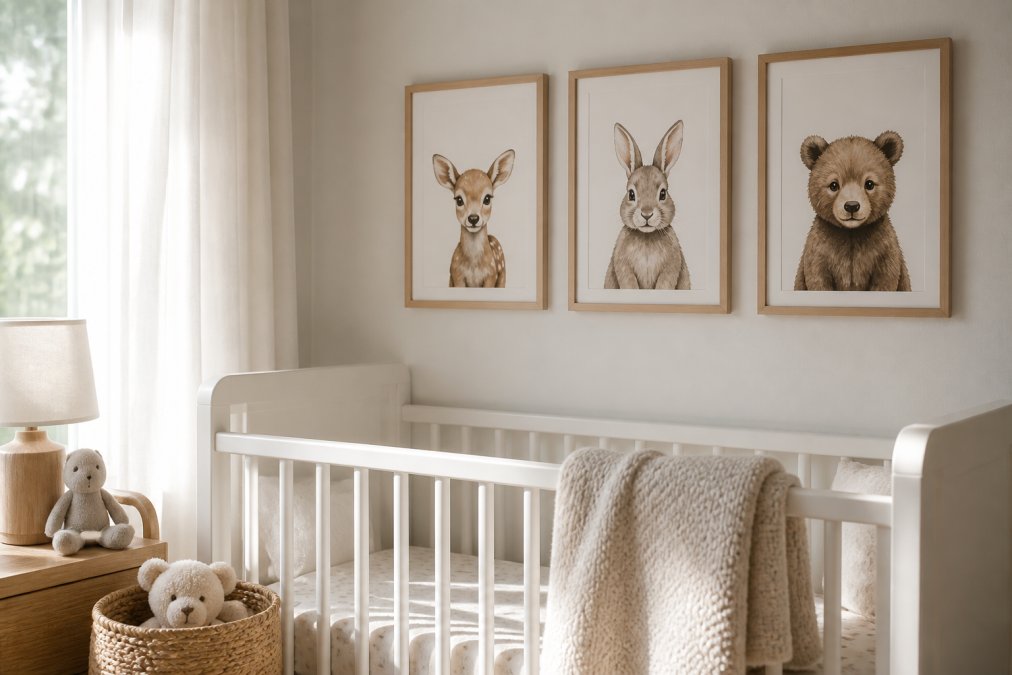
Boho nursery decor runs on texture and warmth: dried grasses, arch-shaped botanical silhouettes, terracotta and sage tones. Botanical prints work especially well as a matched wall art set of three, since the repetition reads as deliberate design rather than clutter.
Whimsical options go the other direction: hot air balloons, illustrated storybook scenes, and soft watercolor animals suit a playroom or a child's room that will grow with them. A watercolor art style earns its keep here, soft edges keep a busy illustration from feeling loud.
File Formats and Resolution: What to Check Before You Download
The minimum resolution for a printable nursery wall art file is 300 DPI at the largest size you plan to print. Anything lower will look soft in a frame, no matter how good your printer is.
Here is what to verify before you pay:
- Resolution: 300 DPI at final print size. A file labeled "300 DPI" at 8x10 is not automatically 300 DPI at 16x20.
- File format: PDF for fixed-size prints, JPG or PNG for maximum flexibility. PNG handles transparent backgrounds; PDF holds vector graphics sharpest.
- Color mode: RGB for home inkjet printers, CMYK only if a commercial printer requests it.
- Aspect ratio: Confirm the file matches your frame. A 2:3 file will not fit an 8x10 frame without cropping.
Vector graphics are the gold standard here, since they scale infinitely without losing edge quality.
How to Print Digital Art at Home
Printing nursery wall art at home takes about 15 minutes once your settings are right, but the settings matter more than the printer. A mid-range inkjet produces gallery-quality results if you match the paper profile, disable auto-scaling, and print at the highest quality mode, failures are almost always software settings, not hardware.
Here is the workflow that produces a frame-ready print on the first or second attempt:
- Open the file at 100% zoom before printing. Check for banding, soft edges, or a visible pixel grid, if it looks soft on screen at full size, it will look soft in the frame.
- Confirm the file's pixel dimensions against your target size. A true 300 DPI 8x10 needs 2400 x 3000 pixels; an 11x14 needs 3300 x 4200 pixels; a 16x20 needs 4800 x 6000 pixels. If the file falls short, print smaller rather than upscaling.
- Set the printer to its highest quality mode (often labeled "Best," "Photo," or "Fine" in the driver), not "Normal" or "Draft."
- Select the correct media type in the print dialog. Choose "Matte Photo Paper" or "Fine Art Paper" so the driver applies the right ink load, leaving it on "Plain Paper" is the most common cause of washed-out prints.
- Turn off automatic color enhancement, borderless scaling, and "fit to page." These crop or stretch the image and can shave a quarter-inch off an edge designed to sit inside a mat.
- Set scaling to 100% or "Actual Size" and verify the print preview shows the full image with no cropping.
- Print one test sheet on plain paper first to confirm sizing and cropping before committing your good stock.
- Print the final version on your chosen paper and let it dry flat for 30 minutes before framing, matte papers take longer to set than glossy, and handling a damp print can leave fingerprints.
Color Management Basics
Home inkjets expect RGB files, and most printable nursery art is delivered in RGB (sRGB is the safest working space). If a commercial printer asks for CMYK, that conversion should happen on their end or in a design tool, not by converting the file yourself in a basic viewer, which shifts colors. For soft watercolor and pastel designs, a poorly converted CMYK file often prints muddy and grayed out.
When to Skip the Home Printer
If you don't own a printer, or if your target size is 16x20 or larger, a local print shop or online service will handle it. Upload the file, select matte finish, choose the exact size, and confirm the lab prints at 300 DPI without upscaling. For large formats, ask for a proof strip first, it costs a few dollars and catches color shifts before a full print.
The Best Paper for Nursery Prints
The best paper for nursery prints is a heavyweight matte cardstock or fine art paper in the 200-300 gsm range. Matte finish prevents glare under nursery lighting and holds watercolor tones more faithfully than glossy stock. But for a room where a baby sleeps, the paper's composition and ink compatibility matter just as much as weight.
What the Numbers Mean
Weight separates a print that feels like an heirloom from one that feels like a flyer. Standard copy paper runs around 90 gsm (roughly 24 lb bond). A 250 gsm matte cardstock has real body, resists curling, and takes ink without bleeding. For watercolor-style designs, textured fine art paper adds visible depth to soft washes.
- Everyday option: 200 gsm matte cardstock, widely available and inexpensive.
- Upgrade option: 250-300 gsm fine art matte paper for a gallery feel.
- Avoid: glossy photo paper, which reflects light and cheapens soft watercolor tones.
Acid-Free and Archival Matters More Than Weight
A 300 gsm paper that is not acid-free will yellow within a few years, especially in a room with indirect sunlight. Look for paper labeled "acid-free," "archival," or "pH neutral." Acid-free matte cardstock in the 200-250 gsm range is the sweet spot: heavy enough to feel substantial, stable enough to hold color for years, and cheap enough to print a full gallery wall.
Ink Compatibility: Pigment vs. Dye
Home inkjets use either dye-based or pigment-based inks. Dye inks produce vivid color but fade faster and can smear on coated papers if the media setting is wrong. Pigment inks are more fade-resistant and sit on the paper surface, pairing well with matte fine art stock. For a set you want to keep for years, pigment ink on acid-free matte paper is the more durable combination.
Sustainable and Non-Toxic Choices for a Baby's Room
This is where most printable nursery art guides stop short, and where it matters most, because the print hangs inches from a crib.
- Look for FSC-certified paper. The Forest Stewardship Council certification means the fiber comes from responsibly managed forests. Most major paper brands and print shops label this on the package or product page.
- Choose acid-free, chlorine-free (TCF or ECF) paper when available. Chlorine-free processing reduces the chemical load in the paper itself.
- Prefer pigment inks or ask your print shop about low-VOC and non-toxic ink options. Many commercial print shops now offer water-based or latex inks that are lower in volatile organic compounds than traditional solvent inks.
- Print on demand, not in bulk. Digital downloads are inherently low-waste: no shipping, no packaging, no returns. Print only the sizes you will hang, and reprint later if you change your mind.
- Skip lamination and plastic sleeves unless you need them. A simple acid-free mat and a standard frame protect the print without adding plastic.
Sizing Guide and Gallery Wall Planning
Standard frame sizes drive everything here. According to Buy Wall Art's 2026 best-selling wall art study, 78% of shoppers have specific preferences about print dimensions for nursery layouts, accent walls, and dresser displays. That means sizing is not an afterthought, it is the decision.
| Print Size | Best Use | Notes |
|---|---|---|
| 5x7 | Small cluster or shelf display | Cheapest to frame |
| 8x10 | Single statement or gallery grid | Most common frame size |
| 11x14 | Above a crib or dresser | Needs a mat to look finished |
| 16x20 | Large accent wall | Requires 300 DPI at full size |
For a gallery wall, plan the arrangement on paper before you hammer anything. A three-piece set works in a row above a crib; a five-piece grid suits a wider accent wall. Keep 2-3 inches between frames and center the group on the wall, not on the furniture below it.
Budget-Friendly Framing and Sustainable Printing
Framing is where printable nursery wall art stops being cheap, a custom frame can cost more than the print itself, so budget framing matters.
- Buy standard-size frames off the shelf and print to fit them, not the reverse.
- Use an acid-free mat to add visual weight without a custom frame.
- Spray-paint mismatched thrift-store frames in one uniform color for a matched set.
- Skip glass on high shelves and use a mat alone for a lighter, more modern look.
On the sustainability side, print on FSC-certified paper, choose print-on-demand over bulk ordering, and print only the sizes you will actually hang.
Conclusion
The hard part of nursery wall art was never finding something beautiful, it was trusting that a downloaded file would print as well as it looked on screen. Check the DPI, match your paper weight to the design, and plan your frames before you print, and the result holds up next to anything from a gallery.
That is exactly the standard we build to at RunwayandHeirloomArt. Our watercolor nursery art collection pairs soft washes with the resolution you need for larger frames, and every piece arrives as an instant download so you can size and print it on your own timeline. If you are decorating a study or a child's room with a passion behind it, our historic aviation prints carry the same story-driven approach.
Get started with RunwayandHeirloomArt and turn a blank nursery wall into something worth keeping.
Frequently Asked Questions
What are some good wall art prints for a nursery?
Woodland and safari animals, botanical florals, minimalist typography, and black-and-white designs remain top choices for 2026. The 2026 Nursery Trend Report notes a shift away from cool grays toward bolder signature pieces while keeping subtle palettes. A coordinated wall art set of three to six prints in a single theme, such as watercolor nursery art, creates a cohesive look without overwhelming a small room.
How do I print digital art for my nursery at home?
Download the file in the highest resolution offered, usually 300 DPI. Set your printer to the best photo quality setting, select the correct paper size (8x10 or 11x14 are most common), and turn off any auto-scaling so the image prints true to size. Use a matte or fine-art paper for a gallery look, and let the print dry flat for a few hours before framing.
What paper type is best for printing nursery wall art?
For a soft, painterly look that suits watercolor prints, choose a matte fine-art paper around 200-300 gsm. Cardstock works well for black-and-white or typography pieces where crisp lines matter. Avoid glossy photo paper unless the design has high-contrast colors, since glare can distract in a nursery. Heavier paper resists curling and feels more like an heirloom.
Where can I download free printable wall art for a nursery?
Free options exist, including collections with over 300 downloadable nursery art files, and stock libraries offer more than 55,000 royalty-free nursery printable images. Free files often come at lower resolution, so check the DPI before printing large. If you want a specific theme, color palette, or an instant download that prints cleanly at 11x14, a curated shop like Runway & Heirloom Art offers a diverse collection.