 how-to
How to Style Children's Room Themes 2026 (Step-by-Step)
Table of Contents
- Step 1: Choose a Theme That Grows With Your Child
- Step 2: Build a Color Palette That Works for Sleep and Play
- Step 3: How to Choose Art for Nursery Walls
- Step 4: Plan Storage and Functional Furniture Before You Decorate
- Step 5: Layer Lighting for Sleep, Play, and Study
- Step 6: Design Evolvable Bedroom Themes for Children
- Common Mistakes to Avoid When Styling Children's Room Themes
- Frequently Asked Questions
Last Updated: September 28, 2026
Step 1: Choose a Theme That Grows With Your Child
The best children's room themes in 2026 start with a theme that can age with your child, not one that will feel babyish in two years. Designers are moving away from strictly kid-only interiors and making these spaces feel like a natural extension of the rest of the home, according to Children's Room Design Trends 2026.
Why 2026 Designers Avoid Kid-Only Interiors
Rooms that look like a themed toy store can feel out of place in an otherwise grown-up home. Designers now treat a child's room as part of the whole house, using the same quality of materials and finish as the living room.
Popular 2026 Motifs: Nautical, Safari, Space, and Beyond
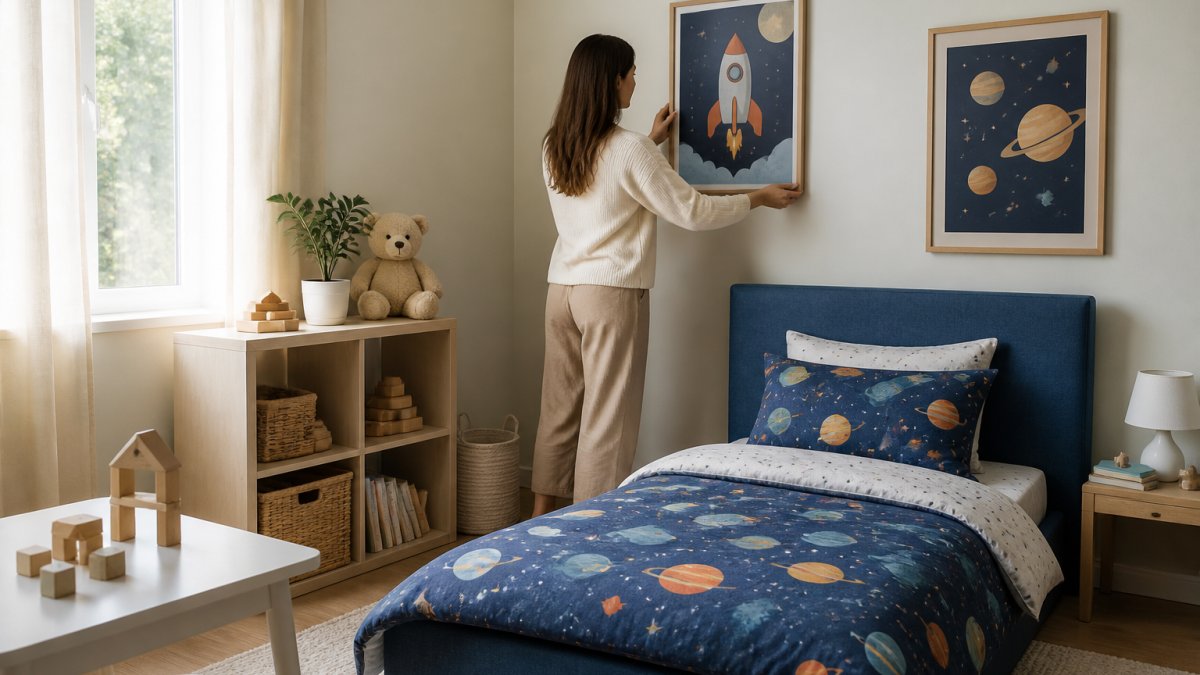
Classic themes still lead the pack. Nautical, jungle safari, and outer space motifs remain popular choices, often added through wall decals and bedding, based on kids' room decor trend coverage.
Here's how to think about each:
- Nautical: Works for any age, pairs well with white and navy
- Safari: Adds warmth through wood tones and earthy greens
- Space: Easy to refresh as your child grows into a study nook
- Beyond: Trains, classic cars, and aviation themes appeal to kids and adults alike
Step 2: Build a Color Palette That Works for Sleep and Play
A good color palette does two jobs at once: it calms the room for sleep and gives it enough energy for play. The 2026 direction leans warm, with cooler grays and stark beiges falling out of favor.
2026 Nursery Color Directions: Warm Boho, Floral Maximalism, Coastal Reimagined
Each direction suits a different kind of room. Warm Boho uses terracotta, cream, and soft rust. Floral Maximalism layers bold pattern and color for a bolder child. Coastal Reimagined swaps classic navy-and-white for sandy neutrals and soft blues.
Step 3: How to Choose Art for Nursery Walls
Choosing art for a nursery comes down to three things: scale, framing, and a layout that can change as your child grows. Art is the easiest way to set a theme without painting a single wall.
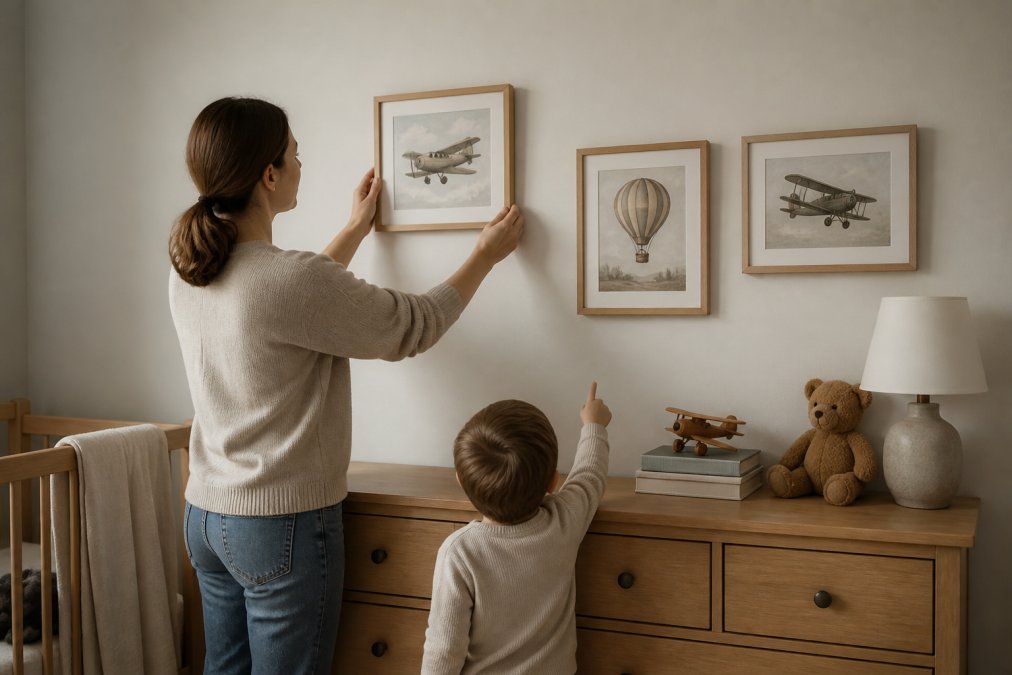
Artful Walls: Framing, Scale, and Gallery Layouts
A gallery wall works best when you plan it on the floor first. Lay out your frames, snap a photo, and adjust before you hang anything.
- Hang art at eye level for an adult, not a toddler
- Leave 2 to 3 inches between frames
- Mix sizes: one large piece with two smaller ones
- Keep a consistent frame color for a clean look
Step 4: Plan Storage and Functional Furniture Before You Decorate
Plan storage before you buy a single decoration. Clutter kills a theme faster than a wrong color ever will, and in a child's room, storage is the theme, everything else is set dressing.
Match the Storage to the Child's Stage, Not the Aesthetic
A four-year-old and a nine-year-old need completely different storage. Plan around the stage your child is in now, with one upgrade path built in.
| Stage | What Works | What to Skip |
|---|---|---|
| Toddler (2-4) | Low open bins, floor-level book ledges, a single rolling cart | Tall shelving, lidded bins, anything requiring a step stool |
| Early elementary (5-8) | Labeled cubbies, wall-mounted book ledges, a low desk with a drawer | Open floor baskets that become toy pits |
| Tween (9-12) | A modular closet system, a real desk, closed storage for clutter | Character-themed bins they've outgrown |
The Budget-Conscious Modularity Angle Most Guides Skip
Every 2026 trend roundup tells you to buy new. A smarter approach is to adapt what you already own so it reads as current without a single new purchase.
- Repaint, don't replace. A dresser or bed frame in a dated finish can be sanded and repainted in one of the 2026 warm neutrals for the cost of a can of paint and a weekend.
- Swap hardware, not furniture. New knobs and pulls on an existing dresser or closet read as a deliberate update and cost a fraction of a new piece.
- Add a topper, not a new desk. A removable desk hutch or a floating shelf above an existing table turns it into a study station.
- Reuse bins across rooms. Open bins that no longer fit the playroom often fit a closet, a bathroom, or a garage shelf, so nothing is wasted.
- Buy one modular piece at a time. A modular closet or cubby system is worth the extra cost because it adapts as needs change, which means fewer replacements over the years. Buy the base unit first and add on as the child grows.
Multi-Functional Pieces That Earn Their Floor Space
In a small room, every piece should do at least two jobs:
- Storage bed or bed with under-bed drawers, replaces a dresser in tight rooms
- Bench with lift-up storage, seating plus toy or blanket storage
- Rolling cart, art supplies now, a bedside table later
- Wall-mounted fold-down desk, study space that disappears when not in use
- Cubby bench under a window, reading nook plus shoe and book storage
Safety and Anchoring
Any tall or heavy furniture, dressers, bookshelves, cubby units, should be anchored to the wall. This is a standard childproofing step and one of the most commonly skipped. Keep heavy items on lower shelves and avoid stacking bins above a child's reach.
Step 5: Layer Lighting for Sleep, Play, and Study
Layer three light sources in every child's room: overhead, task, and ambient. One bright ceiling light flattens a room and makes bedtime harder. The reason is biological, light color and intensity signal to the body whether it's time to wind down or wake up, so the lighting plan is really a sleep plan.
The Three Layers, and What Each One Is For
- Overhead (ambient): a dimmable fixture on a warm setting. This is the base layer for getting dressed and tidying up.
- Task: a desk lamp for homework and a bedside lamp for reading. Bright and focused, but only where it's needed.
- Accent / night light: a low, warm glow near the floor or on a low shelf for overnight comfort.
Color Temperature Is the Setting That Matters Most
Color temperature is measured in kelvins (K), and it's the single most useful number on a bulb box for a kid's room:
- Warm white (about 2700K): best for bedrooms and evening use. It reads as cozy and supports winding down.
- Soft white (about 3000K): a middle ground for general use.
- Cool white / daylight (about 4000K-5000K+): best for focused tasks and daytime study, but harsh in the evening.
Dimming and Smart Lighting Without Over-Stimulating
Dimmable overhead fixtures are worth the upgrade because they let one light serve both play and bedtime. Smart bulbs and smart plugs add a second benefit: you can set a warm, low scene for bedtime and a brighter one for homework, and schedule it so the room dims on its own.
- Keep it simple. One app or one wall switch, not five. A child who can't turn on their own light won't use the room well.
- Avoid color-changing lights as the main light. They're fun for play, but a constantly shifting color scene is over-stimulating at bedtime. Use them as an accent only.
- Set a schedule. A warm, dim scene that turns on 30 minutes before bed does more for sleep than any single fixture.
- Keep cords and plugs out of reach. Use cord covers or wall-mounted cable channels, and keep smart plugs on a shelf a child can't pull on.
Interactive Learning Zones Without the Over-Stimulation
If you're adding a tech element, a smart speaker, a light-up globe, an interactive reading pen, put it in the study or reading zone, not next to the bed. The goal is to separate "active" light and sound from "rest" light and sound.
- Study nook: brighter task light, one interactive device, a chair that supports posture.
- Reading nook: warm, low light, no screens, a soft seat.
- Sleep zone: dim, warm, no screens, a night light on the floor or a low shelf.
Quick Reference
| Zone | Light Color | Brightness | Control |
|---|---|---|---|
| Overhead | Warm white (~2700K) | Dimmable | Wall switch or app |
| Bedside | Warm white | Low | Touch or switch |
| Desk | Soft to cool white (~3000-4000K) | Bright, focused | Switch |
| Night light | Red or amber | Very low | Always on or motion |
Step 6: Design Evolvable Bedroom Themes for Children
Evolvable bedroom themes for children are themes built around neutral foundations, so only the accessories change as your child grows. This is the single biggest money-saver in the whole process.
Keep these fixed:
- Wall color and flooring
- Main furniture like the bed and dresser
- Frame layout on the main wall
Swap these over time:
- Bedding and throw pillows
- Art prints and posters
- Small decor and books
Common Mistakes to Avoid When Styling Children's Room Themes
The most common mistake is decorating for the trend instead of the child. Designers suggest focusing on classic foundations so the room stays stylish well beyond this year, per interior design trend analysis.
Other mistakes to skip:
- Buying a full matching set that locks you into one look
- Skipping storage and hoping clutter won't happen
- Hanging art too high for anyone to enjoy
- Choosing cool gray walls that feel cold at night
- Ignoring non-toxic materials for cribs and paint
Frequently Asked Questions
What are the most popular children's room themes for 2026?
The 2026 Nursery Trend Report highlights three directions: Warm Boho, Floral Maximalism, and Coastal Reimagined. Classic motifs like nautical, jungle safari, and outer space remain popular, often styled through wall decals and bedding. Designers are also integrating children's rooms into the home's overall aesthetic rather than treating them as separate kid-only spaces, and they favor natural materials and artful walls over character-heavy decor.
How do I choose art for a nursery that will last beyond the toddler years?
Start with pieces that reflect your family's story rather than a single cartoon character. Framed prints of animals, landscapes, or heirloom-quality illustrations can move from nursery to big-kid room to hallway. When learning how to choose art for nursery walls, consider scale, frame color, and whether the subject will still feel relevant in five years. Rotating a few pieces keeps the room fresh without a full redesign.
What color palettes work best for a gender-neutral nursery in 2026?
Cool grays and stark beiges are giving way to warmer, more layered palettes. Warm Boho leans on terracotta, cream, and wood tones. Coastal Reimagined uses soft blues, sandy neutrals, and natural textures. Floral Maximalism mixes deeper greens, pinks, and yellows. All three can be styled gender-neutral by balancing color with tactile rugs, woven baskets, and framed art that adds personality without locking the room into a single theme.
How can I make a child's bedroom theme evolve as they grow?
Build evolvable bedroom themes for children by treating the room as a base layer plus changeable accents. Keep walls, large furniture, and lighting neutral and durable. Use art, bedding, and wall decals to introduce the current passion, whether that is dinosaurs, aviation, or ballet. Modular furniture and adjustable shelving let the layout shift from crib to toddler bed to study desk without replacing everything. Store outgrown decor for a future sibling or a new phase.
Styling a child's room that lasts takes planning, not a bigger budget. RunwayandHeirloomArt helps with the part that carries a room's story: art with personality, from watercolor nursery prints to historic aviation pieces and art-history-inspired designs. Our prints are made to move from a nursery wall to a study, an office, or a gift for someone you love. Get started with RunwayandHeirloomArt and build a room your child grows into, not out of.