 blog
Aesthetic Nursery Wall Art for Boys: 2026 Style Guide
Table of Contents
- Why Aesthetic Nursery Wall Art for Boys Starts With a Story
- Boy Nursery Prints by Aesthetic: Themes That Go Beyond Blue
- Neutral Nursery Wall Art: Beige, Black and White, and Soft Pastels
- Vintage Nursery Wall Art and Heirloom-Quality Prints
- Nursery Gallery Wall Ideas: Layouts, Sizing, and Placement
- Coordinating Art With Nursery Colors, Furnishings, and Safety
- Conclusion
- Frequently Asked Questions
Last Updated: October 21, 2026
Why Aesthetic Nursery Wall Art for Boys Starts With a Story
Aesthetic nursery wall art for boys is artwork chosen for character, not just color: pieces that carry a narrative, a period, or a passion, and that a child can grow alongside. At Runway & Heirloom Art, we build our nursery collection around that idea, because a room feels designed the moment its art means something.
The usual advice is to pick a theme and match everything to it. That approach dates fast. A print that tells a story, a vintage aircraft, a woodland fox, a hand-painted locomotive, stays interesting for years.
Below, we break down the styles worth considering, what sizes and layouts work, and how to hang everything safely. The guidance draws on standard safety practice from the Consumer Product Safety Commission and on how our own prints are made.
Boy Nursery Prints by Aesthetic: Themes That Go Beyond Blue
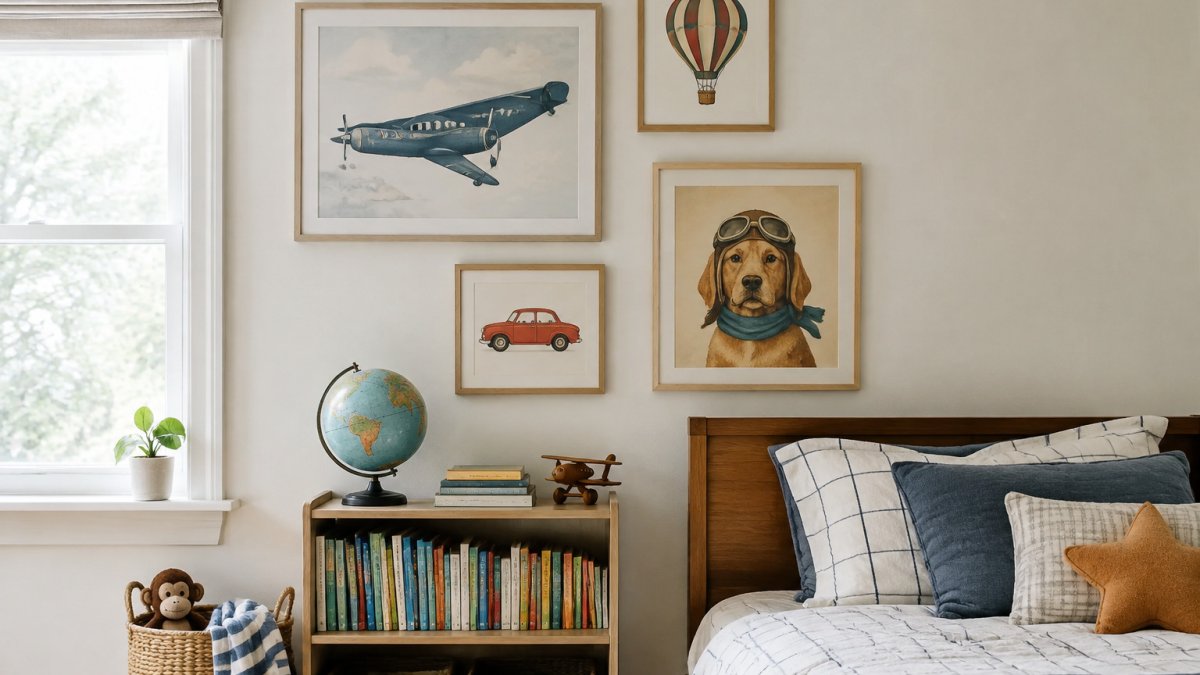
Blue is a color, not a concept. The strongest boy nursery prints start with a subject the family actually loves, then build the palette around it. Here are the themes that hold up best.
Woodland, Animal, and Nature Themes
Woodland animals, baby animals, and quiet nature scenes give a nursery warmth without feeling babyish. A set of three prints, a fox, a bear cub, and a birch grove, reads as a collection rather than a theme. These prints also age well: a child who loved the fox at two still likes it at seven.
Nautical, Adventure, and Aviation-Inspired Art
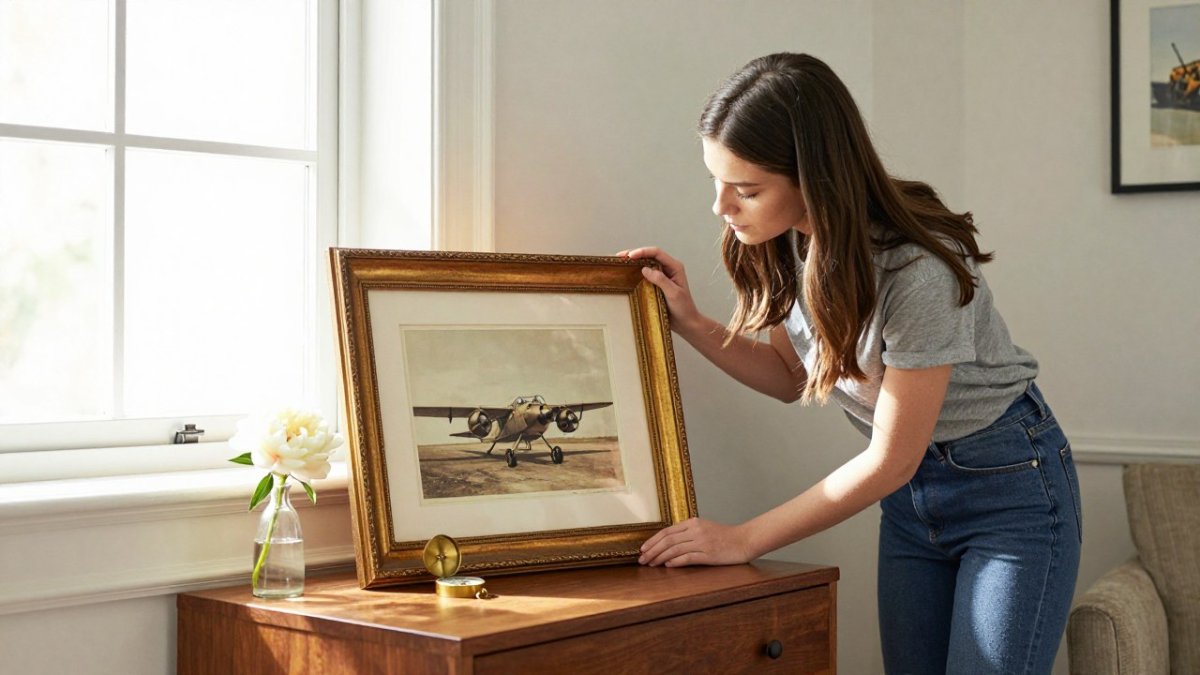
Nautical themes bring sailboats, lighthouses, and coastal color. Adventure themes lean on hot air balloons, maps, and mountain ranges. Aviation art is our specialty: the Smithsonian's National Air and Space Museum documents how rich that visual history is, from early biplanes to the golden age of flight. A vintage aircraft print gives a boy's room a subject with real depth behind it.
Neutral Nursery Wall Art: Beige, Black and White, and Soft Pastels
Neutral nursery wall art is the safest long-term choice, and the easiest to coordinate. Beige, black and white, and soft pastels let the artwork carry the room instead of competing with it.
Black and white prints suit modern, minimal spaces and photograph beautifully. Beige and cream palettes feel calm and pair with wood tones and woven textures. Soft pastels, sage green, dusty blue, muted terracotta, add color without turning the room into a nursery cliché.
Vintage Nursery Wall Art and Heirloom-Quality Prints
Vintage nursery wall art earns its place because it does not expire. A reproduction of a classic illustration or a period aviation plate looks intentional in a nursery and still looks right in a teenager's room.
What separates an heirloom print from a disposable one comes down to materials. Look for heavyweight archival paper and pigment-based inks rated for decades without noticeable fading. Ask any seller directly about paper weight and ink type before you buy. If they cannot answer, that tells you something.
Nursery Gallery Wall Ideas: Layouts, Sizing, and Placement
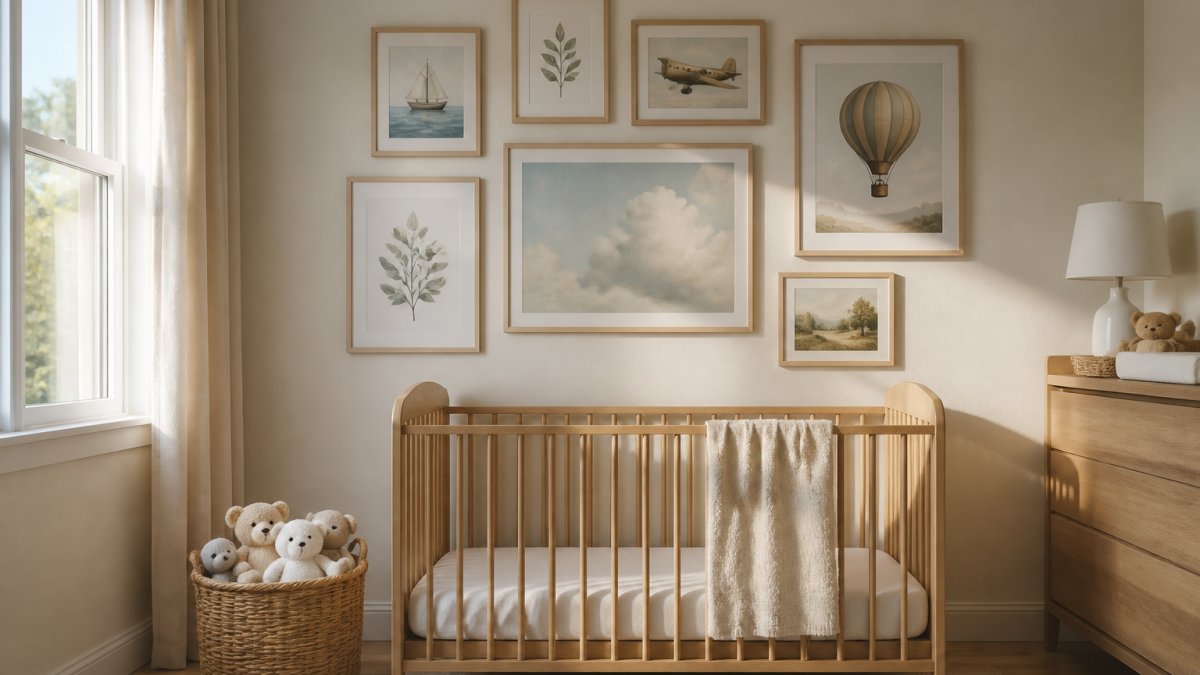
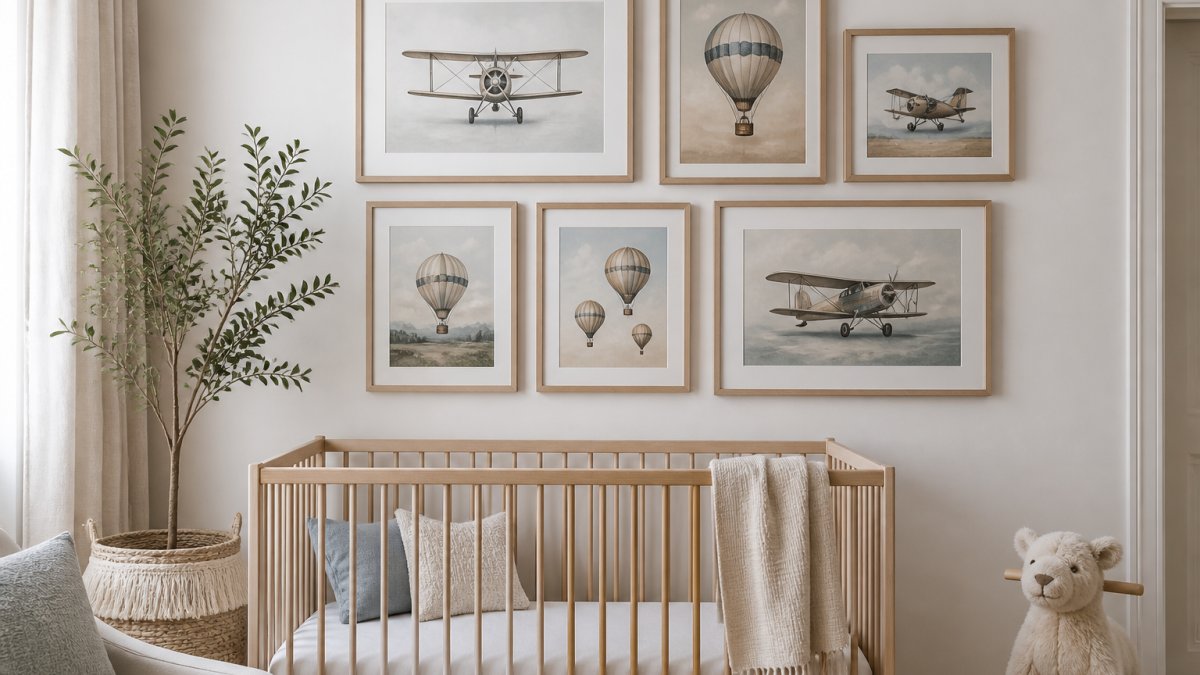
Nursery gallery wall ideas work best when you plan the grid before you buy a single frame. Start with the largest piece as the anchor, then build outward in matching or deliberately varied sizes. The mechanics below are the part most roundups skip: actual dimensions, spacing math, and where the art should sit relative to the crib and changing table.
Pick Print Sizes Before You Pick Frames
Standard print sizes drive both the frame cost and the layout. The sizes below are the ones most print shops and frame retailers stock, which keeps framing simple and affordable.
| Print Size (inches) | Best Use in a Nursery | Frame Note |
|---|---|---|
| 5 x 7 | Small supporting prints in a cluster | Often sold with mats; inexpensive to frame |
| 8 x 10 | The workhorse size for sets of 3 to 6 | Widely stocked frames; easy to swap |
| 11 x 14 | Anchor piece for a small wall | Needs a sturdier frame and anchor |
| 16 x 20 | Single statement above a crib or dresser | Heaviest option; use two anchors |
| 18 x 24 and larger | Large statement walls | Consider canvas to cut frame weight |
A practical rule: choose one anchor size and one supporting size, and repeat them. A 16 x 20 anchor with four 8 x 10 supports reads as a designed set; five unrelated sizes read as clutter.
Layout Options and the Math Behind Them
| Layout | Best For | Print Count | Spacing and Sizing Notes |
|---|---|---|---|
| Single statement piece | Above the crib | 1 | One large piece, centered on the crib |
| Symmetrical grid | Modern, minimal rooms | 4 or 6 | Equal sizes, even gaps, aligned edges |
| Salon style | Collected, vintage feel | 5 to 9 | Mix sizes, keep gaps consistent |
| Horizontal row | Low wall or dresser top | 3 | Easy to hang level; equal gaps |
Keep gaps between frames consistent, roughly 2 to 3 inches, and treat the whole arrangement as one shape. For a symmetrical grid, measure the total width of the frames plus the gaps, mark the centerline of the wall, and build outward from the anchor. For a salon-style wall, cut paper templates to each frame's outside dimensions and tape them to the wall first; this lets you adjust the composition before making a single hole.
How High to Hang Art and What Size Works Above a Crib
Hang art so the center of the arrangement sits at eye level for an adult standing in the room, about 57 to 60 inches from the floor. Above a crib, choose one large piece rather than a cluster, and mount it well out of a standing child's reach.
Above a changing table, center a single 11 x 14 or 16 x 20 piece on the table's centerline, with the bottom edge roughly 12 to 18 inches above the tabletop so it stays clear of supplies and reaching hands. On a dresser wall, a horizontal row of three 8 x 10 prints centered on the dresser is the simplest arrangement to hang level.
Safety matters more than aesthetics here. The CPSC guidance on anchoring furniture and wall items is clear: secure anything heavy, and never hang framed art directly over a crib where it could fall. Use wall anchors rated for the frame's weight, and skip glass in favor of acrylic above a sleeping area.
Coordinating Art With Nursery Colors, Furnishings, and Safety
Coordination starts with the room's fixed elements: wall color, flooring, and the crib. Pull one or two colors from those and repeat them in the art. If the walls are beige and the crib is natural wood, a green and cream print set ties the room together without adding a new palette. The method below turns that principle into a repeatable process, with palettes you can copy.
A Three-Step Coordination Method
- List the fixed colors. Write down the wall color, the floor tone, and the crib finish. These are your constants; the art has to live with them.
- Choose one accent color. Pick a single accent, such as sage green, dusty blue, or muted terracotta, and repeat it in at least two places: the art and one textile, such as a crib sheet, curtain, or rug.
- Match frame finishes to furnishings. Warm wood frames suit oak and walnut cribs; black or brass frames suit painted furniture and modern spaces. Mix and match frames deliberately, one finish for the anchor piece, a second for supporting prints.
Palettes That Work With Common Nursery Setups
| Room Setup | Wall and Floor | Recommended Art Palette | Frame Finish |
|---|---|---|---|
| Warm and natural | Beige walls, light wood floor | Sage green, cream, warm brown | Natural oak or walnut |
| Modern minimal | White or greige walls, gray floor | Black and white with one muted blue accent | Black or brass |
| Coastal | Soft blue walls, pale floor | Navy, sand, and white | White or light wood |
| Earthy | Clay or olive walls, dark floor | Terracotta, ochre, and cream | Walnut or black |
| Vintage | Cream walls, medium wood floor | Muted red, forest green, and parchment | Antique brass or dark wood |
A useful test: squint at the room. The art should read as one of the room's existing colors plus one accent, not as a new palette competing with the walls.
Pairing Art With Textiles and Furniture
Repeat, don't match. If the crib sheet is a solid dusty blue, a print with a dusty blue accent ties in without looking like a matching set. If the rug has a pattern, keep the art quieter so the two do not fight. For a wood crib, echo the wood tone in at least one frame; for a painted crib, echo the paint color in a small detail within the art rather than in the frame.
The Safety Check Before You Hang
Then check the practical side: hardware rated for the weight, cords and blinds kept away from the crib, and nothing hung where a toddler can pull on it. Use wall anchors rated for the frame's weight, choose acrylic over glass above a sleeping area, and keep the bottom edge of any frame above a crib at least 3 feet above the mattress. A beautiful room is only a good room if it is a safe one.
Conclusion
The hardest part of designing a boy's nursery is resisting the pressure to pick a theme and stop there. Art that tells a story, whether it is a woodland set, a vintage aircraft, or a quiet neutral print, gives you a room that grows with your child instead of being outgrown in two years.
At Runway & Heirloom Art, we curate prints for exactly that: our Watercolor Nursery Art and Historic Aviation Prints are made to sit in a nursery now and a study later. Browse the collection and find the piece that starts your room's story.
Frequently Asked Questions
What kind of wall art looks good in a boy's nursery?
Art that reflects a real interest rather than a default color scheme works best. Woodland animals, nature scenes, nautical and adventure themes, and vintage-inspired prints all suit a boy's nursery without feeling babyish. Mix one or two larger statement prints with smaller companion pieces so the wall reads as a collection. Neutral nursery wall art in beige, black and white, or soft pastels keeps the room calm, while a themed set of three or five prints adds personality that lasts past the toddler years.
How do you arrange prints on a nursery wall?
Start with a focal point, usually the largest print, and build outward. A common nursery gallery wall idea is a grid of four to six frames centered above the crib or changing table, spaced 2 to 3 inches apart. Hang the center of the arrangement at roughly 60 inches from the floor, or about 8 to 10 inches above the crib rail. Measure and mark frame corners with painter's tape before nailing anything so you can step back and check balance.
What size prints work best above a crib?
Art above a crib should span roughly two-thirds the width of the crib so it looks anchored rather than floating. A single large print in an 18x24 inch frame works well on its own, or a set of three 11x14 inch prints in a row fills the same space. Keep the bottom edge at least 8 to 10 inches above the crib rail, and always anchor frames into wall studs or use rated drywall anchors so nothing can fall into the crib.
How do you choose nursery wall art that grows with your child?
Pick themes tied to lasting interests rather than trends that date quickly. Vintage nursery wall art, art-history-inspired prints, and vintage aviation or railroad pieces read as heirloom decor in a nursery and still work in a boys' room at age eight. Choose neutral or muted color palettes and quality frames, then swap one or two smaller prints as tastes change instead of replacing the whole collection.