 listicle
Artistic Kitchen Decor for Creative Home Cooks
Table of Contents
- Kitchen Wall Art Ideas That Reflect Your Culinary Personality
- How to Decorate Kitchen Walls Without Cluttering Your Cooking Space
- Kitchen Gallery Wall Ideas for Cohesive, Story-Driven Displays
- Small Kitchen Wall Decor That Adds Impact Without Bulk
- Functional Decor: Art That Supports Real Cooking Workflows
- Decorative Plates, Open Shelving, and Displayed Collections
- Budget Tiers and DIY Approaches to Artistic Kitchen Decor
- Conclusion: Making Your Kitchen a Canvas for Personal Expression
- Frequently Asked Questions
Last Updated: October 12, 2026
Kitchen Wall Art Ideas That Reflect Your Culinary Personality
Artistic kitchen decor for creative home cooks starts with one question: what does your cooking life actually look like?
The fastest way to add personality is through kitchen wall art ideas that match how you actually cook and eat. Think of the wall as a second pantry: it should hold what you reach for emotionally.
Food-Themed Prints and Illustrations
Food-themed prints and illustrations are the most direct route to a kitchen that feels personal. A watercolor lemon study, a vintage-style market scene, or a hand-drawn pasta chart all say something specific about the cook who chose them.
Fruit illustrations work especially well in kitchens with warm wood tones and natural light. Coffee-inspired designs suit morning-heavy households. The trick is choosing one subject family and building around it, rather than mixing every food print you like.
Typography and Cooking Quotes
Typography and cooking quotes turn a wall into a voice. A single framed line, "mise en place" or "salt, fat, acid, heat," does more work than three generic prints.
Keep quotes short and hung at eye level near the prep zone. Long paragraphs of text belong in a study, not above a stove.
How to Decorate Kitchen Walls Without Cluttering Your Cooking Space
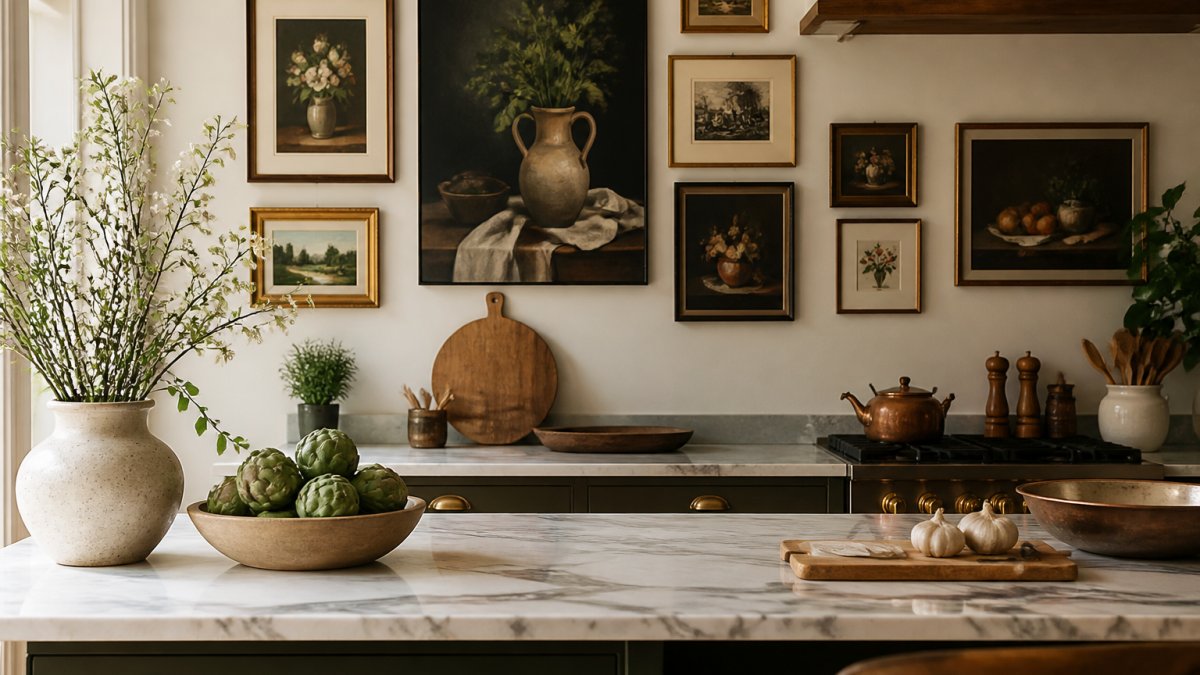
To decorate kitchen walls without cluttering your cooking space, keep art at least 45 centimeters from active burners and steam paths, and treat every wall piece as either decorative or functional, never both at once. The goal is a kitchen that looks curated, not crowded.
Material Safety and Placement for a Working Kitchen
Kitchens punish art. Grease, steam, and heat destroy unprotected paper fast. This is where most guides stop short, and it matters more than any style tip.
- Keep prints at least 45 cm from stove burners and open flames
- Avoid hanging paper art directly above a dishwasher or kettle, where steam rises daily
- Use glass or acrylic glazing to make cleaning splatters easy
- Choose frames with sealed backs to keep out cooking grease
- Hang heavier pieces into studs, not just drywall anchors
Kitchen Gallery Wall Ideas for Cohesive, Story-Driven Displays
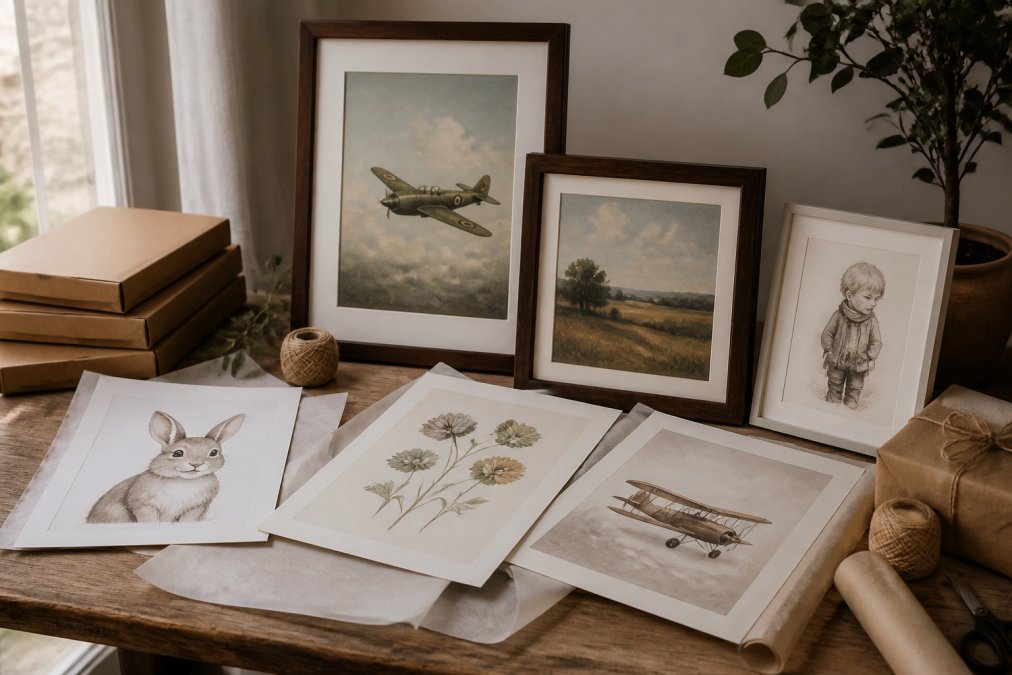
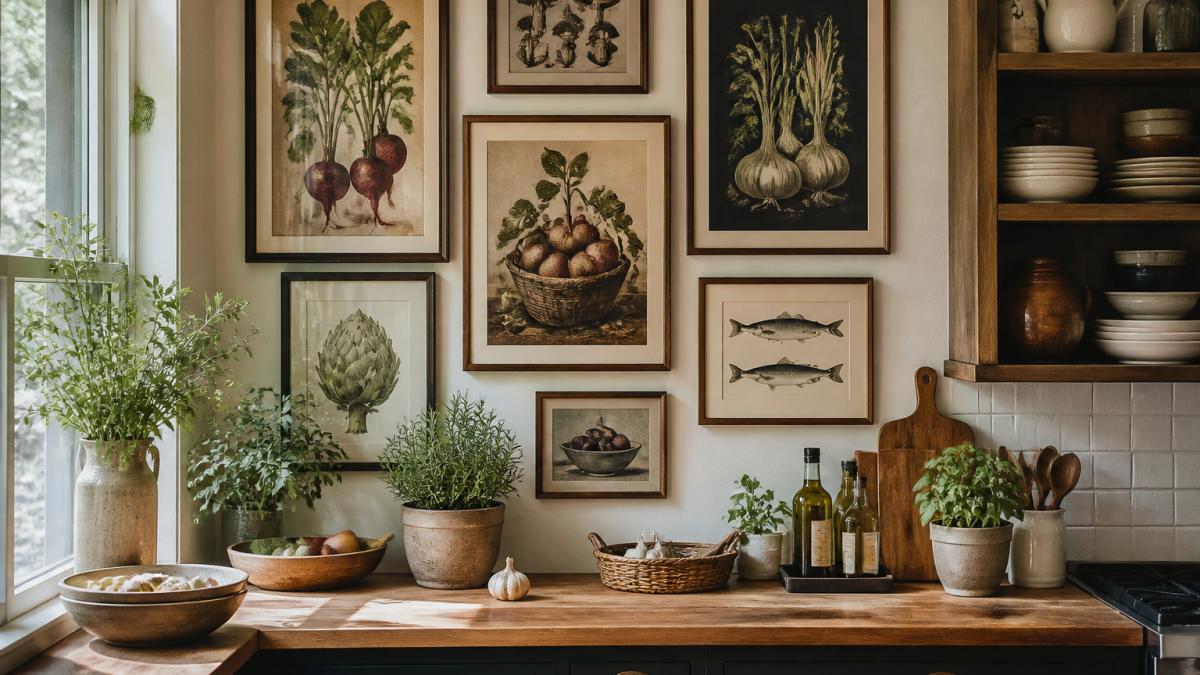
The best kitchen gallery wall ideas start with a story, not a grid. Pick a theme, such as aviation history, vintage rail travel, or heirloom nursery art, then let scale and framing vary while the subject stays consistent.
Mixing Framing, Scale, and Subject Matter
Mixing framing, scale, and subject matter is what separates a designed wall from a random collection. A common approach is one large anchor piece surrounded by three to five smaller prints in matching frames with varied mat widths.
Plan the layout on the floor first. Trace each frame onto paper, tape the paper to the wall, and live with it for a day before hanging anything.
Small Kitchen Wall Decor That Adds Impact Without Bulk
Small kitchen wall decor should go vertical and light, but the real trick is matching the piece to the specific awkward space you are working with. Most guides stop at "go vertical." Here is how that plays out wall by wall.
Narrow Walls and Galley Runs
A galley kitchen often has one long, narrow wall between the counter and the upper cabinets. Treat it as a single horizontal band rather than a gallery. One wide, low-aspect print, a market scene, a long pasta chart, reads as intentional where three small squares would read as clutter. Keep the bottom edge at least 12 inches above the counter so splashes from the sink or prep area do not reach the frame.
Above the Fridge and Upper Cabinets
This is the most underused real estate in a small kitchen, and it is also the dirtiest, grease and dust settle up there. Choose pieces you can wipe: glazed ceramic tiles, enamel signs, or prints behind glass with a sealed back. Avoid raw canvas and unglazed paper. If the gap between the cabinet top and ceiling is under 12 inches, skip art entirely and use a single low-profile object instead, because anything taller will look crammed.
Beside the Range and Sink
These are the two spots where placement matters most. Keep paper and textile art at least 18 inches from a cooktop and out of the direct steam plume above a sink or dishwasher. For the narrow strip of wall beside a range, a slim vertical print or a mounted magnetic strip with a decorative cover works better than a wide frame that crowds the burner zone.
Awkward Corners and Door Swings
Before hanging anything, open every cabinet and appliance door in the room and mark its swing with painter's tape. A piece that looks perfect on an empty wall can be clipped by a fridge door twice a day. Corner walls between a window and a cabinet are good candidates for a single tall narrow print, since the eye reads the vertical line as height rather than bulk.
Scale Rules That Actually Hold Up
A common pattern among designers is to size wall art so it occupies roughly 60 to 75 percent of the width of the furniture or counter below it. In a small kitchen, err toward the lower end. One strong piece beats five weak ones, and a single oversized print can actually make a tight room feel larger by giving the eye one clear focal point instead of many small ones.
Functional Decor: Art That Supports Real Cooking Workflows
Functional decor is art that earns its place by helping you cook. This is the angle most kitchen decor guides miss entirely: the wall can work as hard as the counter.
A few examples that hold up in daily use:
- A framed conversion chart hung beside the prep area
- A print of herb pairings above the spice drawer
- A chalkboard-finish piece for weekly meal planning
- Decorative utensils mounted as a wall feature near the range
- A magnetic strip disguised behind a slim art panel
If a piece never gets glanced at while you cook, it is decoration. If it answers a question mid-recipe, it is a tool.
Decorative Plates, Open Shelving, and Displayed Collections
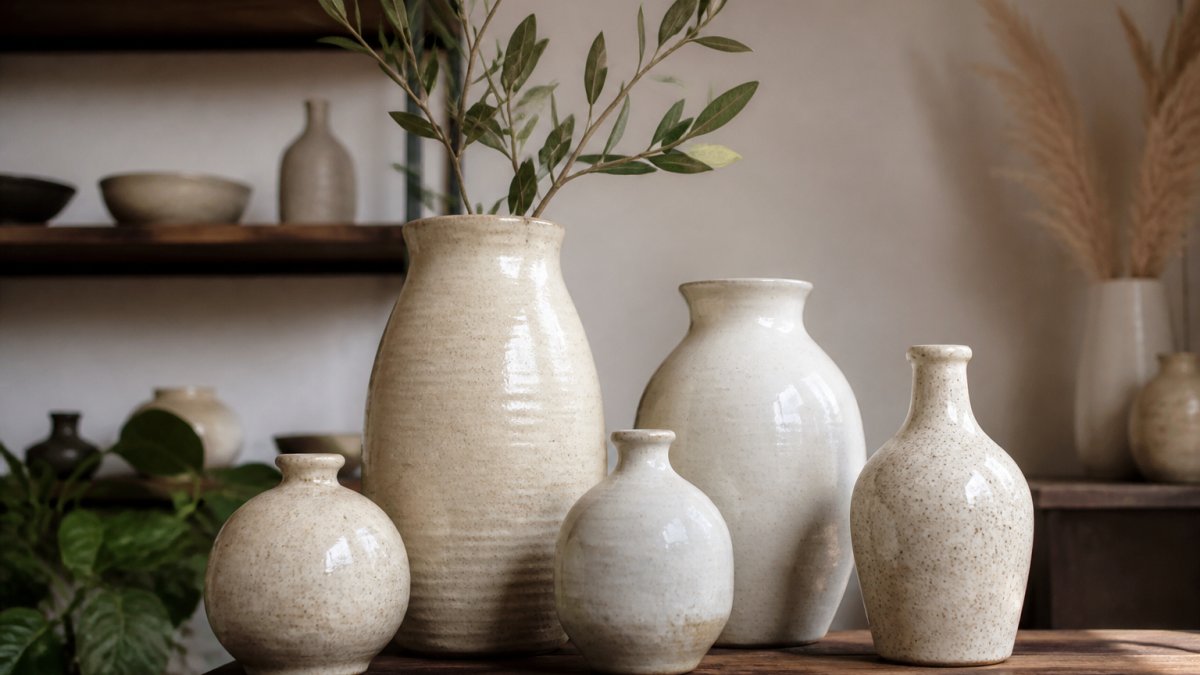
Decorative plates, open shelving, and displayed collections turn storage into display, but only when the collection is planned rather than accumulated. ELLE Decor's roundup of designer-approved kitchen wall decor includes plates that double as art and artful organization as a core idea (ELLE Decor kitchen wall decor ideas). The gap most guides leave is how to make a collection read as one composition instead of a shelf of unrelated objects.
Choosing a Cohesive Collection
Pick one variable to hold constant and let the rest vary. The easiest constants are color family, material, or shape.
A useful test: photograph the shelf, convert the image to black and white, and look at it. If the shelf still reads as one grouping in grayscale, the composition is working. If it looks like noise, the collection needs a tighter through-line.
Displaying Plates as Wall Art
Plates are the most forgiving wall art in a kitchen because they are already built for heat and moisture.
Avoid hanging plates directly over a cooktop or within splashing distance of a sink. Even glazed plates can discolor over time from grease film, and the hanger hardware is what usually fails first, not the plate.
Open Shelving That Survives Daily Cooking
Open shelving works best when it holds one category of thing and when that category is something you actually reach for. Shelves above a coffee station holding mugs and beans stay useful.
Keep the top shelf light, high shelves read as clutter fast, and heavy items up high are both a visual and a physical hazard. Reserve the lowest shelf for the items you use most, since that is the easiest reach.
Rotating and Editing the Display
A displayed collection is not permanent. A seasonal rotation, heavier ceramics and warm tones in cooler months, lighter glass and bright glazes in warmer months, keeps the shelf feeling curated rather than static. When you rotate, remove one piece for every new piece you add. Collections grow by editing, not by accumulation.
Budget Tiers and DIY Approaches to Artistic Kitchen Decor
Budget tiers for artistic kitchen decor break into three honest levels: under $100, $100 to $300, and $300 and up. What changes between them is mostly framing and print quality, not the idea itself.
| Tier | Typical Approach | Best For | Trade-Off |
|---|---|---|---|
| Under $100 | Unframed prints, thrifted frames, DIY hangings | Renters, first kitchens | Frames may need upgrading later |
| $100-$300 | Archival prints with quality frames | Long-term homes | Slower to build a full wall |
| $300+ | Large-format or matched sets | Statement focal walls | Highest upfront cost |
A rental kitchen can be transformed with removable vinyl wall decals or lightweight framed prints on damage-free hooks. If you are working with a dated kitchen, start with one wall rather than the whole room.
Conclusion: Making Your Kitchen a Canvas for Personal Expression
Every kitchen has one blank wall that could carry a story instead of sitting empty. Building artistic kitchen decor for creative home cooks is less about matching trends and more about choosing pieces that reflect how you actually live and cook. Explore the collection and find art with personality that becomes part of your kitchen's story.
Frequently Asked Questions
What are some creative art ideas for my kitchen?
Creative kitchen art goes beyond generic prints. Try food-themed illustrations like fruit or coffee designs, typography wall art featuring cooking quotes, or whimsical chef illustrations. You can also display decorative plates as art, use open shelving to showcase mugs and utensils, or create a gallery wall mixing vintage food prints with modern minimalist art. The key is choosing pieces that reflect your culinary personality and the way you actually use your kitchen.
How can I make my kitchen feel more personal with artistic kitchen decor?
Start by selecting art that tells your story. If you love baking, hang watercolor pastry prints. If aviation is your passion, historic aviation prints can work in a kitchen corner. Mix in personal items like a framed family recipe or a print of your favorite culinary city. Use personalization, like custom typography or a gallery wall of your own food photography. The goal is to make the space feel warm and welcoming, not like a showroom.
Where should I hang art in a kitchen?
Place art where it won't interfere with cooking workflows. Good spots include the wall above a kitchen island, the space between upper cabinets and countertops, or a dedicated gallery wall on an open wall. Avoid hanging art directly above the stove or sink where steam and grease can damage it. For small kitchen wall decor, use vertical space near the refrigerator or on the side of a cabinet. Always consider material safety: framed prints behind glass are easier to clean than canvas in a busy culinary space.
How do you decorate kitchen walls without making the space feel cluttered?
Clutter comes from too many small, unrelated pieces. Instead, choose a cohesive theme or color palette and limit yourself to three to five larger pieces or a single gallery wall. Use artful organization: combine functional decor like open shelving with a few decorative plates or mugs, but leave empty space between groupings. Textured finishes and bold color can add interest without volume. If your kitchen is small, opt for one statement piece rather than many small prints.