 blog
blog
Best Aviation Art Prints for Pilots: 2026 Buying Guide
Table of Contents
- What Makes the Best Aviation Art Prints for Pilots
- Choosing Aviation Art Prints by Aircraft Type and Era
- Vintage Aviation Wall Art for Home Office Displays
- Print Formats and Materials: Canvas, Metal, and Paper
- Airplane Wall Art Sizing, Framing, and Placement
- Signed, Limited-Edition, and Collectible Prints
- Budgeting for Aviation Art and Avoiding Costly Mistakes
- Frequently Asked Questions
Last Updated: October 17, 2026
What Makes the Best Aviation Art Prints for Pilots
The best aviation art prints for pilots do more than decorate a wall: they capture a specific aircraft, era, or flying experience the pilot actually knows. According to AOPA's "Aviation as Art" feature, original oil paintings by leading aviation artists have commanded serious collector attention, which tells you how deeply this subject resonates with people who fly.
At RunwayandHeirloomArt, we curate aviation artwork for exactly this audience: pilots who want a piece that recalls a checkride, a first solo, or a favorite airframe. Below, we'll show you how to choose prints by aircraft type, era, and format so the piece you hang actually means something.
Here's what most guides get wrong: they treat aviation art as generic "man cave" decor. A pilot can spot an inaccurate silhouette from across the room. Accuracy and subject matter matter more than frame style.
Choosing Aviation Art Prints by Aircraft Type and Era
Start with the aircraft, not the color scheme. A pilot's connection to a specific plane usually points to one of two categories: military and historic aircraft, or the general aviation classics they trained in.
Military Aviation and Historic Aircraft
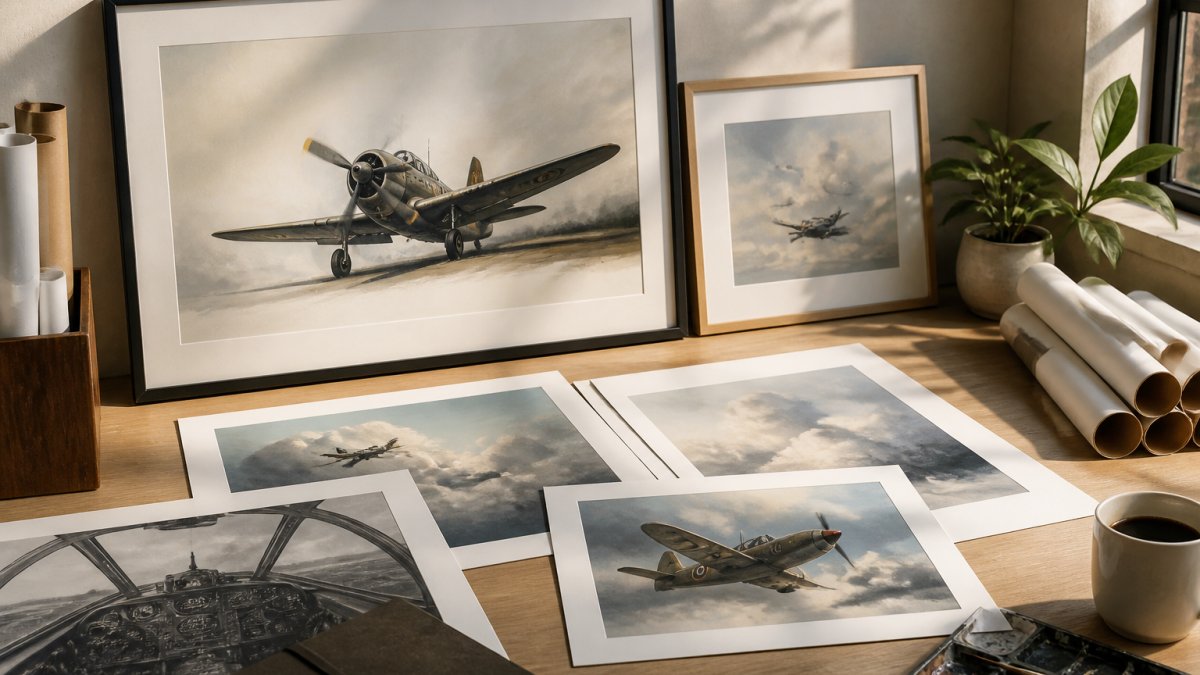
Military aviation art carries the most emotional weight for many collectors. WWII aircraft like the P-51 Mustang, fighter aircraft from the European theater, and WWI aircraft with their fabric-and-wire fragility all appear in classic aviation artwork.
Signed and collectible prints in this category often carry extra value. An eBay listing for a Richard Taylor print, "Ramraiders," autographed by WWII Fw 190 pilots, was priced at US $155 plus US $15 shipping (eBay aviation art listings). That gives you a rough sense of what a signed, historically specific print can command on the secondary market.
General Aviation Classics: Piper Cub, Stearman, Cessna
Not every pilot dreams of a fighter. Plenty learned to fly in a Piper Cub, a Cessna 172, or a Stearman biplane, and those aircraft make deeply personal airplane art. A vintage aircraft portrait of the exact model a pilot soloed in is the kind of piece that starts conversations.
Our Historic Aviation Prints collection covers both ends of this spectrum, from military subjects to the classic airplanes that fill most logbooks.
Vintage Aviation Wall Art for Home Office Displays
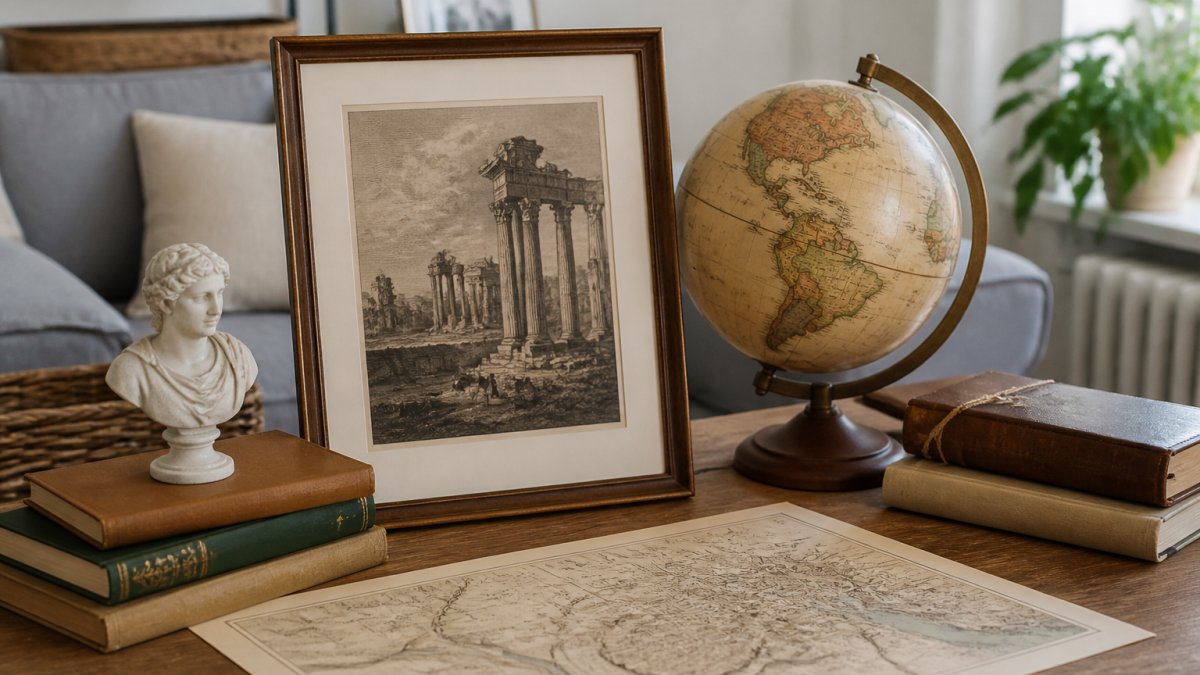
Vintage aviation wall art for home office settings works best when it feels curated rather than themed. One strong piece above a desk beats five prints scattered across every wall.
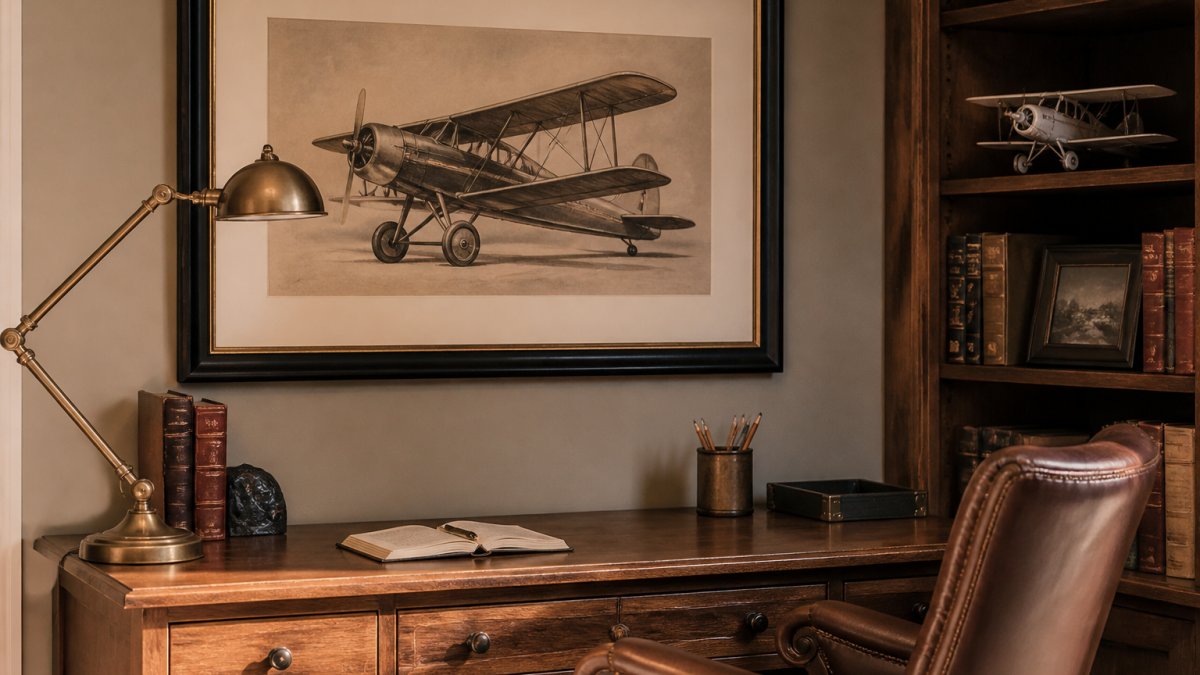
Think about the room's existing palette before ordering. A sepia-toned historic aircraft print suits a wood-and-leather study; a cleaner, more graphic piece fits a modern home office. If your taste leans period-specific, our Art Deco Prints pair well with aviation subjects from the 1920s and 1930s.
Print Formats and Materials: Canvas, Metal, and Paper
Canvas, metal, and paper each solve a different problem, and the right choice depends on where the print will hang, how long you want it to last, and whether you plan to frame it yourself. Most pilots underestimate how much the substrate affects color, glare, and longevity, so treat this as the second-most important decision after the aircraft subject itself.
Here is how the three formats actually compare for a pilot's space:
| Format | Construction | Best For | Watch Out For | Typical Price Band (unframed) |
|---|---|---|---|---|
| Paper (framed or matted) | Archival pigment or giclée on cotton rag or alpha-cellulose paper | Custom framing, tight budgets, fine-art look | Needs glass; fades in direct sun without UV protection | $25-$150 depending on size and edition |
| Canvas | Poly-cotton or cotton canvas stretched over a wooden frame, often gallery-wrapped | Large walls, softer look, rooms without glass | Can sag if poorly stretched; texture softens fine detail | $60-$400 depending on size |
| Metal | Dye-sublimation print on aluminum panel with a gloss, satin, or matte finish | Bright rooms, modern decor, moisture-prone spaces | Gloss finishes reflect light at certain angles; less forgiving of low-resolution source files | $75-$500 depending on size and finish |
Paper. Archival pigment prints on cotton rag or alpha-cellulose paper are the closest thing to a traditional fine-art print. They hold detail well, accept a mat and frame cleanly, and are the easiest format to upgrade later with UV-filtering glass. The trade-off is fragility: paper dents, creases, and fades faster than canvas or metal if it sits in direct sun. If you want a piece that reads as fine art above a desk, paper is usually the right call.
Canvas. Canvas prints are stretched over a wooden frame and often gallery-wrapped, meaning the image continues around the edges so no frame is required. They suit large walls and softer, warmer rooms, and they resist glare better than glossy paper under glass. The trade-off is texture: canvas weave softens fine linework, which matters for detailed aircraft profiles and cockpit scenes. Check that the canvas is stretched on kiln-dried hardwood rather than particle board, cheap stretcher bars are the main cause of sagging over time.
Metal. Dye-sublimation on aluminum produces a sharp, saturated image that resists moisture and glare better than paper or canvas. Metal prints are the best choice for a bright home office, a hangar office, or any wall that catches afternoon sun. Gloss finishes are the most vivid but reflect light at certain angles; satin and matte finishes trade a little punch for fewer reflections.
If longevity matters most, choose archival paper or canvas and frame with UV-filtering glass, or choose metal for rooms where glass is impractical. That single decision, UV protection or metal, is the biggest factor in whether a print still looks sharp a decade from now.
Airplane Wall Art Sizing, Framing, and Placement
Airplane wall art should occupy roughly 60 to 75 percent of the wall width above the furniture it sits over. A print that is too small for the wall looks lost; one that crowds the edges feels heavy.
Framing decisions come down to three practical questions:
- Mat or no mat? A matted print reads as fine art and gives the image breathing room.
- Frame width? Thin frames suit modern rooms; wider frames suit traditional studies.
- Glass type? UV-filtering glass protects against fading in bright rooms.
For placement, group prints by era rather than by size. A wall of WWII aircraft prints tells a coherent story; a random mix of fighters and airliners reads as clutter.
Signed, Limited-Edition, and Collectible Prints
Signed and limited-edition prints hold value because the supply is fixed. An edition number and an artist signature turn a reproduction into a collectible, and provenance matters when you resell or pass a piece down.
Ask three questions before buying collectible prints:
- Is the edition size stated, and is the print numbered?
- Who signed it, and was the signature obtained directly from the artist or aircrew?
- Does the seller document the print's history?
If a listing cannot answer these, treat it as decor rather than an investment. That is not a reason to skip it, just a reason to pay decor prices.
Budgeting for Aviation Art and Avoiding Costly Mistakes
Set your budget by total cost, not by the print price alone. Framing, matting, UV glass, and shipping often add as much as the print itself, and oversized pieces cost more to ship and frame. Price the whole project before you commit.
A simple budget framework, with realistic total-cost ranges:
- Smaller prints: unframed paper prints in small sizes (roughly 11x14 inches or smaller), standard off-the-shelf frames you hang yourself, and domestic economy shipping.
- Mid-range prints: larger paper prints (16x20 to 24x36 inches), basic custom framing or a ready-to-hang canvas, and standard shipping.
- Premium prints: signed or limited-edition paper prints, large canvas or metal pieces, and premium framing with UV glass.
- High-end prints: low-edition-number signed prints, pieces signed by aircrew, oversized canvas or metal, and museum-grade framing.
Three cost drivers most buyers miss:
- Edition size. A print from an edition of 500 costs far less than the same image from an edition of 25. Smaller editions command higher prices because supply is fixed and collectors value scarcity.
- Who signed it. A print signed by the artist is common; one signed by the artist and the aircrew who flew the aircraft is rarer and priced accordingly. Provenance documentation, a certificate, a photo of the signing, a letter from the publisher, adds real value.
- Format and size. Metal and large canvas cost more to produce and ship than paper. Oversized pieces often trigger freight shipping rather than parcel rates.
Three costly mistakes to avoid:
- Buying a print without checking the actual dimensions against your wall. A print that looks generous online can look lost on a 10-foot wall.
- Skipping UV protection in a bright room. Fading is irreversible, and re-framing later costs more than doing it right the first time.
- Assuming "signed" means "valuable" without checking who signed it and how many exist. An open-edition print signed by the artist is decor; a numbered print from a small edition signed by the aircrew is a collectible.
If you are buying as a gift, budget for framing and shipping together and confirm the seller's return policy before ordering, custom-framed pieces are often non-returnable.
Frequently Asked Questions
What are the best aviation art prints for pilots?
The best choice depends on what the pilot flies and loves. A general aviation pilot often connects most with a Piper Cub, Stearman, or Cessna piece, while a history buff may prefer WWII fighters like the P-51 Mustang. Look for accurate aircraft detail, quality paper or canvas, and a clear artist signature. Signed and numbered editions hold more meaning than open-run posters, and a print that matches the pilot's own flying history will always beat a generic aircraft image.
How do I choose the right size aviation print for a wall?
Measure the wall first, then aim for art that fills roughly 60 to 75 percent of the width of the furniture below it, such as a desk or console. A single large print works well over a home office desk, while a grid of three or four smaller airplane wall art pieces suits a longer wall. Leave at least 2 to 3 inches of breathing room between frames. Tape out the dimensions on the wall before ordering to confirm the scale feels right.
What is the difference between aviation art and aircraft posters?
Aviation art prints are typically reproduced from original paintings or illustrations, often in limited or signed editions, on heavier archival paper or canvas. Aircraft posters are usually mass-produced, unsigned, and printed on thinner stock for temporary display. If you want something that feels like a collectible, choose a print with an edition number and artist signature.
How should I frame and display aviation art prints?
Use acid-free mats and UV-filtering glass or acrylic to slow fading, and keep prints out of direct sunlight. A simple black, walnut, or natural wood frame suits most aircraft artwork without competing with the image. Hang the center of the piece at eye level, roughly 57 to 60 inches from the floor. In a home office, placing the print behind the desk keeps it visible during calls and away from glare on your screen.
Finding aviation art that captures a pilot's actual passion takes more than a keyword search. RunwayandHeirloomArt curates prints by era and aircraft so the piece you choose tells a real story, from our Historic Aviation Prints to our Women in Aviation collection. Browse the shop to see current selections, sizing, and shipping details, and pick the print that belongs on your wall.