 ultimate-guide
Why Archival Prints Are Worth the Investment
Table of Contents
- What Makes Archival Prints Different From Standard Prints
- Archival vs Non-Archival Prints: Understanding the Real Difference
- The Investment Case for Archival Quality
- Giclee Print Longevity and Museum-Grade Materials
- Best Practices for Displaying Art Prints
- How to Identify High-Quality Archival Prints
- The True Cost of Archival Prints
- Conclusion
- Frequently Asked Questions
Last Updated: August 23, 2026
What Makes Archival Prints Different From Standard Prints
Archival prints use pigment-based inks and acid-free paper engineered to resist fading for 100 to 200 years. Standard prints use dye-based inks on lignin-containing paper that yellows and deteriorates within 10-20 years. The pigments in archival prints are significantly more stable, and the paper is treated to remove acids and lignin, the culprits behind yellowing and brittleness.
At Runway & Heirloom Art, we understand that collectors want artwork that becomes more meaningful with age. The difference between a $15 poster and a museum-grade archival print isn't just appearance, it's longevity, investment potential, and the story the artwork will tell for generations.
Archival vs Non-Archival Prints: Understanding the Real Difference
Non-archival prints fade, yellow, and become brittle within a decade. Archival prints endure because pigment-based inks are suspended in paper fibers rather than sitting on the surface, making them far more resistant to fading. The acid-free, lignin-free paper won't self-destruct from chemical degradation.
The price difference reflects material costs. Non-archival prints cost less because materials are cheaper and manufacturing is simpler. Archival prints command higher prices because the paper, inks, and production precision cost more. You're paying for materials that will outlast you.
| Characteristic | Non-Archival Prints | Archival Prints |
|---|---|---|
| Ink Type | Dye-based (water-soluble) | Pigment-based (stable) |
| Paper Composition | Contains lignin and acids | Acid-free, lignin-free |
| Expected Lifespan | 10-20 years | 100-200 years |
| Color Stability | Fades within 5-10 years | Resists fading for decades |
| Cost | Lower | Higher |
| Best For | Temporary decoration | Long-term investment |
Both can look identical on day one. The gap widens over time, and that's where the investment argument becomes compelling.
The Investment Case for Archival Quality
The art market has fundamentally shifted. The wall decor market in the United States is expected to grow by USD 12.62 billion, at a CAGR of 8.8% between 2024 and 2029 (dataintelo.com). North America accounted for approximately USD 1.85 billion in art print revenue in 2024.
The sub-$50,000 price bracket now accounts for 85% of total dealer transactions by volume. Younger collectors, particularly Millennials and Gen Z, are driving this shift. They're buying more frequently, in smaller quantities, and with greater intentionality. Archival prints fit perfectly into this landscape, affordable compared to original paintings, yet built to last.
Longevity and Resale Market Mechanics
A print lasting 100 years has fundamentally different economics than one lasting 10. A standard print costing $30 that degrades in a decade costs $3 per year. An archival print costing $75 that lasts 100 years costs $0.75 per year. Over the long arc, archival is cheaper.
The resale market adds another layer. Collectors actively seek archival-quality prints because they hold value. A well-preserved archival print by an established artist can appreciate in secondary markets. A faded standard print has zero resale value.
In 2024, 804,000 art transactions occurred under $5,000, growing 7% year-over-year. Many of these buyers are building collections intentionally, understanding that quality materials matter. As original editions sell out, supply tightens, demand increases, and price follows.
Collector Demand and Market Growth
Millennials and Gen Z high-net-worth individuals are collecting across a wider array of fine art mediums, with Millennials being the most active collectors of prints, photography, and works on paper. These younger collectors prioritize artist admiration (68%) and affordability (65%), with investment potential (45%) following close behind.
Artworks under $50,000 made up 61% of total lots sold at auctions in 2025, a significant increase from the pre-pandemic average of 48% between 2015 and 2019. The market is democratizing. More people are buying art, more are buying prints, and more are choosing archival quality because they understand the value proposition.
Giclee Print Longevity and Museum-Grade Materials
Giclee printing uses inkjet technology to spray microscopic droplets of pigment-based ink onto paper. When done correctly, giclee prints are indistinguishable from original paintings in color accuracy and visual texture. The longevity depends entirely on materials, a giclee print with dye-based inks on standard paper will fade like any other print, but one with pigment-based inks on archival paper becomes museum-grade, lasting centuries.
Museums display archival prints because materials are proven to resist fading and deterioration. That's the standard you should expect.
Pigment-Based Inks and Acid-Free Paper
Pigment-based inks are solid particles suspended in liquid. When the liquid evaporates, pigment particles remain embedded in paper fibers, making them incredibly stable, they don't dissolve in water, don't fade readily under UV light, and don't shift color over time.
Dye-based inks are dissolved in liquid and sit on the paper surface rather than penetrating fibers, making them vulnerable to moisture, light, and oxidation. Dyes also have narrower color gamuts in some ranges.
Acid-free paper is manufactured without lignin, which causes yellowing and brittleness. Archival paper typically has neutral pH or is slightly alkaline, made from cotton fiber or high-quality wood pulp that resists breakdown.
Pigment-based inks combined with acid-free paper create prints lasting generations. The pigments won't fade. The paper won't yellow. Colors remain vibrant.
Lightfastness and UV Resistance
Lightfastness measures how well a pigment resists fading under light exposure. The most lightfast pigments can withstand decades of normal indoor light without visible fading. UV light is particularly damaging, which is why archival prints should be displayed away from direct sunlight or behind UV-protective glass.
Some archival papers are treated with optical brighteners or coatings that reduce UV penetration, extending the print's lifespan further. Hang your archival print on an interior wall away from windows, and it will look vibrant for your entire lifetime and beyond.
Best Practices for Displaying Art Prints
Direct sunlight is the enemy. UV radiation damages pigments and paper. Hang prints on interior walls where they receive only indirect, ambient light. North-facing walls are ideal; avoid south and west-facing walls with unshaded windows.
Humidity and temperature fluctuations accelerate degradation. Keep prints in climate-controlled spaces where temperature and humidity remain stable, ideally 30-50% humidity and 60-75°F temperature.
Use UV-protective glass or acrylic to filter harmful light. Use acid-free matting and backing boards, never standard cardboard. Have valuable prints professionally framed or use archival-quality materials from reputable suppliers.

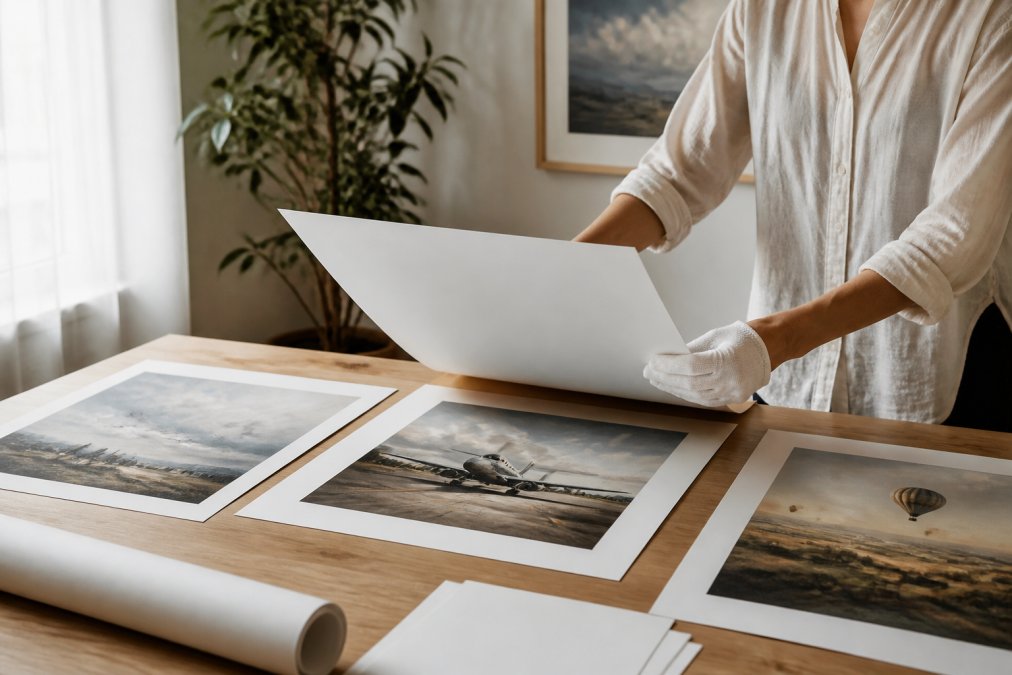
Handle prints carefully. Wear cotton gloves when handling and avoid touching the printed surface. Store prints flat in acid-free sleeves if not displaying them. Never roll a print.
How to Identify High-Quality Archival Prints
Not every print labeled "archival" is actually archival. A reputable seller will tell you exactly what inks were used (pigment-based and which system), the paper by name and weight, and its acid-free status and expected lifespan. If a seller can't provide this information, the print probably isn't truly archival.
Check the paper weight. Archival paper is typically 200+ GSM. Examine the visual texture, high-quality archival prints have subtle texture mimicking original paintings. A completely smooth, glossy surface suggests lower quality. Compare colors to the original artwork; significant differences indicate lower-quality inks or unsuitable paper.
Certificate of Authenticity and Provenance
A certificate of authenticity should include the artist's name, print title, edition number, total edition size, creation date, and printer's signature or seal. It should be printed on archival paper and signed by the artist, publisher, or printer.
Provenance is the documented history of ownership. For established prints, provenance increases value and desirability. A print with a clear chain of ownership from a respected collector or gallery is more valuable than one with unclear history.
Limited Edition vs Open Edition
Limited edition prints are produced in a fixed quantity. Once reached, printing stops. This scarcity creates value. As time passes and original prints are damaged or lost, remaining prints become rarer and more valuable.
Open edition prints have no fixed limit. The artist can print as many as wanted, whenever wanted. This makes them more affordable initially but with less investment potential.
A reputable seller will clearly state whether a print is limited or open edition and, if limited, what the edition number is (e.g., "15 of 250").
The True Cost of Archival Prints
Archival prints cost more than standard prints because pigment-based inks cost 2-3 times more than dye-based inks, and archival paper costs 3-5 times more than standard paper. Professional printing precision and expertise add further costs.
For a single 11x14 print, material cost difference might be $10-20. A 24x36 archival print might cost $150-300 versus $30-50 for standard. But that $30 standard print fades noticeably in 10 years and is worthless in 20. The $200 archival print looks vibrant in 50 years and could appreciate. Per-year cost is actually lower for archival when accounting for longevity.
Pricing varies based on print size, artwork complexity, limited edition status, artist reputation, and printer overhead. At Runway & Heirloom Art, we create archival-quality prints across multiple collections designed to be accessible while maintaining the highest material standards.
For specific pricing on individual prints, visit our collections directly, where you'll find transparent pricing and detailed information about materials and edition sizes.
Conclusion
Archival prints are worth the investment because they combine proven longevity, investment potential, and the assurance that what you buy today will still be beautiful decades from now.
The market data supports this. The art print segment is growing rapidly, younger collectors are prioritizing quality and intentionality, and the sub-$50,000 price bracket now dominates by transaction volume. These are thoughtful purchases by informed collectors who understand materials and value.
When you buy an archival print, you're not just buying decoration. You're buying a piece of art history that will outlast you. At Runway & Heirloom Art, we believe artwork should tell a story and stand the test of time. Whether you're drawn to watercolor nursery art, historic aviation prints, or art-history-inspired pieces, choosing archival-quality materials ensures your collection becomes a genuine heirloom. Explore our curated collections and discover prints that combine distinctive design with the materials and craftsmanship to last for generations.
=== FAQ ANSWERS (audit these too, same rules) ===
[1] Q: How long do archival prints last? A: Archival art prints typically last between 100 and 200 years before any visible fading occurs, depending on the quality of materials used and display conditions. This longevity comes from acid-free paper, pigment-based inks, and UV-resistant coatings that resist deterioration far longer than standard prints. Proper storage and display away from direct sunlight extend their lifespan even further, making them true heirlooms.
[2] Q: What is the difference between a standard print and an archival print? A: Standard prints typically use acid-based paper and dye-based inks that fade within 5-10 years, while archival prints use acid-free paper and pigment-based inks designed to last 100+ years. Archival prints also include UV-resistant coatings and meet museum-grade standards for preservation. The materials cost more, but the investment pays off in longevity and resale value, collectors actively seek out archival-quality prints because they hold their aesthetic and financial value over time.
[3] Q: Do archival art prints hold their value over time? A: Yes. The sub-$50,000 price bracket now accounts for 85% of total dealer transactions by volume, and archival prints within this segment are increasingly recognized as collectible assets. Younger collectors prioritize affordability and quality, with 59% purchasing art online in 2024. Limited-edition archival prints with certificates of authenticity and clear provenance maintain or appreciate in value because demand among informed collectors continues to grow, especially for prints from established artists with cultural significance.
[4] Q: Are giclée prints considered archival? A: Giclée prints can be archival, but only when produced with museum-grade materials: acid-free paper, pigment-based inks, and UV-resistant coatings. Not all giclée prints meet archival standards, the term 'giclée' refers to the printing method, not the materials. When sourcing giclée prints, verify that they use archival-quality materials and request a certificate of authenticity. Giclee print longevity depends entirely on the inks, paper weight, and protective coatings used during production.
Frequently Asked Questions
How long do archival prints last?
Archival art prints typically last between 100 and 200 years before any visible fading occurs, depending on the quality of materials used and display conditions. This longevity comes from acid-free paper, pigment-based inks, and UV-resistant coatings that resist deterioration far longer than standard prints. Proper storage and display away from direct sunlight extend their lifespan even further, making them true heirlooms.
What is the difference between a standard print and an archival print?
Standard prints typically use acid-based paper and dye-based inks that fade within 5-10 years, while archival prints use acid-free paper and pigment-based inks designed to last 100+ years. Archival prints also include UV-resistant coatings and meet museum-grade standards for preservation. The materials cost more, but the investment pays off in longevity and resale value, collectors actively seek out archival-quality prints because they hold their aesthetic and financial value over time.
Do archival art prints hold their value over time?
Yes. The sub-$50,000 price bracket now accounts for 85% of total dealer transactions by volume, and archival prints within this segment are increasingly recognized as collectible assets. Younger collectors prioritize affordability and quality, with 59% purchasing art online in 2024. Limited-edition archival prints with certificates of authenticity and clear provenance maintain or appreciate in value because demand among informed collectors continues to grow, especially for prints from established artists with cultural significance.
Are giclée prints considered archival?
Giclée prints can be archival, but only when produced with museum-grade materials: acid-free paper, pigment-based inks, and UV-resistant coatings. Not all giclée prints meet archival standards, the term 'giclée' refers to the printing method, not the materials. When sourcing giclée prints, verify that they use archival-quality materials and request a certificate of authenticity. Giclee print longevity depends entirely on the inks, paper weight, and protective coatings used during production.
This article was written using GrandRanker