 ultimate-guide
How to Appreciate the Appeal of Vintage Aircraft Illustrations
Last Updated: November 1, 2026
Quick Summary
The appeal of vintage aircraft illustrations is that they make flight feel personal again, returning viewers to a time when an airplane was still a marvel. They satisfy aviation enthusiasts through accurate aircraft and satisfy everyone else through strong silhouettes, shading, and period texture.
- Nostalgic illustrations depict anticipation rather than flight, letting the viewer fill in the story.
- Reading an aviation illustration takes about ten seconds: check aircraft type, rendering style, then era cues.
- The 1930s poster era produced the travel-poster look most people mean by vintage aviation art.
- Hang the center of the image roughly 57 to 60 inches from the floor.
- Use acid-free matting and backing so the paper does not yellow.
Table of Contents
- Why Vintage Aircraft Illustrations Capture Our Imagination
- The Visual Language of Vintage Aircraft Illustrations
- Aviation Illustration History: From 1920s Modernism to Mid-Century Progress
- Vintage Airplane Prints: Bringing the Thrill of Flight Into Your Space
- Vintage Aviation Wall Art: Styling Ideas for Studies, Offices, and Nurseries
- How to Choose, Display, and Care for Vintage Aircraft Art
- Find Your Story in Flight: Exploring Historic Aviation Prints
- Frequently Asked Questions
Why Vintage Aircraft Illustrations Capture Our Imagination
The appeal of vintage aircraft illustrations comes down to one idea: they make flight feel personal again. In an age of cramped seats and security lines, these images return us to a moment when an airplane was still a marvel.
Vintage aircraft illustrations work on two levels: they satisfy the aviation enthusiast who can name the airframe, and they satisfy everyone else through pure composition. Below, we break down the emotional and visual mechanics behind that pull, then show how to choose and hang a piece.
Emotional Pull: Nostalgia and the Romance of the Skies
Nostalgia is the first hook. A vintage airplane illustration rarely depicts a flight; it depicts anticipation. The plane sits on a sunlit apron or climbs through cloud, and the viewer fills in the story.
There is also the adventure factor. Early aviation was genuinely dangerous, and period illustrations carry a trace of that risk without asking the viewer to experience it, for a study or office, that reads as quiet optimism.
Aesthetic Allure: Texture, Shading, and Black-and-White Drama
Composition does the rest. Vintage aircraft illustrations lean on strong silhouettes, because an airplane reads instantly as a shape.
Then comes the rendering. Black-and-white work uses shading to model metal and fabric, and the contrast between a bright sky and a dark wing creates drama without color. Texture, whether from a screen-printed halftone or a hand-inked line, adds age and weight.
The Visual Language of Vintage Aircraft Illustrations
Reading an aviation illustration is a skill, and it takes about ten seconds to learn. Look at the aircraft type first, then the rendering style, then the era cues. A vintage aircraft illustration is a drawn or printed depiction of an aircraft that uses the visual conventions of its period to place the subject in a specific moment in aviation history.
A Three-Pass Method for Reading Any Aviation Illustration
Start with the silhouette. An airplane reads instantly as a shape, so the outline tells you the aircraft family before any detail does.
Then read the rendering. Line weight, shading, and color palette are the illustrator's fingerprints. Heavy black outlines and flat fills suggest commercial or poster work.
Finally, read the era cues. Registration markings, airline liveries, propeller style, and even caption typefaces all date an illustration.
The Four Main Illustration Styles and Their Visual Signatures
Technical and line illustration. Precise outlines, minimal shading, and blueprint-like restraint.
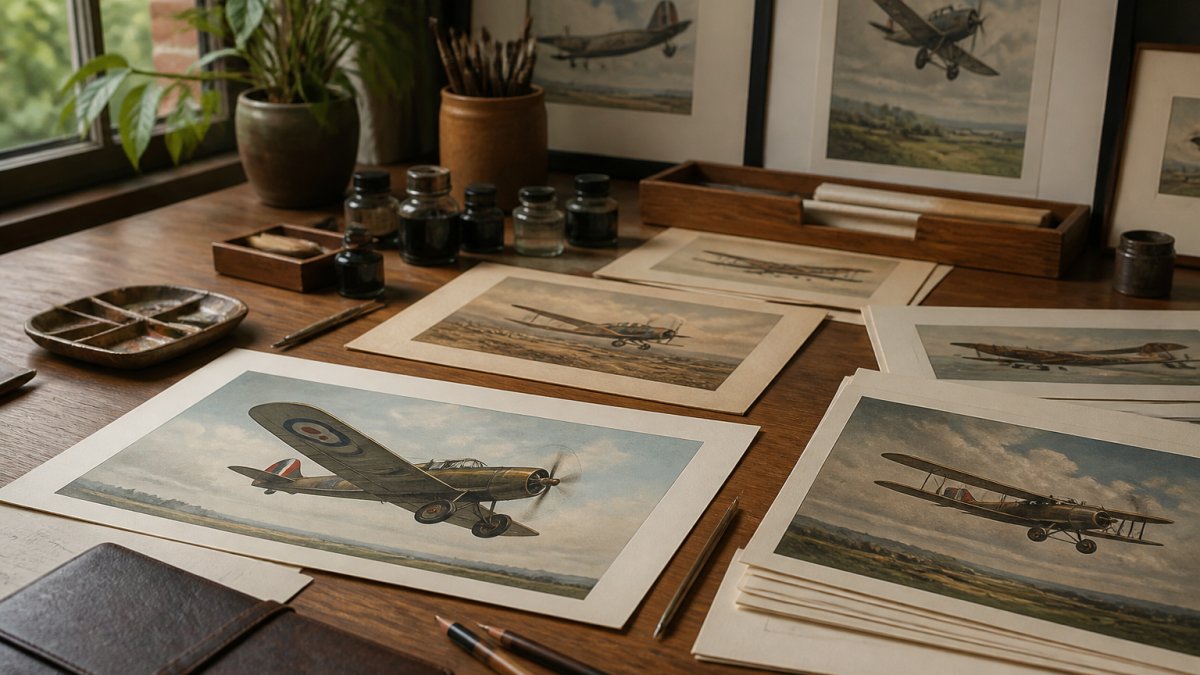
Painterly realism. Soft gradients, visible brushwork, and atmospheric skies. Common in travel posters and magazine covers, where the goal was to make flight feel glamorous.
Mid-century graphic. Flat color blocks, bold geometry, and heavy modernist influence.
Halftone and screen-print. Visible dot patterns and slightly misregistered colors give the image a printed, period texture.
A common mistake is assuming all vintage aviation art is sepia.
Why This Matters for Buyers and Collectors
Style recognition is not academic. It tells you whether a print will read as authentic in a period room or as a modern graphic in a contemporary one. It also protects you: a seller who cannot explain the illustration style and its era cannot document the piece. For a deeper look, our guide to 10 famous aviation artists to follow picks up where this method ends.
Aviation Illustration History: From 1920s Modernism to Mid-Century Progress
Aviation illustration history tracks the technology it depicted, but it also tracks what the public believed about that technology.
The 1920s: Modernism Meets the Machine
In the 1920s, artists absorbed modernist ideas: clean lines, geometric order, and a belief that machines could be beautiful. Aircraft were the perfect subject. Biplanes such as the de Havilland DH-4 and the Curtiss JN-4 were familiar from wartime service, and illustrators treated them as symbols of a machine age.
This was also the barnstorming era, when pilots flew war-surplus aircraft from town to town. Illustrations from the period often carry that dual identity: the aircraft is a marvel and a workhorse at once.
The 1930s: The Poster Becomes the Medium
By the 1930s, the poster had become the medium. Airlines and aircraft makers commissioned artists to make flight look glamorous, blending adventure with design.
The decade's signature is the sunlit apron and the dramatic cloud bank. Artists used strong diagonals to suggest motion and warm light to suggest possibility. This is the era that produced the travel-poster look most people mean when they say "vintage aviation art."
The 1940s: Documentation and Morale
The Second World War pushed illustration toward documentation and morale. Recognition guides, training manuals, and nose-art traditions expanded the visual vocabulary. Aircraft such as the Boeing B-17 and the North American P-51 became subjects of both technical illustration and patriotic poster work.
Visual conventions shifted toward clarity and function. Line illustration became more precise, and color coded information rather than evoking mood.
The 1950s: Progress as a Consumer Product
The postwar boom turned illustration back toward consumer optimism. Through the 1950s, airplane artwork sold progress: faster, farther, more connected.
The decade's signature is flat color and confident scale. Aircraft were shown large and clean, often against simplified skies, with a palette of saturated blues, reds, and creams. This is the mid-century graphic style many contemporary interiors are designed to accommodate.
The 1960s and Beyond: The Jet Age Turns Graphic
Jet-age imagery pushed further into graphic abstraction. Swept wings and podded engines became the shorthand for modernity, and illustrators leaned on bold shapes rather than atmospheric rendering. Flight was no longer a marvel but a routine, and the illustrations began to reflect speed and system rather than adventure and risk.
The Smithsonian National Air and Space Museum's collection of aviation art documents how closely this imagery followed real aircraft development. If the history pulls you in, our guide to 10 famous aviation artists to follow picks up where the timeline ends.
Vintage Airplane Prints: Bringing the Thrill of Flight Into Your Space
A print is the practical form this art takes in a home. Vintage airplane prints let you own the look of a period illustration without hunting down an original, and the best ones preserve the texture and shading that made the source image work.
Think about where the piece will live before you choose the subject. For ideas, our guide to styling vintage aviation art in modern homes walks through room-by-room options.
Vintage Aviation Wall Art: Styling Ideas for Studies, Offices, and Nurseries
Hanging aviation art well is mostly about scale and grouping. A single large print needs breathing room; a cluster of three or four smaller pieces needs consistent spacing and a shared visual thread.
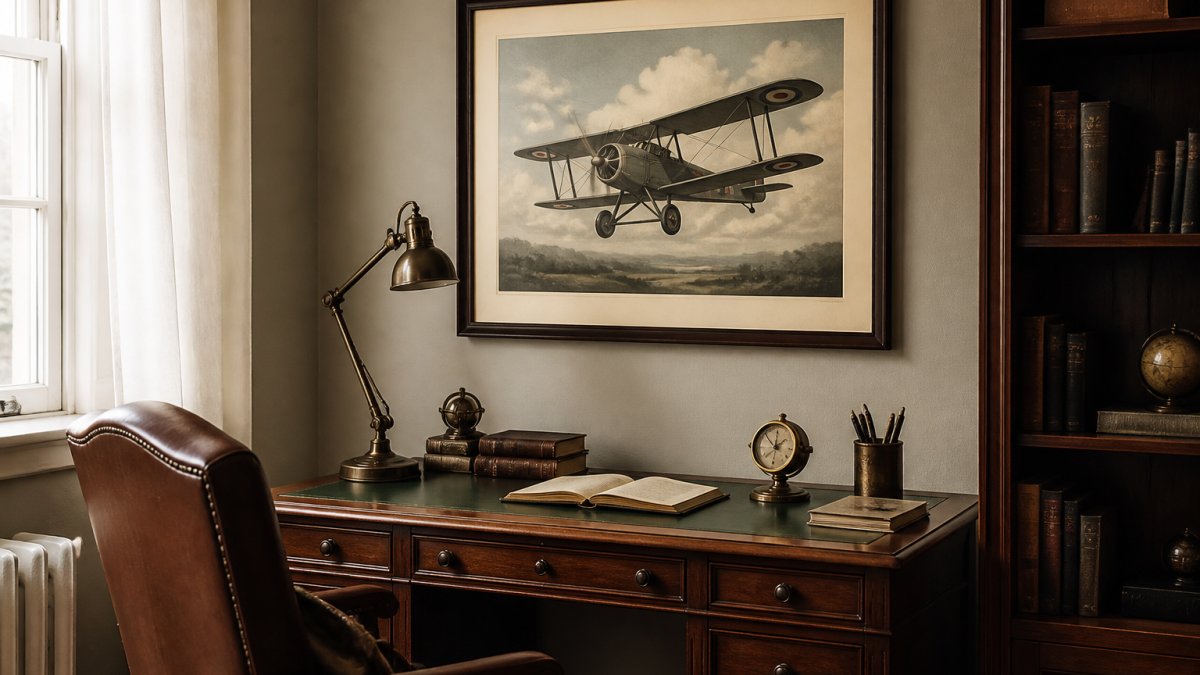
A few placements that work:
- Home office: one large print behind the desk, hung at eye level when seated
- Study or library: a grid of four smaller prints, matched frames, tight spacing
- Nursery: a single soft-toned aircraft print above the crib, well out of reach
For the full method, see our guide on how to style aviation art prints, and if the room in question is a workspace, the vintage aviation wall art home office guide covers layout and lighting in detail.
How to Choose, Display, and Care for Vintage Aircraft Art
Choosing well comes down to three checks: subject accuracy, print quality, and framing. Verify that the aircraft depicted matches the era the style suggests, since a mismatched combination is the fastest way to make a piece feel off. Ask how the print was produced and on what paper. Then frame it properly.
Display rules that hold up:
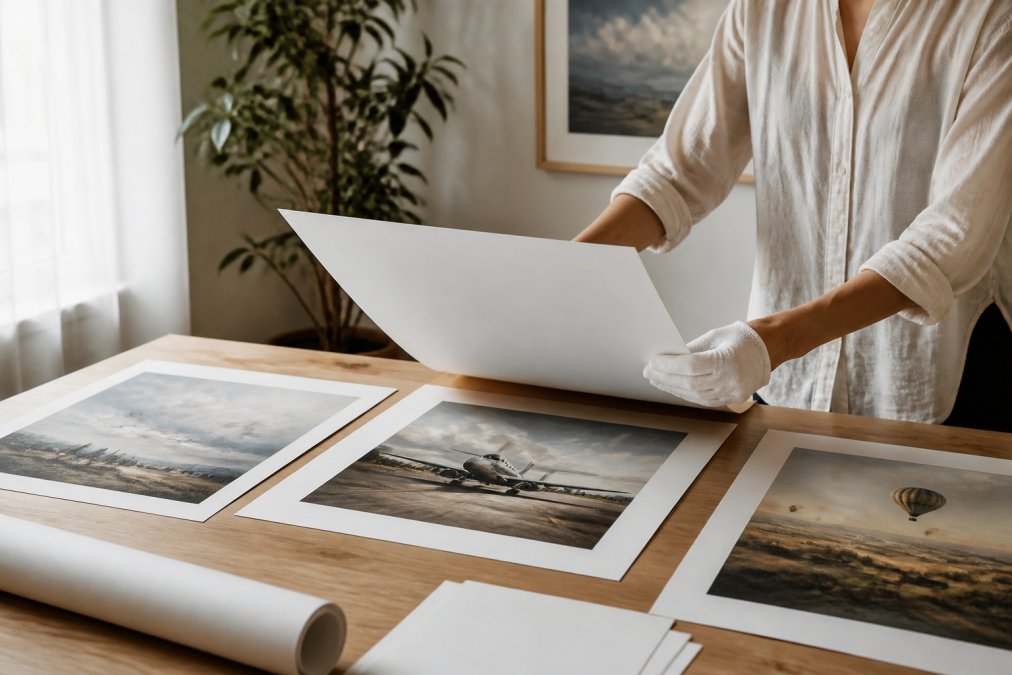
- Hang the center of the image at eye level, roughly 57 to 60 inches from the floor.
- Keep prints out of direct sunlight; UV exposure fades inks over time.
- Use acid-free matting and backing so the paper does not yellow.
- Leave at least two inches of wall between frames in a cluster.
- Dust with a dry, soft cloth rather than a damp one.
Authenticity, Copyright, and Reproduction Considerations
Copyright is the part most buyers skip, and it matters. Our breakdown of whether limited edition aviation prints are worth it explains how editions work and what to check before buying.
Watch out: buying an "original" without documentation is the most common way collectors overpay. If a seller cannot explain the print method and the source, treat it as decor, not an investment.
| Decision | What to check | Why it matters |
|---|---|---|
| Aircraft type | Matches the era of the style | Prevents an anachronistic mismatch |
| Print method | Stated by the seller | Signals reproduction quality |
| Paper and ink | Archival, acid-free | Determines how long it lasts |
| Edition terms | Run size, signature, certificate | Separates collectible from decor |
| Framing | UV glass, acid-free mat | Protects against fading and yellowing |
Find Your Story in Flight: Exploring Historic Aviation Prints
The appeal of vintage aircraft illustrations is finally about story. A propeller plane on a wall is a small act of remembering: an era when flight was new, and the people who made it happen. Choosing a piece is choosing which chapter of that story you want in the room.
At Runway & Heirloom, our historic aviation prints and women in aviation collection offer pieces for studies, offices, and children's rooms.
Frequently Asked Questions
Why are people drawn to vintage aircraft illustrations?
People are drawn to vintage aircraft illustrations for a mix of nostalgia, historical curiosity, and visual charm. The romance of the skies and the thrill of flight from early aviation eras evoke a sense of adventure. The illustration styles, with their careful shading, texture, and often black-and-white drama, also offer a timeless aesthetic that feels both decorative and meaningful. These prints let enthusiasts and decorators connect with aviation history in a personal, artistic way.
What makes vintage aviation art different from modern aviation art?
Vintage aviation art typically reflects the illustration techniques and design sensibilities of the 1920s through the 1950s, including hand-drawn linework, shading, and a focus on propeller-driven aircraft like biplanes. Modern aviation art often uses digital tools, vector art, and contemporary subjects such as jets. The vintage style carries a stronger sense of nostalgia and historical context, while modern pieces may emphasize sleekness or technical precision. The appeal of vintage aircraft illustrations lies in that handcrafted, story-rich quality.
How can vintage airplane prints add character to a home office?
Vintage airplane prints add character to a home office by introducing a storytelling element that reflects personal interests and a sense of adventure. A framed print of a classic biplane or passenger aircraft can serve as a focal point above a desk or on a gallery wall, bringing warmth and history into the workspace. The black-and-white or sepia tones often complement various decor styles, from industrial to traditional, making the space feel curated and unique.
Are vintage aircraft illustrations historically accurate?
Many vintage aircraft illustrations are based on real aircraft and eras, but accuracy varies by artist and purpose. Some illustrations were created for advertising or editorial use and may take creative liberties with proportions or details. Others are carefully researched. When choosing vintage aircraft illustrations, look for details like the correct number of propeller blades, wing shape, and markings. For historically significant artwork, seek prints that note the aircraft type and era, and consider the source's reputation for authenticity.
The hard part is not finding aviation art; it is finding art that says something about you. Runway & Heirloom curates prints across aviation, art history, and childhood nostalgia, so a single collection can hold a lifelong passion and a nursery wall alike. Browse the historic aviation prints to see the range, then start with one piece that means something and build from there.