 how-to
How Do You Niche Aviation Art Without Losing Your Passion?
Last Updated: October 25, 2026
Quick Summary
Narrowing your aviation art niche means inventorying the aircraft and eras you love, scoring each candidate on demand, competition, and your edge, then validating with a small low-cost test before building a full collection. Commit to the narrowest version that still sells and write a one-sentence positioning statement naming the subject, era, and buyer.
- Score candidate niches on demand signals, competition, and your own access to reference material.
- Build a starter set of three to five pieces that share era, palette, and story.
- Track interest, conversion, repeat buyers, and best-performing subjects monthly, then review quarterly.
- Limit a single wall to three to five pieces with at least a hand's width between frames.
- Keep a log of references, licenses, and accuracy notes for every piece you print.
Table of Contents
- Why a Narrow Aviation Art Niche Beats a Broad One
- A Step-by-Step Method for Picking Your Aviation Art Niche
- Start With the Aircraft and Eras You Already Love
- Score Each Candidate Niche Before You Commit
- Validate Demand With a Small, Low-Cost Test
- Position the Niche So It Cannot Be Confused With a Generalist
- Measure Whether the Niche Is Working
- Name Your Niche in One Clear Sentence
- Build a Small Starter Set Around It
- Aviation Art Collecting Tips for Building a Cohesive Set
- Aviation Art Collection Ideas That Tell a Story
- Vintage Aviation Wall Art for Home Office Spaces
- How to Style Aviation Wall Art Without Clutter
- Rights, Accuracy, and the Details That Build Trust
- Choosing Your First Historic Aviation Print
- Frequently Asked Questions
Why a Narrow Aviation Art Niche Beats a Broad One
Narrowing your aviation art niche is the fastest way to stand out in a crowded market, because a focused collection gives buyers a clear reason to choose you over a generalist.
A narrow niche does three things at once:
- It makes your work instantly recognizable.
- It attracts buyers who already care about that era or aircraft.
- It gives you a story to tell in every listing.
The Smithsonian National Air and Space Museum's exhibition on art and flight shows how deeply flight captures the imagination. That same pull is what a sharp niche taps into.
A Step-by-Step Method for Picking Your Aviation Art Niche
Picking your aviation art niche comes down to a repeatable process: inventory what you love, validate it against real buyer behavior, position it so it cannot be confused with a generalist shop, then commit to the narrowest version that still sells. Follow these steps in order to avoid going too broad or chasing a theme you do not care about.
- Inventory the aircraft, eras, and stories you genuinely love.
- Score each candidate niche on demand, competition, and your own access to reference material.
- Validate demand with a small, low-cost test before you build a full collection.
- Write a one-sentence positioning statement that names the subject, the era, and the buyer.
- Build a starter set of three to five pieces around that statement.
- Set a simple scorecard so you can measure whether the niche is working.
Start With the Aircraft and Eras You Already Love
Start with what you already know and enjoy, because passion keeps a niche alive over years. Write down the aircraft types that draw you in: helicopters, seaplanes, biplanes, jets. Then note the eras and stories behind them.
A useful filter at this stage is reference access. Without clear, citable photographs, manuals, or museum records, you will struggle to get markings and proportions right later.
Score Each Candidate Niche Before You Commit
Score every candidate on a simple three-column sheet so you are comparing like with like instead of guessing:
- Demand signals: search interest, saved pins, questions in aviation forums, and how often the subject appears in museum exhibitions and airshow programs.
- Competition: how many established artists already own that exact subject, and whether their work is generic or deeply specific.
- Your edge: access to reference material, personal connection to the aircraft or era, and whether you can tell a story competitors cannot.
A common pattern is to favor a niche with moderate demand and low specific competition over a high-demand niche crowded with generalists. A narrow subject with a clear buyer beats a broad subject with no clear buyer.
Validate Demand With a Small, Low-Cost Test
Test demand before you invest in a full collection, because a niche only works if buyers are actually searching for it. Run a small test:
- Publish three to five pieces or mockups in the niche and watch which ones get saved, shared, and asked about.
- List one or two pieces on a marketplace or your own storefront and track views versus inquiries.
- Ask a focused question in aviation communities and note which subjects draw real replies rather than polite likes.
If a theme draws steady interest and questions, build on it. If it stays quiet after a fair test, narrow it further or shift. Spend little before you spend a lot.
Position the Niche So It Cannot Be Confused With a Generalist
Positioning is where most aviation artists stall. A positioning statement should name the subject, the era, and the buyer in one sentence.
Differentiation usually comes from one of four levers: a distinctive subject, a specific era, a recognizable style, or a story tied to people and missions. Pick one primary lever and let the others support it. Trying to lead with all four at once blurs the niche back into a generalist shop.
Measure Whether the Niche Is Working
Set a simple scorecard before you build out the collection so you can tell whether the niche deserves more investment. Track four things monthly: interest (views, saves, inquiries), conversion, repeat buyers, and which subjects perform best. High interest with low conversion points to presentation or pricing; strong repeat buyers mean room to expand. Review quarterly and prune subjects that consistently underperform.
Name Your Niche in One Clear Sentence
Once the test and scorecard point in one direction, write the niche down in a single sentence and use it as a filter for every future piece. If a new print idea does not fit, it belongs in a separate collection. That discipline keeps a focused shop recognizable.
Build a Small Starter Set Around It
Build three to five pieces that share the era, palette, and story implied by your positioning statement. A small, coherent starter set reads as intentional and gives buyers a clear entry point. Add pieces over time only when the scorecard shows the niche is pulling its weight.
Aviation Art Collecting Tips for Building a Cohesive Set
Building a cohesive set of aviation art starts with one rule: every piece should feel like it belongs to the same story. Choose a shared era, color family, or aircraft type, then let each print add a new chapter. A cohesive set reads as intentional, and that is what turns a wall into a collection.
A few tips that make a real difference:
- Pick one era or aircraft family as your spine.
- Repeat a color palette across pieces.
- Mix sizes but keep a consistent frame style.
Aviation Art Collection Ideas That Tell a Story
The best aviation art collection ideas share a single thread, whether that is a famous flight path, a decade of design, or the people who flew. Choose a narrative first, then let each print play a role in it. This guide to art prints that tell a meaningful story expands on choosing pieces with meaning.
Try one of these angles:
- Trace a single aircraft from early design to final flight.
- Follow one era across jets, props, and seaplanes.
- Build around the people, including women in aviation.
Vintage Aviation Wall Art for Home Office Spaces
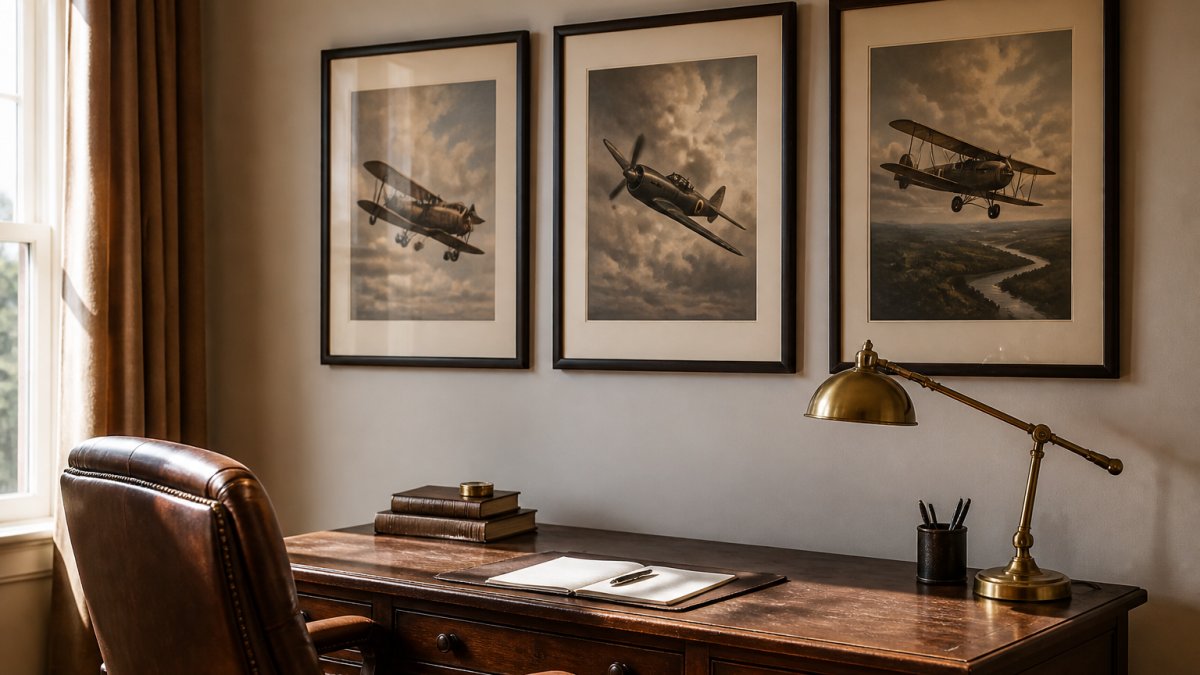
Vintage aviation wall art for a home office works best when it anchors the room without overwhelming it. Hang a small group of framed prints above the desk, keep the frames consistent, and let warm lighting bring out the tones.
How to Style Aviation Wall Art Without Clutter
Styling aviation wall art without clutter comes down to spacing and restraint: fewer pieces, more breathing room, and a clear focal point. For the full method, read the complete guide to styling aviation art prints. Crowding a wall with every print you own kills the impact. Instead, treat each piece as if it has to earn its spot.
Use these rules:
- Limit a single wall to three to five pieces.
- Keep at least a hand's width between frames.
- Match frame finishes across the group.
Rights, Accuracy, and the Details That Build Trust
Accuracy and rights are the quiet foundation of a trusted aviation art collection. When a print claims to show a specific aircraft, the markings, proportions, and era should be right; that is what separates a serious piece from a decorative one. The practical work happens in three areas: reference research, permissions, and a written accuracy check.
Build a Reference File Before You Paint
A reference file is the single habit that separates accurate aviation art from decorative guesswork. For each aircraft, collect:
- Clear photographs from multiple angles, ideally from public museum collections or official archives.
- Manufacturer or unit records that confirm markings, serial numbers, and paint schemes for the specific era.
- Notes on variant differences, because many aircraft types changed noticeably between production blocks.
Public institutions such as the Smithsonian National Air and Space Museum and the Library of Congress maintain searchable collections useful for cross-checking details. Treat any single source as a starting point, not a final answer, and note where sources disagree.
Understand the Rights Around Reference Images
Rights are where well-meaning artists get into trouble. A photograph you find online is not automatically free to copy, even of a historic aircraft. In the United States, copyright generally protects original photographs, and a work derived too closely from one can create risk. Habits that reduce that risk:
- Prefer public-domain or openly licensed reference images, and keep a record of the license for each one.
- Use multiple references and your own interpretation rather than tracing a single photograph.
- Get written permission when you want to work closely from a specific photographer's image.
Fact-Check Markings, Proportions, and Era Details
A simple accuracy check before a piece goes to print catches most errors:
- Confirm the variant against the reference file, including tail shape, canopy, and engine configuration.
- Check markings against unit records for the specific year depicted.
- Verify proportions against a known dimension rather than eyeballing.
A common mistake is treating historical details as an afterthought. Buyers notice, and they also notice when an artist respects permissions and credits sources. That care builds trust, and trust brings collectors back.
Credit Sources and Keep Records
Keep a simple log for every piece: the references used, the license or permission for each, and the accuracy notes. That log protects you if a question arises and gives buyers a reason to trust the description. When a source requires attribution, include it in the listing. Transparency is itself a differentiator, because few generalist shops bother.
Choosing Your First Historic Aviation Print
Your first historic aviation print should match your space, your budget, and the story you want to tell.
| Step | What to Do | Why It Matters |
|---|---|---|
| 1 | Pick one era or aircraft | Keeps the choice focused |
| 2 | Confirm historical accuracy | Builds long-term trust |
| 3 | Match size to your wall | Avoids a cramped look |
| 4 | Choose a consistent frame | Ties the set together |
| 5 | Add pieces over time | Grows a real collection |
Narrowing your aviation art niche takes patience, but the payoff is a collection with a clear identity and buyers who trust it. At RunwayandHeirloomArt, we built our historic aviation prints and women in aviation collections around exactly that idea: focused themes, accurate details, and pieces that tell a story.
Frequently Asked Questions
What is aviation art, and what counts as a niche within it?
Aviation art is artwork that depicts aircraft, flight, and aerospace subjects, from biplanes and seaplanes to jets and helicopters. A niche is a narrower slice of that field, such as Women in Aviation, a single era like the 1930s, or a specific aircraft type. Choosing a niche means your collection or studio has a clear identity instead of trying to cover every aircraft ever built.
How do I choose aviation art for a home office?
Start with the wall you actually look at and measure it before buying anything. Pick one anchor piece, then build two or three smaller prints around it in the same era or color family. Vintage aviation wall art for home office walls works best when frames match and the subject matter connects, so the wall reads as one collection rather than a scatter of unrelated prints.
How can I build a cohesive aviation art collection over time?
Pick a theme first, such as a single aircraft family, a decade, or a group like Women in Aviation, then buy only pieces that fit it. Keep a simple catalog of what you own, including artist, subject, and size, so you avoid duplicates. Adding one strong piece a year beats buying five random prints, and it keeps the collection focused as it grows.
What should I check before buying a historic aviation print?
Confirm the aircraft details are accurate, including markings, model, and era, because enthusiasts notice errors quickly. Check whether the seller holds the rights to reproduce the artwork.