 ultimate-guide
The Benefit of Storytelling Through Home Art
Table of Contents
- Why Home Art Tells a Story, Not Just a Color Scheme
- The Psychological Benefits of Viewing Art Daily
- How to Style Art Prints in a Home Without Losing the Narrative
- Curating Art for Emotional Connection: A Practical Framework
- Unique Art Prints for Living Room Spaces That Start Conversations
- Storytelling Through Art for Kids: Building Visual Literacy Early
- The Emotional Value of Home Art: Why It Lasts
- Frequently Asked Questions
Last Updated: September 30, 2026
Why Home Art Tells a Story, Not Just a Color Scheme
The benefit of storytelling through home art is that it turns a room into a narrative: it connects the people who live there to memory, identity, and feeling, not just to a palette. According to Fortune Business Insights' 2026 wall art market analysis, the global wall art market is estimated at $66.89 billion in 2025 and is projected to reach $70.94 billion in 2026. That spending reflects something deeper than decoration. At RunwayandHeirloomArt, we see it in what buyers ask for: pieces that recall a place, a passion, or a person.
Home art is any artwork selected and displayed in a living space to shape its atmosphere and meaning. A color scheme coordinates a room. A story gives it a reason to exist.
Below, we break down how storytelling through home art works in practice, from the psychology of daily viewing to a curation framework you can use this weekend.
The Psychological Benefits of Viewing Art Daily
Viewing art daily supports psychological well-being by giving the brain a repeated, low-effort moment of aesthetic experience. The payoff is measurable. Research from University of Arizona Health Sciences found that 45 minutes of art-making significantly reduces cortisol, the body's primary stress hormone. Viewing works differently than making, but the principle holds: regular exposure to imagery you chose deliberately keeps a room emotionally active rather than neutral.
A 2026 study on wall art habits found that 86% of people who displayed art in every room reported higher satisfaction with their home's overall state than those who limited art to a few rooms (Inprint Designs wall art statistics, 2026).
How to Style Art Prints in a Home Without Losing the Narrative
Styling art prints without losing the narrative comes down to one rule: arrange by story, not by symmetry. Group pieces that share a subject, era, or feeling, then let size and frame follow. The mechanics below turn that rule into a gallery wall that reads as one composition instead of a scattered collection.
Start with a spine. Choose one anchor piece per room, then build outward with two to four supporting prints that share a thematic thread. A study anchored by historic aviation artwork might pair with a vintage train print and a classic car piece, all speaking the same language of motion and machinery.
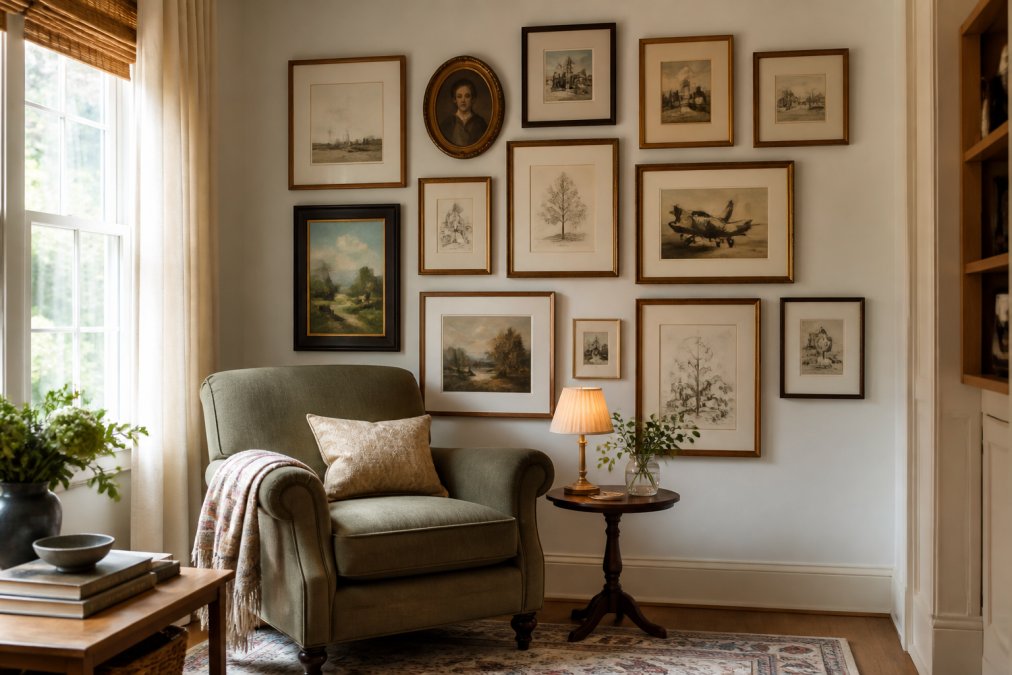
Pick a layout that matches the story's shape. Three layouts cover most rooms, and each one implies a different narrative:
- Salon grid, a tight, edge-aligned block of six to twelve pieces. Reads as a single curated collection and suits a dense, maximalist story (a family's travel history, a single artist's body of work).
- Linear row, three to five prints hung on one horizontal line. Reads as a sequence, which suits a chronological story (a child's growth, a career, a move across states).
- Organic cluster, pieces of mixed sizes arranged around a center point. Reads as a constellation and suits an associative story where the thread is a mood rather than a timeline.
Set spacing and height by the numbers. Keep 2 to 3 inches between frames so the grouping reads as one composition rather than scattered objects. Hang the center of the arrangement at 57 to 60 inches from the floor, the standard museum eye level and the height most adults scan a wall from. For a salon grid, align outer edges to a single invisible rectangle; for an organic cluster, keep the gaps roughly equal even when the frames are not.
Build the wall in layers, not in one shopping trip. A common pattern among collectors is to start with the anchor, live with it for a few weeks, then add one supporting piece at a time as a related print surfaces. This slow-build approach prevents the most frequent failure mode: buying a full set at once and ending up with a wall that feels like a store display rather than a story.
Let empty space carry weight. A common mistake is filling every wall. Empty space is part of the story; it gives the eye somewhere to rest and makes the pieces that are present feel intentional rather than crowded.
Match the frame to the narrative, not the sofa. A uniform frame style across a gallery wall signals that the pieces belong to one story. Mixed frames can work, but only when the variation itself is the point, for example, original vintage frames on antique prints alongside modern frames on contemporary pieces. Choosing frames purely to coordinate with upholstery is the fastest way to make a storytelling wall read as decoration.
Curating Art for Emotional Connection: A Practical Framework
Curating art for emotional connection means selecting pieces against a clear personal criterion, not a trend. Use this four-step framework:
- Name the feeling. Decide what the room should evoke: calm, curiosity, nostalgia, ambition.
- Match the medium. Watercolor suits softness and memory; oil painting prints carry weight and drama; art deco prints signal structure and glamour.
- Test the scale. Measure the wall, then choose a piece that occupies roughly two-thirds to three-quarters of the intended display width.
- Check thematic consistency. Every piece should share a subject, era, or mood with at least one other piece in the room.
| Step | What You Decide | Time Needed | Common Mistake |
|---|---|---|---|
| Name the feeling | Room's emotional goal | 10 minutes | Skipping straight to color |
| Match the medium | Print style and texture | 15 minutes | Mixing five unrelated styles |
| Test the scale | Print size for the wall | 20 minutes | Buying too small for large walls |
| Check consistency | Shared thread across pieces | 10 minutes | Isolating one print with no partner |
Unique Art Prints for Living Room Spaces That Start Conversations
Unique art prints for living room spaces work best when they invite a question. A conversation piece is specific: a Women in Aviation portrait, a rail line that no longer runs, a building that means something to your family.
The living room carries the most social weight of any room, so it rewards art with a clear point of view. Choose one piece that anchors the room's identity and let the rest support it. If you collect across interests, group by room rather than by theme: aviation in the study, watercolor nursery art in the child's room, art deco prints in the entry.
Storytelling Through Art for Kids: Building Visual Literacy Early
Storytelling through art for kids builds visual literacy, the ability to read meaning from images. Research published in ScienceDirect on oral storytelling in the home shows that storytelling practices within the home help children negotiate their personal identity and strengthen family identity. Art does the same work visually.
A 2025 study in Nature Scientific Reports on creative storytelling programs found that expressive art-based storytelling reduced behavioral and psychological symptoms in older adults, evidence that narrative art supports emotional processing across the lifespan.
For a child's room, choose images with a clear narrative arc: a train leaving a station, a plane mid-climb, an animal mid-journey. Then talk about them.
The Emotional Value of Home Art: Why It Lasts
A 2026 public opinion poll from Americans for the Arts found that 86% of people believe arts and culture improve their community's quality of life, a sentiment that carries directly into the home. That belief only holds up when the art stays present enough to be noticed, which is what rotation, proper storage, and deliberate re-hanging are for.
Frequently Asked Questions
What is storytelling through art?
Storytelling through art means choosing pieces that carry meaning beyond decoration. A print might recall a childhood road trip, honor a family member's service, or introduce a child to a favorite animal. The art becomes a visual narrative you live with daily. Research from ScienceDirect (2020) shows that even everyday storytelling practices at home strengthen family identity and help children negotiate their sense of self.
How does art in the home influence mood and well-being?
Art in the home affects mood through daily visual engagement. A 2026 InPrint Designs study found that 86% of people who displayed art in every room reported higher satisfaction with their home compared to those with limited displays. Separately, University of Arizona Health Sciences research found that 45 minutes of art-making significantly reduced cortisol levels. Viewing meaningful art daily reinforces a sense of sanctuary and psychological well-being.
Why do people choose art that reflects their personal history?
Personal history gives art authenticity and emotional resonance. A 2025 Harper's Bazaar trend report noted that consumers increasingly select art connected to their lived experiences, treating walls as a canvas for personal history. This shift moves collecting away from investment motives toward a lifestyle-oriented practice where art serves as a medium for identity and storytelling, according to Women in Arts Network (2026).
How do you start building a collection that tells a story?
Start with one anchor piece that holds genuine meaning, then build outward. Choose a theme, era, or feeling and let each new print connect to it. Mix sizes and mediums to create visual rhythm. A 2026 public opinion poll from Americans for the Arts found that 86% of Americans believe arts and culture improve community quality of life, a sentiment that applies to personal spaces too. Let your collection grow gradually rather than all at once.