 how-to
How to Add Character to a Study With Vintage Aviation Art
Last Updated: October 30, 2026
Quick Summary
Vintage aviation art adds character to a study because it carries history, memory, and human story into a room built for focus. A vintage airplane poster gives the eye something to land on and the mind something to return to, unlike a generic abstract print that merely fills wall space.
- Vintage aviation art depicts aircraft, flight, and aircrew from the golden age through the mid-twentieth century.
- Hang the center of your main piece about 57 to 60 inches from the floor.
- Treat the anchor piece as roughly one-third to one-half the width of its wall.
- Use 2 to 3 inches between frames in a tight grid and 3 to 4 inches in salon-style clusters.
- Use UV-filtering glass or acrylic and keep prints away from strong afternoon sunlight.
Table of Contents
- Why Vintage Aviation Art Adds Character to a Study
- How to Style Aviation Wall Art for a Cohesive Study
- Aviation Gallery Wall Ideas That Tell a Story
- Vintage Airplane Posters and the Era They Capture
- Choosing Aviation Prints for Office and Study Spaces
- Framing, Lighting, and Preserving Your Prints
- Browse Historic Aviation Prints for Your Study
- Frequently Asked Questions
Why Vintage Aviation Art Adds Character to a Study
A study should feel like a room with a point of view. Vintage aviation art gives it one fast.
Here is the short answer. Vintage aviation art adds character to a study because it carries history, memory, and human story into a room built for focus.
That difference matters more than most people expect. A study is where you read, plan, and work through hard problems.
Below, we'll show you exactly how to choose, arrange, and care for aviation artwork so the result looks deliberate, not cluttered. For a deeper walkthrough, see this complete guide to styling aviation art prints.
The Nostalgia and Heritage Factor
Nostalgia is the engine behind most aviation art collecting. The aircraft themselves are gone or grounded, but the imagery keeps the era alive.
Vintage aviation art is artwork that depicts aircraft, flight, and aircrew from the golden age of aviation through the mid-twentieth century. It includes posters, illustrations, and portraiture.
That heritage angle is why these prints feel different from decorative art. They connect a room to a real moment in time.
Storytelling Beyond Decoration
Most wall art decorates. Aviation art narrates.
A single bomber print can carry a crew story, a mission, a hometown name painted on a fuselage. Group several and the wall becomes a visual narrative about flight itself. This is the part most guides miss: the character comes from the story, not the frame.
That is also why collectors keep coming back. Each piece adds a chapter.
How to Style Aviation Wall Art for a Cohesive Study
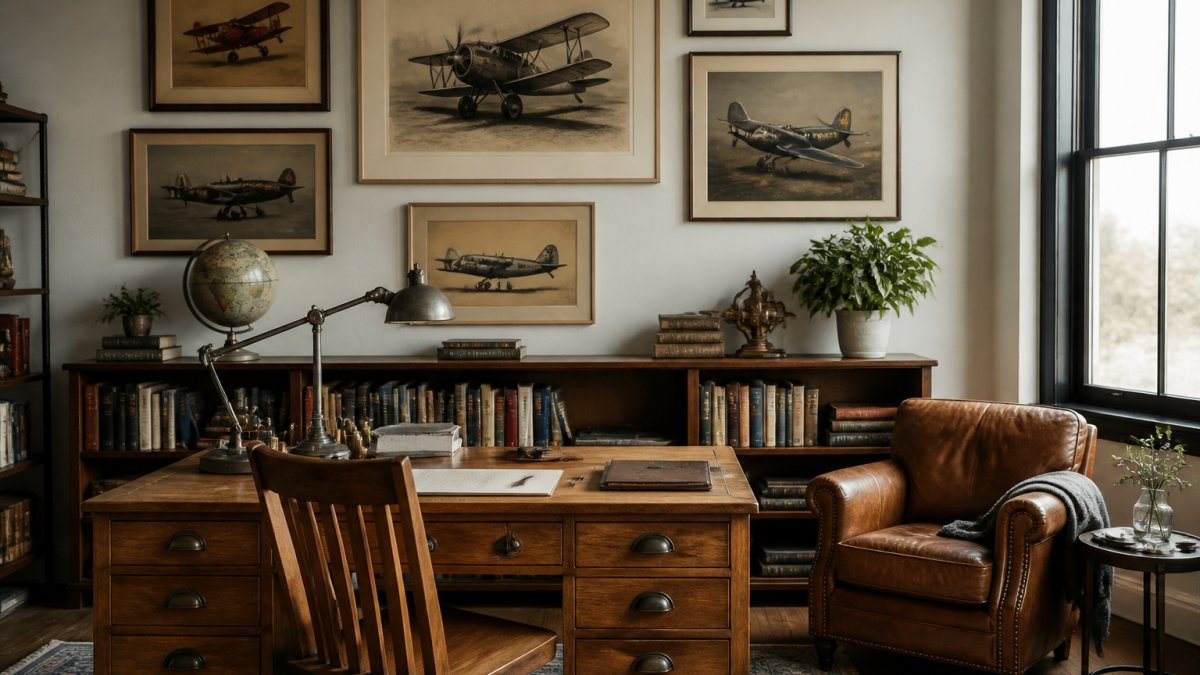
To style aviation wall art well, pick one era or one theme, hang the largest piece at eye level, and build the rest of the wall around it.
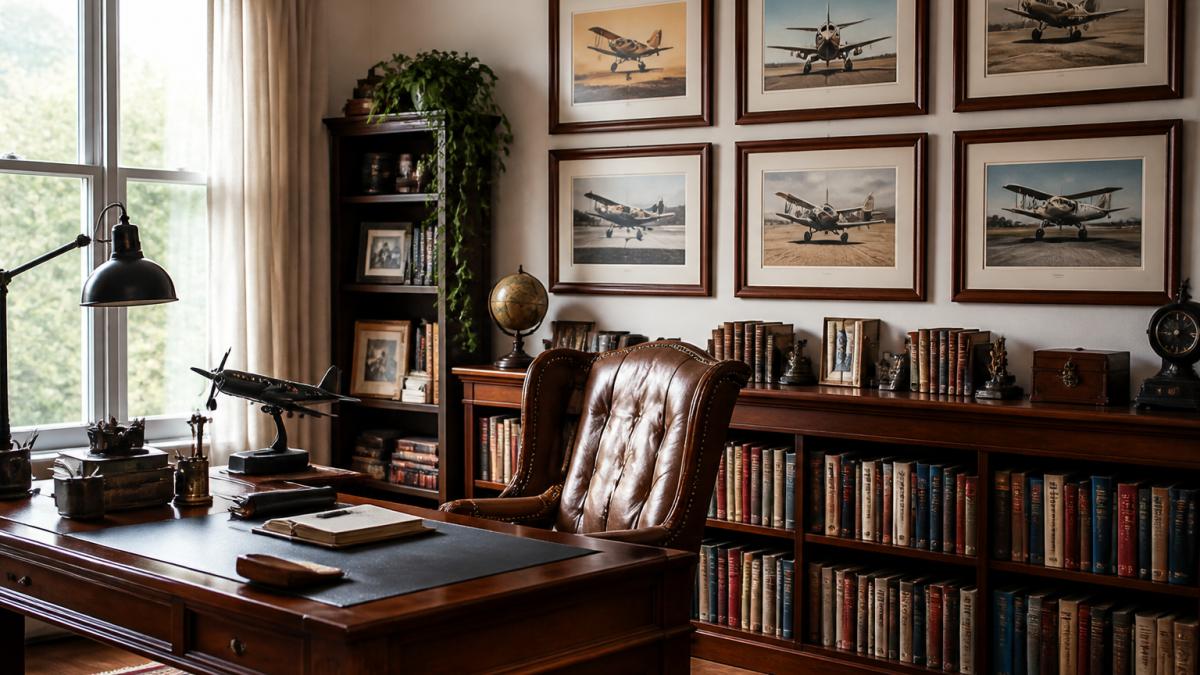
Start with a clear throughline. Early flight, military aircraft, or commercial aviation posters each give a different mood. Mixing all three in one small study usually reads as clutter.
Then decide the anchor piece. It sets the scale for everything else.
Sizing, Hanging Height, and Layout
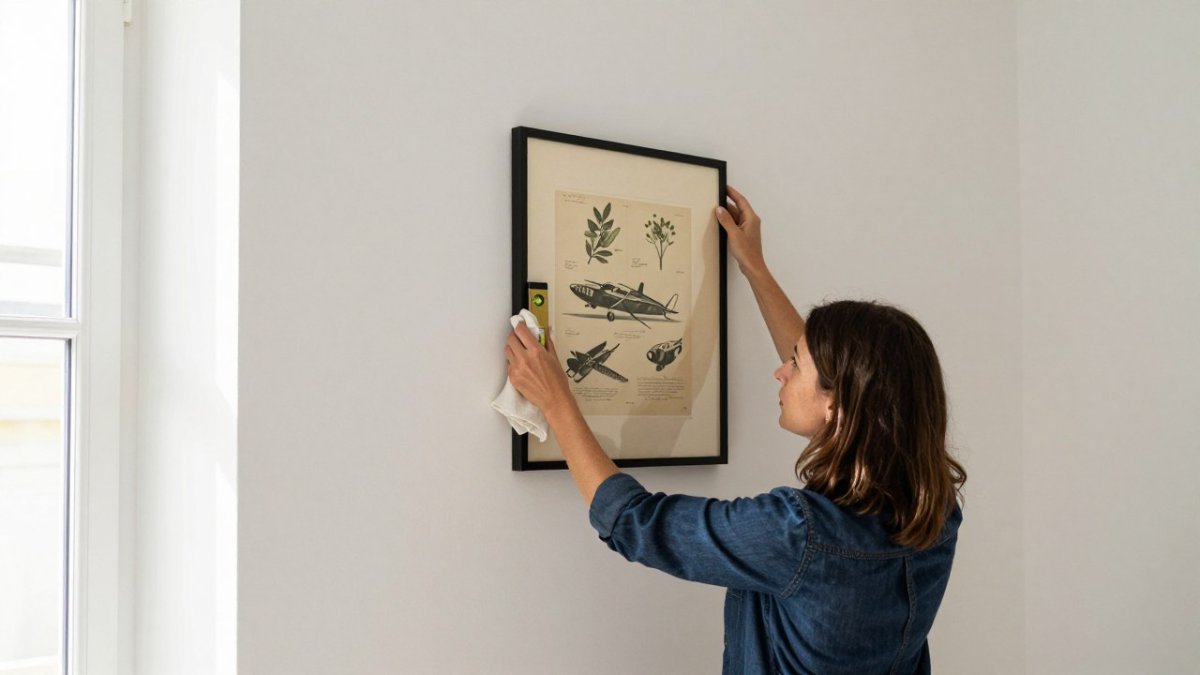
Hang the center of your main piece at roughly eye level, about 57 to 60 inches from the floor. That single rule fixes most hanging mistakes.
Layout options that work in a study:
- One large anchor print above the desk
- A tight grid of four to six smaller prints
- A single row at consistent height along a side wall
- A salon-style cluster on the tallest wall
Watch out: hanging pieces at different heights across one wall makes even good art look accidental. Pick a centerline and hold it.
Placement, Scale, and Sightlines
The study is a working room, so placement should follow where you sit and where you look.
Scale is relative to the wall, not the print. A common pattern is to treat the anchor piece as roughly one-third to one-half the width of the wall it hangs on.
Sightlines matter more in a study than in a living room because the room is often small and the desk creates a fixed viewing angle.
Grouping and Spacing Rules
A gallery wall lives or dies on spacing. Most practitioners use 2 to 3 inches between frames in a tight grid, and 3 to 4 inches in a looser salon-style cluster.
For a grid, pick a column count that divides evenly into your piece count. Four prints work as a 2x2; six work as a 2x3 or 3x2.
For a salon-style wall, start from the center and work outward, keeping the heaviest or largest piece near the middle.
Matching Art to the Study's Interior
Frame and palette choices should answer to the room, not to the art alone.
A simple rule: let the art carry the color and let the frame carry the finish. If the room already has strong color, choose frames that recede.
Lighting should be layered. Overhead light alone flattens art.
These are the hanging and spacing rules the article gives for a cohesive study wall.
| Item | Value | Note |
|---|---|---|
| Center of main piece height | About 57 to 60 inches from floor | Fixes most hanging mistakes |
| Anchor piece width | One-third to one-half the wall width | Scale is relative to the wall |
| Spacing in tight grid | 2 to 3 inches between frames | Consistent spacing beats matching frames |
| Spacing in salon-style cluster | 3 to 4 inches between frames | Start from the center and work outward |
| Grid piece counts | Four as 2x2; six as 2x3 or 3x2 | Pick a column count that divides evenly |
| Bottom edge of art | Above monitor or desk lamp top | Check from the desk chair |
Aviation Gallery Wall Ideas That Tell a Story
A strong aviation gallery wall follows a sequence, not a random spread. Think of it as a timeline or a mission log rather than a collection of pictures.
Three arrangements we like for studies:
The timeline wall. Start with early flight on the left, move through military aircraft in the center, and finish with commercial aviation on the right. The eye travels the history.
The crew wall. Group nose art, aircrew portraiture, and aircraft studies together. This reads as a tribute to the people, not just the machines.
The era wall. Keep everything inside one decade. Matching illustration style and color palette does the cohesion work for you.
Vintage Airplane Posters and the Era They Capture
Vintage airplane posters are period illustrations made to promote airlines, air shows, and aircraft.
Each decade has a signature. Early flight imagery leans on wonder and open sky. Wartime imagery leans on duty and mechanical precision. Mid-century airline posters lean on glamour and travel.
Collectors often chase a specific era because the style carries the mood they want in a room. To go deeper, explore these famous aviation artists to follow.
Choosing Aviation Prints for Office and Study Spaces
Choose aviation prints for a study by matching subject and scale to the room's purpose, then checking print quality before you buy. A print that looks sharp on a screen can arrive flat and washed out.
What to check before ordering:
- Print resolution and paper weight
- Whether the listing states archival inks and materials
- Color accuracy between photos and the physical print
- Packaging and shipping protection
- Return policy if the colors miss
A common mistake is buying for the frame instead of the image. The frame can always be changed. A weak print cannot be rescued.
Framing, Lighting, and Preserving Your Prints
Framing and lighting decide whether a print lasts years or decades. It also helps to understand why archival prints are worth the investment. Both are easy to get right once you know the basics.
Use UV-filtering glass or acrylic. Direct sunlight fades ink faster than anything else in a room. Hang prints away from windows that get strong afternoon light, or add a blind.
Framing choices that suit aviation art:
- Thin black or natural wood frames for a clean, modern read
- Wide mats in off-white to give the image breathing room
- Consistent frames across a gallery wall for cohesion
- Museum-grade mat board to prevent acid burn
UV, Glare, and Light Control
Ultraviolet light is the main enemy of any print, vintage or modern. Standard glass blocks some UV but not all, and UV-filtering glazing blocks more.
Glare is the other problem. A glossy print under bright overhead light can turn into a mirror.
A common pattern is to keep vintage prints off walls that receive direct afternoon sun and to rotate pieces seasonally if a room gets strong light.
Archival Materials and Acid Burn
Paper and mat board are not neutral, and acidic materials can yellow or stain a print over time. Avoid dry mounting or taping a vintage print directly to the backing, since that is difficult to reverse.
Authenticity, Reproduction, and Provenance
Not every vintage-looking print is vintage, so it helps to ask whether a piece is an original period print, a later reprint, or a modern reproduction.
Condition matters. Foxing, tears, and fading are part of a vintage piece's story, but they also affect price and display.
Provenance is the paper trail: where a piece came from and who owned it.
Display Conditions That Protect the Art
Keep framed art out of damp rooms and away from heat sources. A study above a garage or in a basement needs a dehumidifier more than a new frame.
Dust with a dry, soft cloth and avoid sprays near the glazing.
A simple rule: treat the print like a document, not a poster. The frame is the display; the materials are the protection.
Browse Historic Aviation Prints for Your Study
The fastest way to add character to a study is to start with one piece you genuinely love and build outward. For a focused starting point, see this guide to vintage aviation wall art for a home office.
Runway & Heirloom offers aviation-themed prints inspired by aviation, history, and self-expression, chosen to feel like part of a story rather than filler for a wall.
A few ways to begin:
- Pick one anchor print for the wall behind your desk
- Add two or three smaller pieces that share its era
- Frame everything consistently so the art does the talking
Browse our historic aviation prints and find the piece that sets the tone for the room.
Frequently Asked Questions
Why does vintage aviation art add character to a study?
Vintage aviation art brings a sense of history and narrative that mass-produced decor cannot match. Each piece, whether a warbird portrait or a vintage airplane poster, carries a story about flight innovation, crew identity, or a specific era. That storytelling quality gives a study personality and makes it feel collected rather than decorated. The nostalgia and heritage embedded in aviation artwork also create a conversation piece, which is exactly what a study, a room built for thinking and focus, benefits from most.
How do I choose the right size aviation print for a study?
Measure your wall space first, then aim for artwork that fills roughly 60 to 75 percent of the width above a desk or console. A single large vintage aviation art piece works well as a focal point, while smaller prints suit gallery wall arrangements. Hang the center of the artwork at eye level, typically 57 to 60 inches from the floor. For aviation prints for office settings, a larger statement piece behind the desk creates authority and anchors the room.
What frame works best for vintage aviation artwork?
Dark wood or black metal frames suit the mechanical precision and military heritage of most aviation artwork, while thin brass or gold frames pair well with Art Deco prints. UV-protective glass can help limit fading, which matters for pieces you want to keep for years. A white or cream mat gives vintage airplane posters breathing room and keeps the focus on the illustration itself.
Can I mix vintage aviation prints with modern office decor?
Yes, and the contrast often improves both. A clean modern desk against a wall of framed vintage aviation art creates a deliberate tension between old and new that reads as sophisticated. Keep the frame styles consistent to tie the collection together, and limit the palette to two or three frame finishes. Grouping aviation gallery wall ideas around a single era or aircraft type also helps vintage pieces feel intentional rather than random in a contemporary space.
Your study deserves more than blank walls and a monitor. If you want artwork that carries history, nostalgia, and a real point of view, Runway & Heirloom can help. Our curated aviation collection includes historic aircraft prints, women in aviation pieces, and era-specific illustration, all chosen to bring character and story into a working space. Get started with Runway & Heirloom and give your study a wall worth looking up at.