 ultimate-guide
Buy Unique Art History Wall Prints: A 2026 Guide
Table of Contents
- Why Art History Wall Prints Belong in Modern Homes
- Exploring the Styles of Art History Prints
- How to Style Art History Prints in Modern Offices
- Best Practices for Framing Art Prints
- Curating a Gallery Wall with Historical Prints
- Authenticity, Archival Quality, and Care
- Finding Your Story: Matching Prints to Passions
- Conclusion: Start Your Collection
- Frequently Asked Questions
Last Updated: September 4, 2026
The global wall art market is projected to grow from $70.94 billion in 2026 to $145.49 billion by 2034, according to Fortune Business Insights’ wall art market report. Within this expanding landscape, art history wall prints have emerged as a distinctive way to bring depth and narrative into contemporary interiors. At Runway & Heirloom Art, we believe that decorating with historical artwork is about more than filling empty wall space; it is about curating a visual narrative that connects your home to the past. Below, we’ll show you exactly how to select, style, and preserve these meaningful pieces so they become enduring parts of your personal story.
Why Art History Wall Prints Belong in Modern Homes
The appeal of historical prints lies in their ability to bridge eras. A sepia-toned botanical or a classic portrait introduces a sense of permanence and craftsmanship that mass-produced decor often lacks. This desire for connection is driving a significant shift in the market, where lower-priced contemporary works now dominate the overall volume of sales even as trophy lots drive high-end value Bank of America Private Bank’s Art Market Update.
Interior styling today favors spaces that feel collected rather than decorated. Mixing a 19th-century engraving with modern furniture creates tension and interest, anchoring a neutral palette or softening a minimalist aesthetic.
Exploring the Styles of Art History Prints
Art history wall prints span a remarkable range of movements, from classic oil painting reproductions to the geometric elegance of Art Deco. Understanding these styles helps you choose pieces that resonate with your space and your sensibilities. The current 2026 consumer trends show a strong preference for neutral abstracts, botanicals, and earthy landscapes, which brings historical works into fresh relevance Buy Wall Art’s consumer trend analysis.
From Classic Oil Painting Reproductions to Art Deco
Giclee printing captures the texture and depth of classic oil paintings with museum quality. Art Deco prints offer bold geometry that translates beautifully into contemporary settings. Mix a Renaissance portrait with a 1920s architectural study for a curated, sophisticated collection.
How to Style Art History Prints in Modern Offices
The modern home office benefits enormously from visual stimulation that goes beyond a standard motivational poster. A study featuring historical maps or documentary photography provides a link between past and present, creating an atmosphere of intellect and focus. This trend toward archival quality vintage prints in home offices reflects a broader desire for workspaces with character HistoricPrints.com’s trend report on vintage prints.
Historical prints often feature muted earth tones, deep greens, and sepia tones that promote concentration. Pair a series of small framed botanicals above a desk, or choose a single large canvas of an antique map as a focal point.
Best Practices for Framing Art Prints
Framing is where the difference between a poster and an heirloom becomes apparent. Here is a practical breakdown of what matters, what costs what, and where you can save without sacrificing longevity.
The Non-Negotiables: Matting and Mounting
For archival paper prints, acid-free matting is a requirement. Standard matboard contains lignin, which produces acid and yellows your print over time. Museum-grade matboard, typically 100% cotton rag, is pH-neutral and costs $8 to $15 per sheet versus $3 to $5 for standard. If buying a ready-made frame, replace any brown or grey pulp backing board with an acid-free alternative.
Hinging with archival tape allows the print to expand and contract with humidity changes. Dry-mounting is permanent and can cause cockling over time. For a valuable print, always request hinging.
Glass: The Trade-Off Between Clarity and Protection
Standard picture frame glass blocks about 40% of UV rays, which is not enough for direct sunlight. Here is how the options stack up:
- Regular glass: Cheapest option, around $10 to $20 for a standard 18x24 frame. High glare, low UV protection. Fine for low-light hallways.
- UV-protective glass: Blocks 97% to 99% of UV rays. Adds roughly $15 to $40 to the frame cost. A solid default for most rooms.
- Museum glass (anti-reflective + UV): Blocks 99% of UV and eliminates glare using a micro-coated surface. Costs $50 to $120 extra per frame. Worth it for pieces above a bright window or in a gallery wall where glare competes with viewing.
- Acrylic (plexiglass): Lighter and shatter-resistant, making it the right choice for nurseries or high-traffic areas. But it scratches easily and can bow over large sizes. Use a plastic-safe cleaner, never glass cleaner with ammonia.
Collectors commonly use museum glass only for the hero piece in a room and UV glass for supporting prints, balancing protection with budget.
Frame Profiles and Aesthetic Fit
A thin metal frame (under an inch) suits minimalist spaces; a wide wood frame (2 to 3 inches) anchors a large print with traditional presence. For a modern office, a sleek black or natural oak frame with a white mat creates a clean, gallery-like presentation.
For a canvas print, a floating frame adds a contemporary edge, with the canvas stretched over a wooden strainer bar and sitting inside the frame with a visible gap. This typically adds $30 to $80 over a standard frame.
Where to Frame: Custom vs. Ready-Made vs. Online
- Custom framers (local shops, or national chains like Aaron Brothers or Michaels custom framing) offer the widest selection and best advice, but a single 18x24 custom frame with museum glass can run $120 to $250.
- Ready-made frames from Target, IKEA, or Walmart cost $15 to $50 but almost always come with standard glass and non-archival backing. You can upgrade the glass and backing yourself for about $25.
- Online framing services like Framebridge or Simply Framed offer convenience and mid-range pricing ($80 to $150 for an 18x24 with UV glass). They ship a finished frame to your door, but you lose the ability to see materials in person.
The Bottom Line
The frame is not just decoration; it is the first line of defense for your print. Spend on acid-free matting and UV glass before you spend on an ornate frame profile. A simple, well-constructed frame with archival materials will outlast a decorative frame with poor protection every time.
Curating a Gallery Wall with Historical Prints
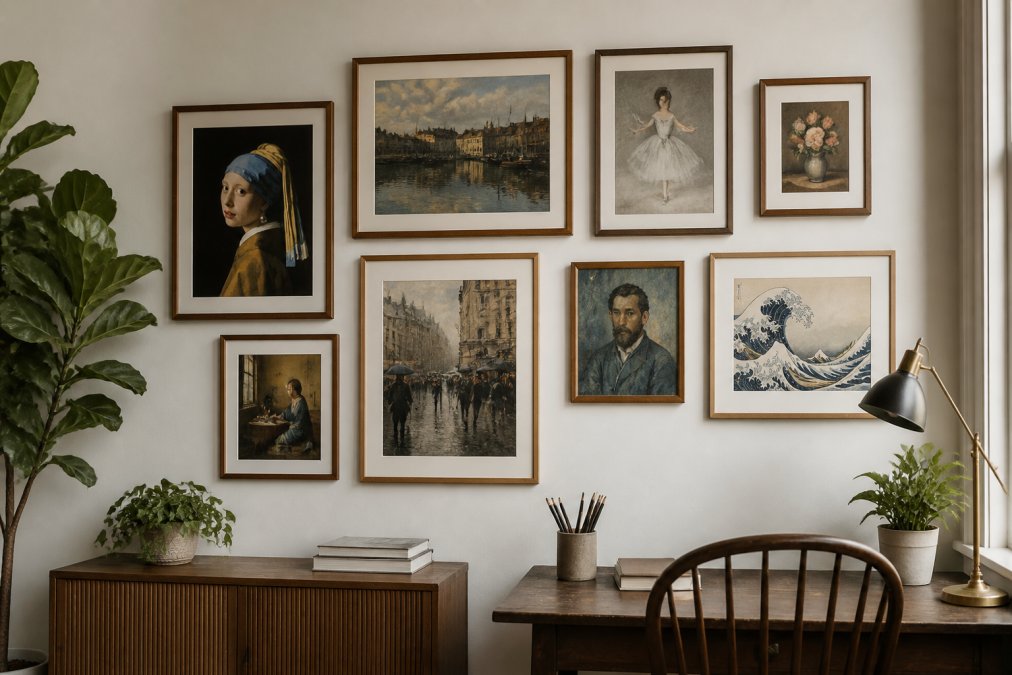
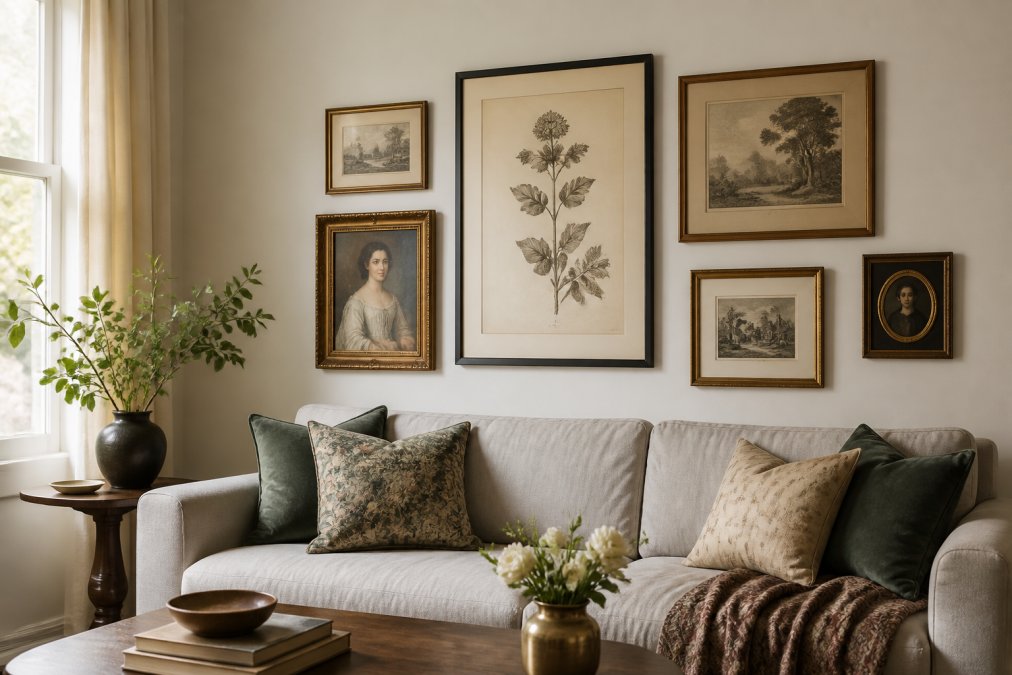
A gallery wall is the most effective way to make a statement with multiple prints. Start by selecting a unifying element: a consistent frame color, a shared sepia tone, or a common subject matter.
Lay out prints on the floor first to experiment with spacing, maintaining a consistent gap of two to three inches between frames. Mixing sizes adds dynamism, but keep visual weight balanced.
Authenticity, Archival Quality, and Care
One of the primary concerns with historical reproductions is the risk of encountering high-quality forgeries that mimic original materials and techniques Sage Journals’ case study on art counterfeits. When you buy unique art history wall prints, provenance matters. But here is the problem: most sellers of wall prints are not selling original artworks, they are selling reproductions of public-domain images. That means the authenticity question is not "is this a real Van Gogh?" but rather "is this a faithful, high-resolution reproduction of the original work, and is the seller honest about its source?"
Most buyers never ask that second question, and that is where the risk lies. A low-quality reproduction can be cropped, color-shifted, or upscaled from a third-generation scan. Here is how to verify what you are buying.
How to Verify Image Source and Accuracy
Reputable sellers should provide clear information about the image source. Look for these specifics on a product page:
- Institution of origin: Many high-resolution scans come from museum open-access programs. The Metropolitan Museum of Art, the Smithsonian Institution, the Library of Congress, and the National Gallery of Art all offer public-domain images of their collections. If a seller names the holding institution, you can cross-check the image against that institution's online catalog.
- Catalog or accession number: Museum catalogs assign a unique identifier to each work. A seller who includes this number demonstrates that they have done the archival work.
- Image resolution and source file: A reproduction of a 19th-century engraving should state its resolution in DPI (dots per inch) at the printed size. A 300 DPI print at 18x24 inches requires a source file of at least 5400 x 7200 pixels. If the seller does not state this, ask.
- Color correction and restoration notes: Some historical images require digital restoration to remove stains, tears, or fading. A seller who describes this process is being transparent. A seller who claims the image is "as-is" may be passing off a degraded scan.
Run a reverse image search (Google Images or TinEye) on the product page image. If the same file appears on a free public-domain site, compare resolution and cropping. If the seller's version is cropped tighter or has altered colors, you are getting an edited reproduction.
Archival Quality: What the Terms Actually Mean
Archival quality is determined by paper, ink, and method of reproduction, but the term "archival" is not regulated in the United States. Here is what to look for instead:
- Paper: Look for "100% cotton rag" or "alpha-cellulose" paper. These are lignin-free and pH-neutral, meaning they will not yellow or become brittle over time. Standard poster paper is made from wood pulp and will degrade noticeably within 5 to 10 years.
- Ink: Pigment-based inks are more fade-resistant than dye-based inks. The Wilhelm Imaging Research Institute, a well-known independent testing lab, has documented that pigment inks on fine-art paper can resist fading for 100 to 200 years under typical indoor display conditions. Dye-based inks may fade noticeably within 10 to 20 years.
- Printing method: Giclee printing, which uses large-format inkjet printers with pigment inks, is the current standard for museum-quality reproductions. Offset lithography, used for mass-produced posters, is cheaper but produces a dot pattern that is visible under magnification and is less color-accurate.
Care and Preservation: The Routine That Matters
How you hang and maintain a quality print determines how long it lasts. The three environmental enemies of paper art are light, humidity, and temperature.
Light: UV radiation is the primary cause of fading. Even UV-protective glass does not block 100% of UV rays. Never hang a print where direct sunlight hits it for more than one hour per day. North-facing walls are safest; south- and west-facing walls need UV glass.
Humidity: Paper absorbs moisture from the air. Above 65% relative humidity, paper can develop mold and foxing; below 30%, it becomes brittle. The American Institute for Conservation recommends keeping relative humidity between 40% and 50%. Avoid bathrooms, kitchens, and exterior walls in humid climates; a dehumidifier is a worthwhile investment in the Southeast or Gulf Coast.
Temperature: Heat accelerates chemical degradation. Avoid hanging prints above radiators, heating vents, or fireplaces. The ideal range is 65 to 75 degrees Fahrenheit.
Maintenance routine: Dust frames weekly with a soft, dry microfiber cloth. Never spray cleaner directly on glass, spray the cloth instead. Every 6 to 12 months, inspect the back of the frame for moisture or insect activity. Rotate pieces seasonally to reduce prolonged light exposure.
Finding Your Story: Matching Prints to Passions
The most successful art collections speak to the collector’s individual story. For aviation enthusiasts, a vintage aircraft print captures a specific moment in history; for new parents, a watercolor reproduction of a classic children’s tale introduces a child to a world of imagination.
The following table summarizes how different passions align with historical art themes:
| Interest Area | Art History Theme | Style Suggestion |
|---|---|---|
| Aviation | Early flight, vintage aircraft | Sepia-toned documentary photography |
| Childhood | Classic illustrations, nursery rhymes | Soft watercolor reproductions |
| Patriotism | Founding fathers, national landmarks | High-resolution engraving prints |
| Classic Design | Art Deco, mid-century modern | Bold geometric framed canvas |
| Nature | Botanicals, landscape studies | Matte finish archival paper prints |
This approach ensures the artwork you select is not merely decorative but deeply personal.
Conclusion: Start Your Collection
Building a collection of art history wall prints is a journey of discovery, acquiring fragments of visual narrative that enrich your daily environment. The challenge lies in finding pieces that are both authentic and expressive of your personal taste.
Runway & Heirloom Art offers a curated selection of art-history-inspired prints, from Art Deco designs to historic aviation artwork, that combine history, imagination, and individual style. Our digital download format provides instant access to printable wall art, allowing you to customize your space immediately. Explore our Art Deco Prints and Oil Painting Prints collections to find pieces that will become part of your home's story.
Get started with Runway & Heirloom Art and discover artwork with personality, crafted to endure as a cherished part of your life.
Frequently Asked Questions
What is the difference between giclée and standard art prints?
Giclée printing uses high-resolution digital files and pigment-based inks to produce museum-quality archival prints. Standard prints often rely on lower-resolution dye-based inks that can fade faster. When you buy unique art history wall prints, look for giclée on archival paper to ensure the colors stay true and the piece lasts for generations.
How do I choose the right size art prints for my wall?
Measure your wall space first. For a large, empty wall, a single oversized print makes a strong statement. For smaller spaces or above furniture, a cluster of smaller prints works well. A common rule is that artwork should cover about two-thirds to three-quarters of the width of the furniture below it.
Are vintage art history prints considered fine art?
Yes. A high-quality reproduction of a significant work is often considered fine art. These prints capture the aesthetic, composition, and historical importance of the original. The value depends on the quality of the reproduction, the archival materials used, and the significance of the original piece.
How can I incorporate historical art into a modern home decor style?
Treat historical art as a focal point. A single, well-framed Art Deco print can anchor a minimalist room. For a more collected look, curate a gallery wall with historical prints, mixing black-and-white photography with sepia-toned botanical studies. The contrast between old art and clean, modern lines creates a sophisticated tension.
This article was written using GrandRanker