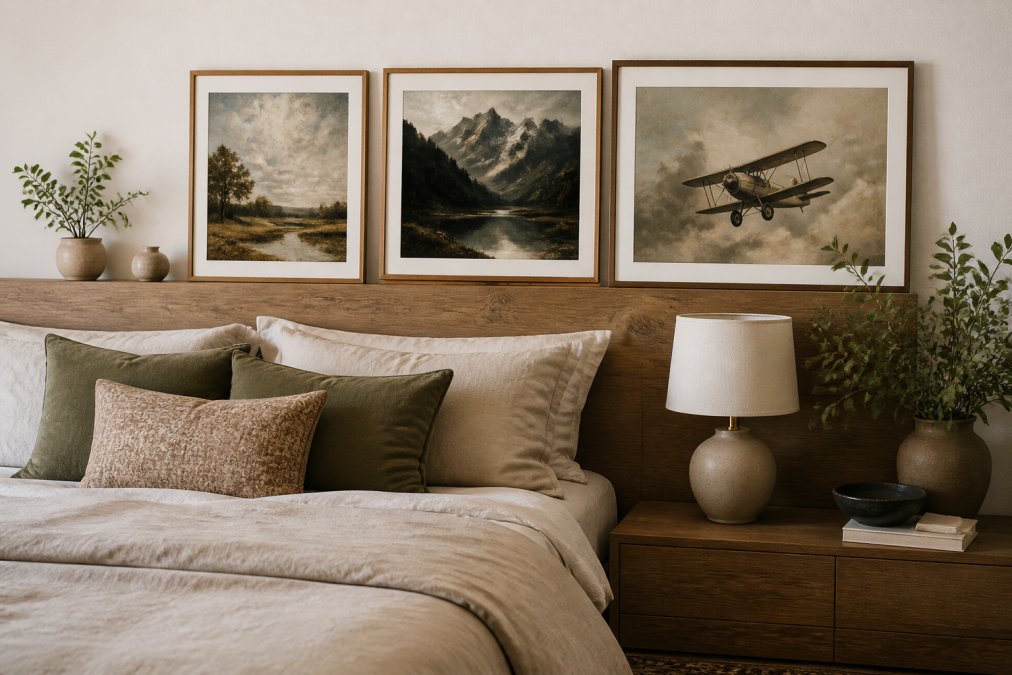
 listicle
High Quality Art Prints for Bedrooms: A 2026 Guide
Table of Contents
- Why High Quality Art Prints for Bedrooms Matter in 2026
- How to Style Art Prints in the Bedroom for a Calming Effect
- Best Art Print Materials for Home Decor That Last
- 5 High Quality Art Print Styles That Transform a Bedroom
- Curating a Gallery Wall for the Bedroom: Layout and Balance
- Framing, Placement, and Maintenance: Protecting Your Investment
- Conclusion: Choose Prints That Tell Your Story
- Frequently Asked Questions
Last Updated: September 5, 2026
The global wall art market is projected to reach USD 66.89 billion in 2025, yet most bedrooms still feature bland, mass-produced decor that fails to create a personal retreat (EXTERNAL_LINK: Merchize market valuation report | merchize.com). High quality art prints for bedrooms do more than fill wall space; they set the emotional tone of the room you enter first and last each day. This guide explains what separates a print worth keeping from one you will replace in a year, covering materials, styles, and placement strategies. We have curated this advice for homeowners who want their personal spaces to feel intentional rather than generic.
The shift toward quality is measurable. Buyers in 2026 show a strong preference for prints made with fade-resistant inks, actively moving away from mass-produced decor (EXTERNAL_LINK: BuyWallArt.ca consumer behavior report | buywallart.ca). Quality wall art is defined by archival materials, accurate color reproduction, and a design that resonates with your personal story. Below, we show you exactly how to choose pieces that last, style them for calm, and protect your investment.
Why High Quality Art Prints for Bedrooms Matter in 2026
The wall art market reached USD 63.61 billion in 2024, and the difference between a forgettable print and a meaningful one comes down to intentionality (EXTERNAL_LINK: Merchize market valuation report | merchize.com). Your bedroom is a sanctuary, and art prints for bedrooms should support rest rather than compete with it. A study of home decorating habits found that 46% of respondents have at least one piece of wall art in every room, with 22% identifying art prints as a key element in refreshing their spaces (EXTERNAL_LINK: InPrint Designs wall art statistics | inprintdesigns.com).
The Visual Cortex and the Pre-Sleep Wind-Down
Your brain does not simply 'turn off' when you lie down. The visual cortex remains active, processing the last images it receives before sleep. High-arousal imagery, chaotic abstracts, busy patterns, or emotionally charged subjects, can keep your sympathetic nervous system engaged, delaying deeper non-REM sleep.
Conversely, low-arousal imagery promotes calm. Research in environmental psychology shows that scenes of nature, particularly those with 'soft fascination' like water, foliage, and open skies, allow the brain to enter a more restorative state.
The 'Soft Fascination' Principle
The Attention Restoration Theory (ART), developed by psychologists Rachel and Stephen Kaplan, distinguishes between 'hard fascination' (which demands focused attention) and 'soft fascination' (which gently holds attention without effort).
For a bedroom, you want art that offers 'soft fascination.'
- Landscape photography with a wide depth of field and muted tones allows your gaze to wander without a focal point that demands analysis.
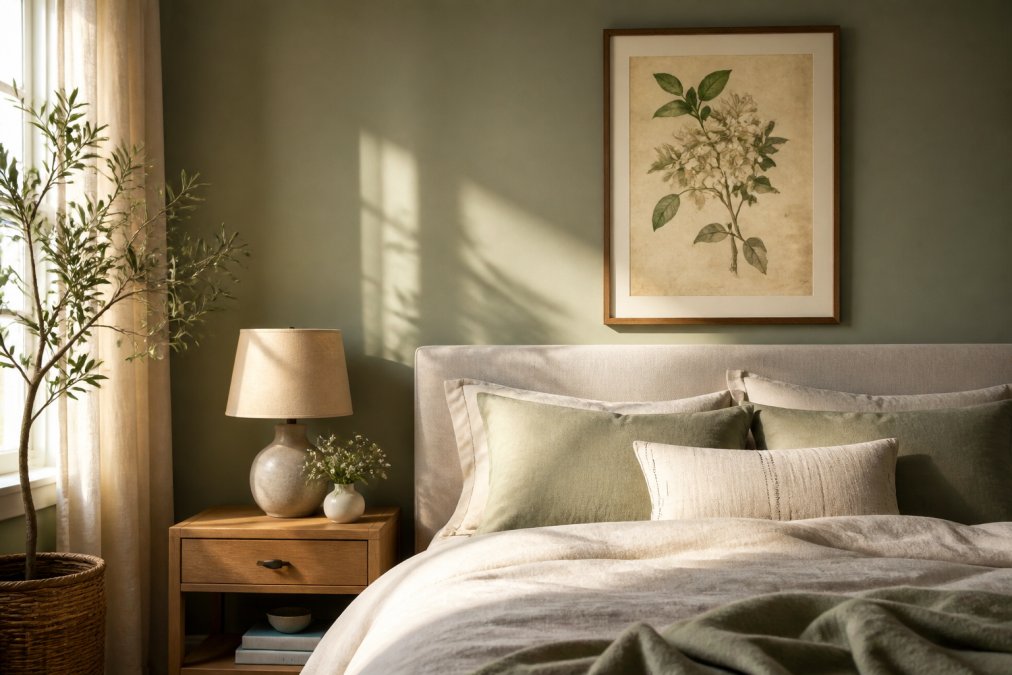
- Botanical prints with organic, repeating patterns (like ferns or eucalyptus) provide a rhythmic visual that is soothing, not stimulating.
- Abstract art with organic, flowing lines in a monochromatic palette can mimic the calming visual noise of nature without the literal representation.
Color Temperature and Melatonin
Beyond subject matter, color plays a direct role in your body's hormonal cascade. The photoreceptors in your eyes are sensitive to blue light wavelengths, signaling the pineal gland to suppress melatonin production, your primary sleep hormone. While blue light from screens is the most potent suppressor, large areas of cool, blue-dominant art can have a subtle effect if it's the last thing you see.
- Warm neutrals (beige, terracotta, soft ochre) are associated with lower color temperature and are less likely to interfere with melatonin secretion.
- Deep, dark tones (forest green, navy, charcoal) create a 'cave-like' environment that signals darkness and safety.
- Muted pastels (sage, dusty rose, powder blue) offer a middle ground, providing color without the high-energy stimulation of saturated hues.
The Emotional Anchor
Finally, the 'meaning' of the art matters. A piece that holds personal significance, a print of your hometown or an abstract that reminds you of a specific feeling, can trigger a positive emotional association, helping reduce cortisol as you settle in for the night.
How to Style Art Prints in the Bedroom for a Calming Effect
Styling art prints for bedrooms begins with color coordination rather than trend-chasing. Muted elegance dominates 2026 aesthetics, with consumers demanding calming botanical and landscape prints for bedroom sanctuaries (EXTERNAL_LINK: Printful trend analysis | printful.com). Select pieces whose palette echoes your bedding and walls, creating a seamless visual flow that feels restful.
Current trends emphasize scale to evoke specific emotions, focusing on calm within bedroom environments through abstract compositions or photorealistic imagery (EXTERNAL_LINK: Extra Large Wall Art 2026 trends | extralargewallart.com). A single oversized piece can anchor a room more effectively than several small ones. Position art where you will see it while lying down, typically above the headboard or on the wall facing the bed.
Best Art Print Materials for Home Decor That Last
Professional-grade prints for home decor are increasingly produced on durable, thick cardstock or canvas to ensure longevity (EXTERNAL_LINK: A Humble Place production standards | ahumbleplace.com). The material determines how long your art prints for bedrooms will hold their color and structure. Giclee printing on archival paper delivers museum-quality results, while canvas offers a textured, gallery-like presence that suits casual spaces.
| Material | Best For | Longevity | Finish |
|---|---|---|---|
| Archival cardstock | Framed fine art prints | Decades with UV glass | Matte, glare-free |
| Stretched canvas | Unframed modern decor | 20+ years indoors | Textured, gallery feel |
| Fine art paper | Detailed illustrations | Decades with proper care | Smooth, high detail |
| Metal or acrylic | Contemporary aesthetics | Very long, scratch-prone | Glossy, vibrant |
Choose matte finishes for bedrooms to reduce glare from morning light. Glossy surfaces reflect windows and lamps, creating distractions during rest. The responsible sourcing trend also matters; buyers increasingly seek prints made with responsibly sourced materials (EXTERNAL_LINK: BuyWallArt.ca best-selling wall art 2026 | buywallart.ca).
5 High Quality Art Print Styles That Transform a Bedroom
The best high quality art prints for bedrooms balance personal meaning with aesthetic longevity. These five styles consistently deliver both.
1. Nature-Inspired Photography and Botanical Prints
Nature-inspired artwork remains a dominant seller in 2026, with continued high demand for landscape photography, botanical prints, wildlife imagery, and coastal scenes (EXTERNAL_LINK: FinerWorks home decor trends | finerworks.com). These pieces bring organic lines and calming greens into your space. Some design enthusiasts argue that floral prints have become predictable, so seek compositions with unusual perspectives or muted, non-traditional palettes (EXTERNAL_LINK: Houzz interior design discussion | houzz.com).
2. Art History and Nostalgic Storytelling Pieces
Art-history-inspired prints add depth and conversation to a bedroom. RunwayandHeirloomArt offers oil painting prints and Art Deco pieces that recall another era while fitting modern interiors. These prints work beautifully in studies or primary bedrooms where you want sophistication without sterility.
3. Abstract Compositions with Organic Lines
Abstract art with flowing, organic shapes supports a minimalist aesthetic and a serene atmosphere. These pieces introduce visual interest without literal imagery that demands interpretation. They suit contemporary rooms with clean lines and neutral furnishings.
4. Aviation and Passion-Driven Themes
For the enthusiast, passion-driven art transforms a room from generic to personal. Historic aviation prints and women in aviation collections celebrate achievement and adventure. RunwayandHeirloomArt curates these story-driven pieces for studies, offices, and bedrooms where individual style takes priority over trend.
5. Personalized Watercolor and Nursery Art
Watercolor art brings softness and imagination to children's rooms. Specialized watercolor styles with charming subjects introduce a child to a world of wonder. These art prints for bedrooms grow with the child, transitioning from nursery decor to tween expression.
Curating a Gallery Wall for the Bedroom: Layout and Balance
A gallery wall turns a flat surface into a curated collection, but layout mistakes create visual chaos. Start by selecting pieces that share a common thread: color palette, frame finish, or subject matter.
Lay out your arrangement on kraft paper, tracing each frame and taping the outlines to the wall. Maintain 2 to 3 inches between frames, mix orientations and sizes, and anchor the arrangement with one larger focal point.
Framing, Placement, and Maintenance: Protecting Your Investment
Framing protects your art prints and elevates their presence. Choose frames that complement your interior design style without competing with the artwork. The true test of a 'high quality' print is how it survives the unique conditions of a bedroom: humidity from sleep, UV exposure from morning light, and airborne dust. This section offers the maintenance protocols that professional conservators use.
The Real Enemy: UV Light and the Fading Curve
All inks fade, but the rate is determined by pigment type and light source. The industry standard is the Blue Wool Scale, which rates lightfastness from 1 (very poor) to 8 (excellent).
- Pigment-based inks (used in most giclee printing) score between 6 and 8 on the Blue Wool Scale. They are made of solid particles that sit on top of the paper, making them highly resistant to UV degradation.
- Dye-based inks (common in cheaper, mass-produced posters) score between 2 and 4. They are absorbed into the paper and are chemically broken down by UV light much faster.
Even a pigment print rated at 8 will fade if exposed to direct sunlight for 8 hours a day. The solution is using UV-filtering glazing.
- Standard glass blocks about 40% of UV rays.
- UV-filtering acrylic (like Optium Museum Acrylic) blocks 99% of UV rays. It is also shatter-resistant and lighter, making it ideal for large pieces above a bed.
- Conservation-grade glass is the gold standard, offering 99% UV protection with a low-iron composition that eliminates the greenish tint of standard glass, ensuring color accuracy.
Humidity and the 'Breathing' of Paper
The bedroom is one of the most humid rooms in the house. A single person exhales approximately 400 milliliters of water vapor per night, and your art prints absorb this moisture.
Paper is hygroscopic, meaning it absorbs and releases moisture. As humidity rises, paper fibers expand; as it falls, they contract. This constant 'breathing' causes warping, buckling, and micro-cracks over time.
The mechanism of prevention is the frame's backing. Cheap frames use a thin cardboard backing that offers no moisture barrier. Professional framing uses a foam core board or, better yet, a sealed backing with a moisture barrier (like a sheet of Mylar or a specialized conservation board) to prevent humidity from reaching the print from behind.
The 60/40 Rule: Maintain bedroom relative humidity between 40% and 60%. Below 40%, paper becomes brittle; above 60%, mold and mildew become a risk. A simple hygrometer (available for under $15 at any hardware store) is the most cost-effective preservation tool you can buy.
The DIY Conservation Framing Hack
You do not need to pay a custom framer to get archival protection. The 'museum mount' method is a professional technique you can replicate at home.
- Purchase a standard-size frame from a craft store (e.g., 18x24 or 24x36).
- Replace the included glass with a UV-filtering acrylic sheet cut to size at a local hardware store (they will cut it for you).
- Do not mount the print directly to the backing. Instead, use acid-free archival tape (available at any art supply store) to create a 'hinge' at the top of the print, allowing it to hang freely and expand/contract with humidity without buckling.
- Add a mat. A mat creates a physical air gap between the print and the glass, preventing condensation from forming on the glass and transferring to the print.
Cleaning Protocols: What to Touch and What Not to Touch
- Dusting: Use a soft, dry microfiber cloth or a clean, wide-bristle brush (like a makeup brush) to dust the frame and glass weekly. Never use a damp cloth on the frame if it is wood, as moisture can warp the frame's joints.
- Glass Cleaning: Spray the cleaner on the cloth, never directly on the glass. Use an ammonia-free glass cleaner. Ammonia can off-gas and damage the print over time if it seeps past the frame's seal.
- Canvas Prints: Do not use water or any liquid cleaner on a canvas print. Dust it gently with a soft brush. If a stain occurs, do not attempt to scrub it. Consult a professional art conservator.
Placement: The Micro-Climate of the Wall
Beyond avoiding direct sunlight, consider the wall's thermal properties.
- Exterior walls in a bedroom can have significant temperature swings, leading to condensation on the inside of the frame. If you must hang art on an exterior wall, ensure the frame is sealed with a backing board to prevent moisture ingress.
- Above a radiator or HVAC vent: The constant airflow carries dust and causes rapid temperature fluctuations. Avoid this placement entirely.
- The 'Headboard Zone': The space directly above the bed is typically safe from direct sunlight but is in the path of your breath's moisture. Ensure the frame is sealed, and consider using a mat to keep the print away from the glass.
Conclusion: Choose Prints That Tell Your Story
The best high quality art prints for bedrooms reflect who you are, not just what matches your duvet. Whether you choose nature photography, aviation history, or personalized watercolor art, the right piece becomes part of your home's narrative. RunwayandHeirloomArt offers a curated collection spanning art history, aviation, childhood, and nostalgia, with digital downloads for instant access and easy customization. Artwork should tell a story, whether it recalls another era, reflects a lifelong passion, or introduces a child to imagination. Discover art with personality, and let your walls become part of your story. Get started with RunwayandHeirloomArt and find prints that will still speak to you years from now.
Frequently Asked Questions
What are the best art prints for a bedroom?
The best art prints for a bedroom are those that create a serene atmosphere and reflect your personal style. Nature-inspired landscape photography, botanical prints, and abstract compositions with organic lines are top sellers in 2026 because they promote calm. For a distinctive touch, consider art history pieces or aviation prints that tell a story. Prioritize prints made with fade-resistant inks on archival quality paper or canvas to ensure they remain vibrant for years.
How do you choose art for a bedroom wall?
Start with your color palette and the mood you want to create. For a restful space, choose prints with muted tones and a matte finish. Consider the scale: a single large statement piece above the bed works well, or you can curate a gallery wall with a mix of small and medium frames. Match the art to your interior design style, whether that's minimalist, modern, or nostalgic, to ensure visual balance.
Should bedroom art be framed?
Yes, framing protects your print and elevates its appearance. For high quality art prints for bedrooms, choose frames that complement your decor: thin metal frames suit modern rooms, while handmade wooden frames add warmth to traditional spaces. Use mats to create breathing room and prevent the artwork from touching the glass. Ensure your frame includes UV-protective glass or acrylic to prevent fading from sunlight.
What are the best art print materials for home decor?
For longevity, look for giclee printing on archival quality heavyweight paper or canvas. Giclee prints use fade-resistant inks that maintain color accuracy for decades. Canvas prints offer a textured, gallery-like look without needing a frame, while fine art prints on matte paper are ideal for a minimalist aesthetic under glass. Avoid standard poster paper, which fades and tears quickly, and check the print's material specifications before purchasing.
This article was written using GrandRanker