 how-to
How to Mix Modern and Vintage Art in Bedrooms
Last Updated: November 4, 2026
Quick Summary
Mix modern and vintage art in bedrooms by keeping vintage art to about 20-30% of the wall, with one antique piece as the focal point and modern prints flanking it. Contrast the styles but agree on tone, and repeat two or three colors from the vintage piece in the modern work.
- Rossetti Art suggests 30-40% vintage to 60-70% contemporary, while Hommes Studio argues for 20% vintage to 80% modern.
- Art should span roughly two-thirds to three-quarters of the width of the furniture below it.
- Balance a weighty vintage oil print with two lighter modern pieces, or give a large modern canvas a single small antique companion.
- Repeat each frame finish at least twice so warm wood and cool metal can coexist.
- Keep mixed-age pieces out of direct sun and dust with a dry microfiber cloth.
Table of Contents
- Why Mixed-Era Art Belongs in a Bedroom
- How to Mix Vintage and Modern Decor Without a Fight
- Choosing a Cohesive Color Palette for Mixed-Era Art
- Gallery Wall Layout Ideas for Bedrooms
- Framing Vintage Art for Modern Homes
- Bedroom Layouts, Budget Sourcing and Caring for Mixed-Age Pieces
- Choosing Your First Mixed-Era Piece for the Bedroom
- Frequently Asked Questions
Why Mixed-Era Art Belongs in a Bedroom
Mixing modern and vintage art in bedrooms gives a room a story no single-era scheme can match. According to InPrint Designs' wall art and home decor statistics, 46% of homeowners keep at least one piece of art in every room, and 21% redecorate a space specifically to fit new art. That last number matters: art is driving the design, not following it.
What the 30-40% Vintage Rule Actually Looks Like
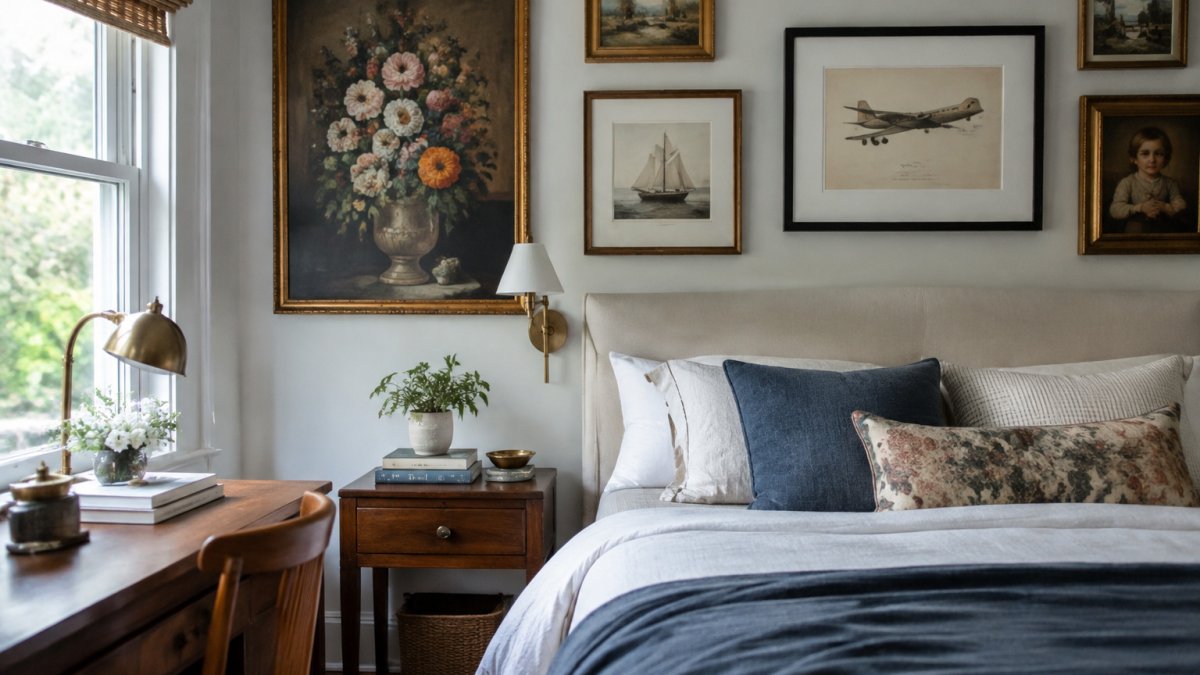
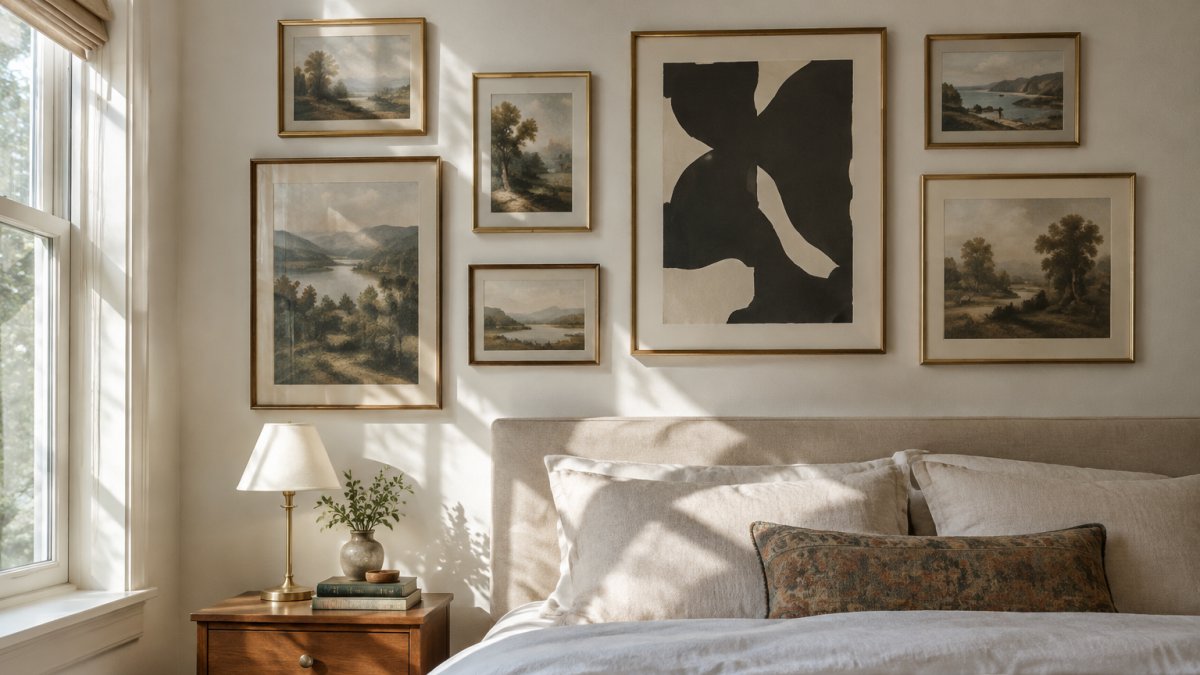
Designers disagree on the exact ratio, and that flexibility is useful. Rossetti Art's sociocultural interior design report suggests 30-40% vintage to 60-70% contemporary, while Hommes Studio argues for 20% vintage to 80% modern. Both land in the same place: vintage work as seasoning, not the whole meal. In a bedroom, we lean toward the lighter 20-30% range. One antique landscape over the bed, two or three modern prints flanking it.
How to Mix Vintage and Modern Decor Without a Fight
The trick to mixing eras is contrast in style and agreement in tone. A sepia-toned antique next to a neon abstract will bicker. The same antique beside a muted modern print in a shared warm palette will sing. Start with one anchor piece, then choose every other work to echo either its color or its mood, never both.
Balance Visual Weight and Proportion
Visual weight is how much attention a piece demands. Dark colors, heavy frames, and dense detail carry more of it. Balance a weighty vintage oil print with two lighter modern pieces, or give a large modern canvas a single small antique companion with generous negative space around it.
The article's core mixing rules come down to a few measurable proportions and pairings.
| Rule | Value | Note |
|---|---|---|
| Vintage share of art (Rossetti Art) | 30-40% vintage, 60-70% contemporary | One suggested ratio |
| Vintage share of art (Hommes Studio) | 20% vintage, 80% modern | Alternative ratio |
| Vintage share in a bedroom | 20-30% | The article's preferred range |
| Art width vs. furniture below | Two-thirds to three-quarters of width | Scale guideline |
| Contrast rule | Contrast in style, agree in tone | Sepia antique beside muted modern print |
| Anchor approach | Start with one anchor piece | Echo its color or mood, never both |
Choosing a Cohesive Color Palette for Mixed-Era Art
A cohesive palette is the fastest way to make mixed-era art look intentional, and in a bedroom it does double duty: it calms the room and it keeps an antique landscape from reading as a mistake beside a contemporary abstract. The method is simple enough to run in an afternoon.
Pull, Don't Match
Start with the vintage piece, since it is the harder one to replace. Identify two or three colors that already appear in it, not the dominant color alone, but a secondary and an accent. Then choose modern prints that repeat those colors in cleaner, flatter form. The goal is repetition, not duplication: a muted modern print that echoes the sky in an antique oil painting ties the wall together without looking like a copy.
Build a Three-Tier Palette
Treat the wall as three tiers: a base, a bridge, and an accent.
- Base: the wall color and the largest art piece. In a bedroom, keep this tier low-contrast so the room stays restful.
- Bridge: the mid-sized works and the frames. This is where old and new actually meet.
- Accent: one saturated note, a single bright modern print, a colored mat, or a lamp base, repeated no more than twice in the room.
A common pattern is to let the vintage piece own the base tier and the modern work own the accent tier, which keeps the older piece feeling like the anchor rather than the outlier.
Let Frames Carry the Palette
Warm wood frames and cool metal frames can coexist if you repeat each finish at least twice. Patina reads as a color in itself, so let aged brass or tarnished gold appear in frames and lighting fixtures to tie old and new together. If your vintage piece has a gilt frame you want to keep, repeat that gold once in a modern frame or a brass sconce and the wall reads as deliberate.
Bedroom-Specific Adjustments
Bedrooms tolerate less color contrast than living rooms because the eye has nowhere to rest at night. Two adjustments matter most:
- Lower the saturation of the modern pieces. A modern print in a dusty version of the vintage palette will sit more quietly than the same print at full saturation.
- Repeat the palette in textiles. A throw, pillow, or rug that picks up one color from the art makes the whole room read as one scheme, which is the effect that makes the whole room read as one scheme.
Watch out: pulling a color from a vintage piece under warm incandescent light and then buying a modern print online will often produce a mismatch, because screens and bulbs both shift color, compare the print against the actual piece in daylight before you commit.
Gallery Wall Layout Ideas for Bedrooms
Most gallery-wall advice is written for living rooms, where a wall can carry a dense, busy arrangement. A bedroom is different: the wall is usually seen from a pillow, the furniture below it is often the largest piece in the room, and the arrangement has to work in low light. The layouts below are bedroom-specific and account for the furniture each one sits above.
Layout 1: The Single Row Above a Modern Bed
If your bed frame is modern and low-profile, a single horizontal row of three to five frames centered above the headboard keeps the wall calm and lets a vintage piece hold the center. Keep the row's total width at roughly two-thirds to three-quarters of the bed width. Put the vintage piece in the middle and flank it with modern prints in matching frames. This is the safest configuration when the bed is the visual anchor.
Layout 2: The Asymmetric Cluster Beside a Vintage Armoire
A large vintage armoire already carries heavy visual weight. Do not hang a dense gallery wall on the same wall, instead, place a small asymmetric cluster of three to five pieces on the adjacent wall, kept inside one imaginary rectangle, and leave the armoire wall mostly bare. The negative space is what keeps the armoire from feeling crowded.
Layout 3: The Paired Column Flanking a Window
When the bed sits between two windows, two narrow vertical columns of two to three frames each balance the wall without competing with the bed. Put the vintage work at the top of one column and the modern work at the top of the other, so the eye crosses the room diagonally rather than settling on one side.
Layout 4: The Low Salon Wall Opposite the Bed
Opposite the bed is the wall you see first and longest. A low, wide salon-style arrangement, mixed sizes, tight spacing, bottom edge roughly at the height of the nightstand, gives the room a collected feel and works well when the bed itself is minimal. Keep the vintage pieces toward the center and the modern pieces toward the edges so the older work reads as the focal point.
Measure Before You Hang
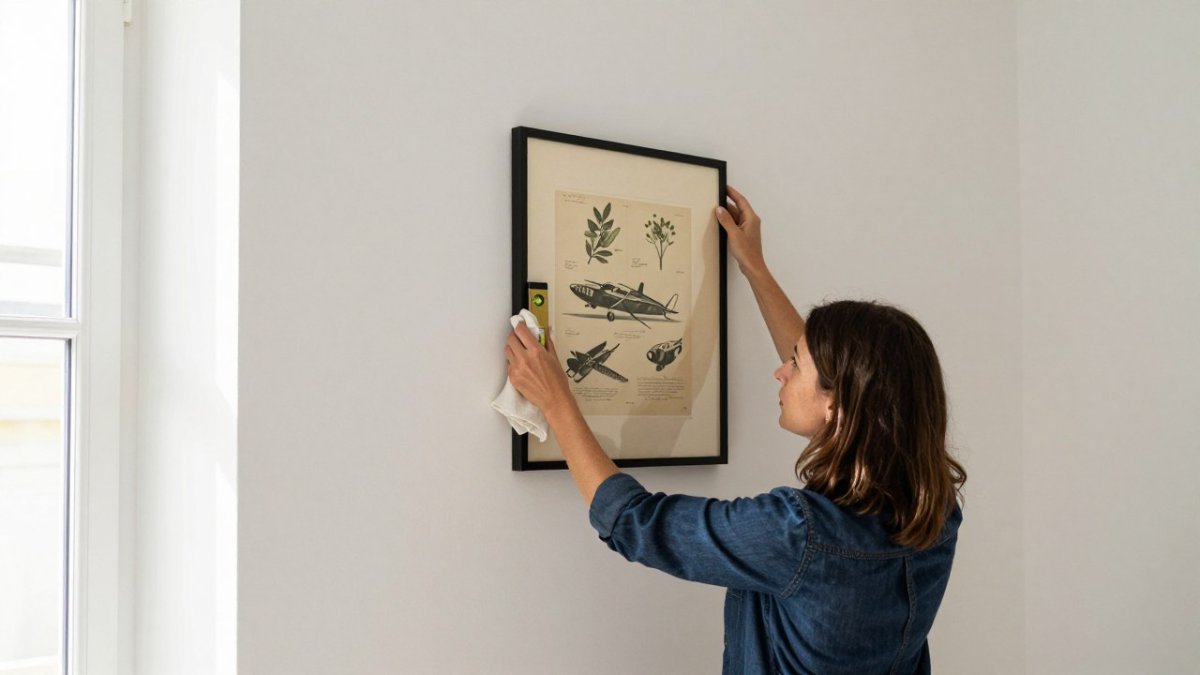
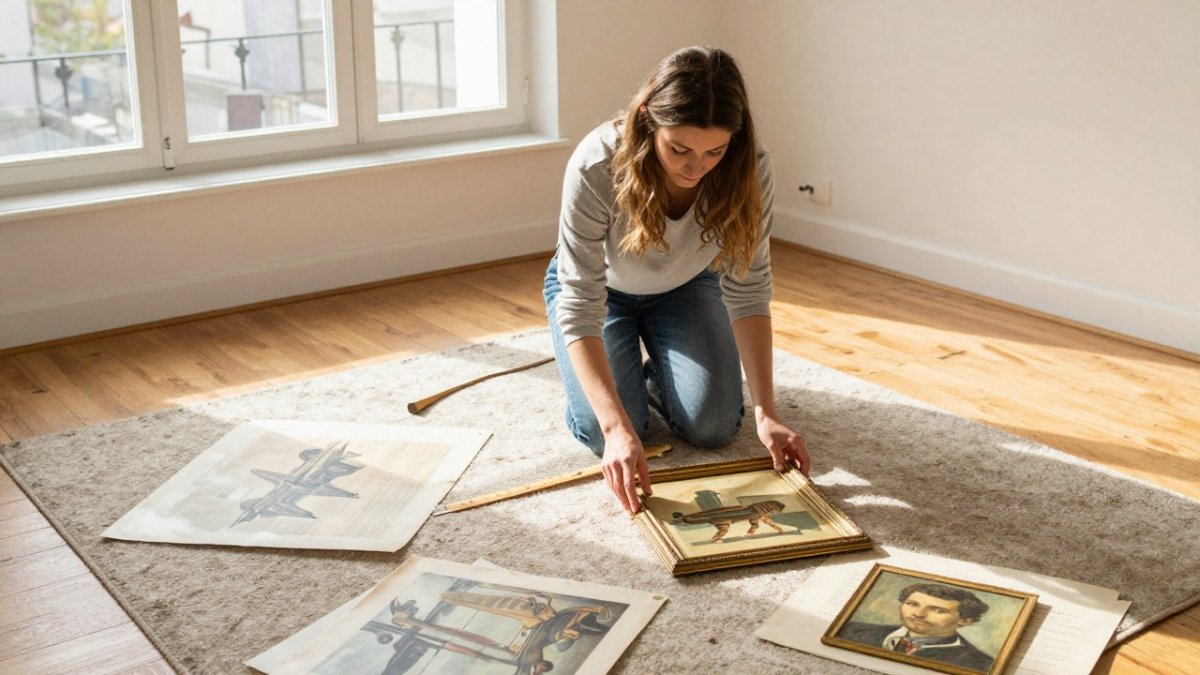
Lay every frame on the floor first and photograph the arrangement before you hang anything. For a full walkthrough, see our guide to creating a nostalgic gallery wall.
Framing Vintage Art for Modern Homes
Framing vintage art for modern homes means simplifying the frame, not the art. Thin black, natural oak, or brushed brass profiles let an old piece sit comfortably beside contemporary work. Keep mat widths consistent across the wall, and use archival materials with UV-protective glazing so aged paper and inks do not fade further. Our complete framing guide covers the materials in detail.
Bedroom Layouts, Budget Sourcing and Caring for Mixed-Age Pieces
Two practical angles to consider: where each era sits in the room, and how to buy well without overspending.
Where Each Style Sits in the Room
- Above the bed: one large piece or a tight pair; keep it modern if the headboard is ornate
- Bedside walls: smaller vintage prints at eye level from the pillow
- Opposite the bed: the boldest piece, since it is what you see first
- Reading corner: a layered pair mixing eras at seated eye height
Sourcing Well on a Budget
Estate sales, local auctions, and inherited pieces can carry real history, and the cost varies widely by piece. Before spending on antiques, read whether vintage art decor is worth the investment.
Care is simple. Keep mixed-age pieces out of direct sun, dust with a dry microfiber cloth, and avoid hanging paper art over radiators or in humid bathrooms.
Choosing Your First Mixed-Era Piece for the Bedroom
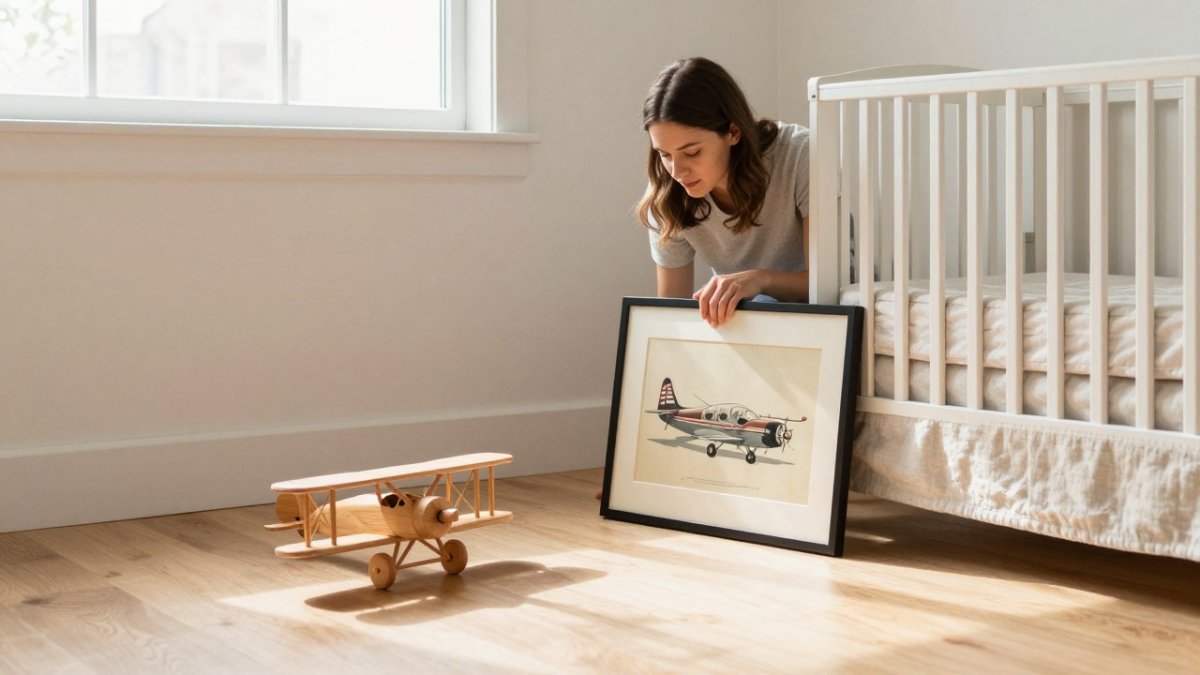
Start with one piece you genuinely love, then build outward. A single strong vintage art find, such as a historic aviation print or an Art Deco study, gives the room its anchor and tells you which colors to repeat. Our guide to high-quality art prints for bedrooms walks through paper weight, ink quality, and sizing. For broader strategies, read how to mix art history with modern decor.
Frequently Asked Questions
Can you mix modern and vintage art in a bedroom?
Yes, and the balance matters more than the pieces themselves. Designers differ on the exact ratio, though most favor keeping vintage pieces as an accent rather than the majority. Pick one anchor wall, keep the palette to three or four colors, and let vintage art supply patina and history while modern pieces keep the room from feeling like a museum. Mixing art from different eras is a common approach, not a risky one.
How do you create a cohesive gallery wall with different art styles?
Unify first, vary second. Choose one frame finish, one mat width and one hanging gap (usually 2 to 3 inches) so the layout reads as a single composition. Then vary the art: pair a vintage oil painting print with a contemporary line drawing of similar visual weight. Keep the center of the arrangement at eye level, roughly 57 to 60 inches from the floor, and anchor it above the bed or dresser so the grouping has a focal point instead of floating.
How do you prevent a bedroom from looking cluttered when mixing art eras?
Limit the number of frames per wall and leave negative space around the grouping. Combining large vintage pieces with contemporary art in smaller bedrooms can create visual clutter if the arrangement is not carefully balanced. A practical rule: one anchor piece, two to four supporting pieces, and at least 8 to 10 inches of clear wall around the cluster. Keep nightstands and dresser tops sparse so the art carries the personality.
What are the best framing techniques to unify vintage and modern art?
Framing vintage art for modern homes usually means simplifying the frame, not the artwork. A thin black, brass or natural wood frame with a generous white mat makes an antique print sit comfortably beside a contemporary piece. Match frame profiles across the wall, keep mat widths identical, and use UV-filtering glass or acrylic to slow fading on older paper. Consistent framing does more to blend eras than matching subject matter ever will.
Your bedroom does not need a designer to feel collected. It needs one honest anchor piece and a little patience. Runway & Heirloom curates prints across art history, aviation, and childhood nostalgia, from watercolor nursery art to historic aviation prints, so you can find the vintage-feeling anchor and the modern companion in one place. Get started with Runway & Heirloom and build a bedroom wall that tells your story.